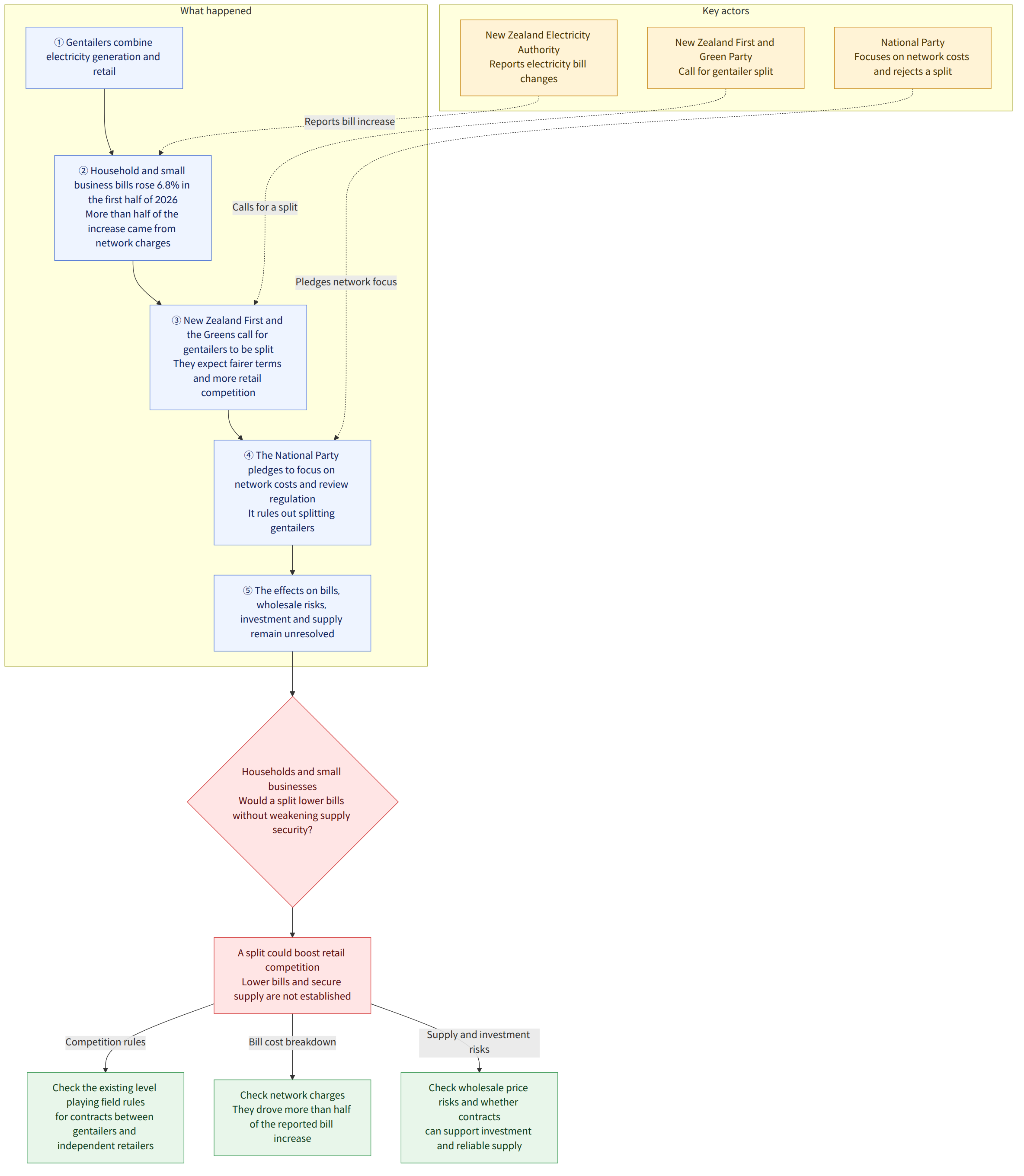
New Zealand First (뉴질랜드 퍼스트) and the Green Party (녹색당) are calling for large electricity companies that combine generation and retail—the so-called “gentailers”—to be split into two businesses. Their argument is that if independent retailers can buy electricity on fairer terms, competition will increase and household electricity bills could fall. But it has not been established how bills and security of electricity supply would actually change after a split.
Background and context
The cost burden is already growing. The New Zealand Electricity Authority (뉴질랜드 전력청) said average electricity bills for households and small businesses rose 6.8% in the first half of 2026. More than half of the increase came from higher network charges for using the electricity grid, while generation costs and retail margins accounted for much of the rest.
The National Party (국민당) recently pledged, as part of its energy policy, to focus on network costs and review how electricity network companies are regulated. It ruled out splitting gentailers. Finance Minister Nicola Willis argued that a split would cause “enormous disruption.”
Keeping both businesses within one company can help cushion price fluctuations. A gentailer can supply its own generated electricity to its customers and buy or sell electricity on the wholesale market only when needed. Independent retailers must buy or contract for all the electricity their customers will use.
That difference matters when wholesale prices surge. Prices can rise when hydro storage levels are low, gas is scarce or electricity demand is high. A retailer charging relatively stable rates may see its electricity procurement costs climb sharply even as its sales revenue stays the same. Long-term contracts can reduce the risk, but the article explains that such contracts may be expensive or may not fully cover it.
The fact that more than half of the increase in electricity bills came from network charges makes it difficult to conclude that separating generation and retail businesses alone could resolve the overall cost burden.
What this means
The expected benefit of a split is that independent retailers could secure electricity on more favorable terms and increase competition. But having more retailers is not the same as consumers paying less in the end. If generators and retailers each add a margin after a split, consumers could risk paying two margins on the same electricity.
It is also necessary to consider where price volatility risks would shift. If generation and retail are separated, generators could focus on selling electricity on the wholesale market. The article’s author analyzes that this could give them greater incentive to push wholesale prices higher. By contrast, a company that operates both generation and retail also has a retail business that needs to buy electricity, so high wholesale prices could put that business under pressure. This is an analysis presented in the article, not a certainty that prices would rise after a split.
Investment and security of supply are also issues to consider. The article explains that new generation facilities require substantial upfront capital and revenue over several years, while retailers need a reliable supply of electricity. If the relationship between generation and retail within one company is separated, that relationship would have to be recreated through contracts. The article does not establish whether such contracts could adequately support investment and supply.
As an example of how these risks can materialize, the article cites the failure of 29 suppliers in the UK during the wholesale energy price shock of 2021–2022. In New Zealand, when wholesale prices surged in 2001, Natural Gas Corporation sold its electricity customers to generation companies. These examples alone, however, cannot establish that a split in New Zealand would produce the same outcome.
For example, even if the number of independent retailers grew after a split, their profits could come under pressure if they were unable to pass higher procurement costs on to customers’ bills promptly during a wholesale price surge. This hypothetical illustrates why greater competition does not automatically guarantee stable reductions in bills.
Relevant rules and support information
The New Zealand Electricity Authority (뉴질랜드 전력청) has already introduced “level playing field” rules (공정한 경쟁의 장) governing contracts between gentailers and independent retailers. The policy debate therefore needs to consider not only whether to split the companies, but also how the existing rules affect the ability of independent retailers to compete and the prices consumers pay.
The OECD’s position, as reported in the article, is that it supports measures to help independent retailers. However, the example it cites as international best practice is not separating the competitive generation and retail businesses, but separating the monopoly-like electricity network from competitive businesses. The measure was presented as a way to prevent a company that owns essential infrastructure from favoring its related businesses over competitors. The fact that these two types of separation involve different targets and rationales is central to the policy decision.
What is known and what remains uncertain
What is known
- New Zealand First (뉴질랜드 퍼스트) and the Green Party (녹색당) want gentailers’ generation and retail businesses separated.
- The New Zealand Electricity Authority (뉴질랜드 전력청) said average electricity bills for households and small businesses rose 6.8% in the first half of 2026.
- More than half of the increase came from higher network charges.
- The Electricity Authority has introduced “level playing field” rules (공정한 경쟁의 장) governing contracts between gentailers and independent retailers.
What remains uncertain
- The article does not establish how total electricity bills and security of supply would actually change if gentailers were split.
- No specific measures are set out for how separated generation and retail companies would manage wholesale price volatility risks and continue investing in generation.
- It is not known how much the benefits of increased competition would be reflected in total household bills, including network charges and generation costs.
What readers should check
- When comparing a split proposal with alternatives, it is worth checking how each addresses not just the number of retailers, but also network charges, generation costs and retail margins.
- Readers can look at how retailers would manage procurement risks during wholesale price surges, and how those risks could affect consumer bills or security of supply.
- To assess the results of a policy change, it is important to consider actual bills, security of supply and investment in generation—not just whether new businesses enter the market.