
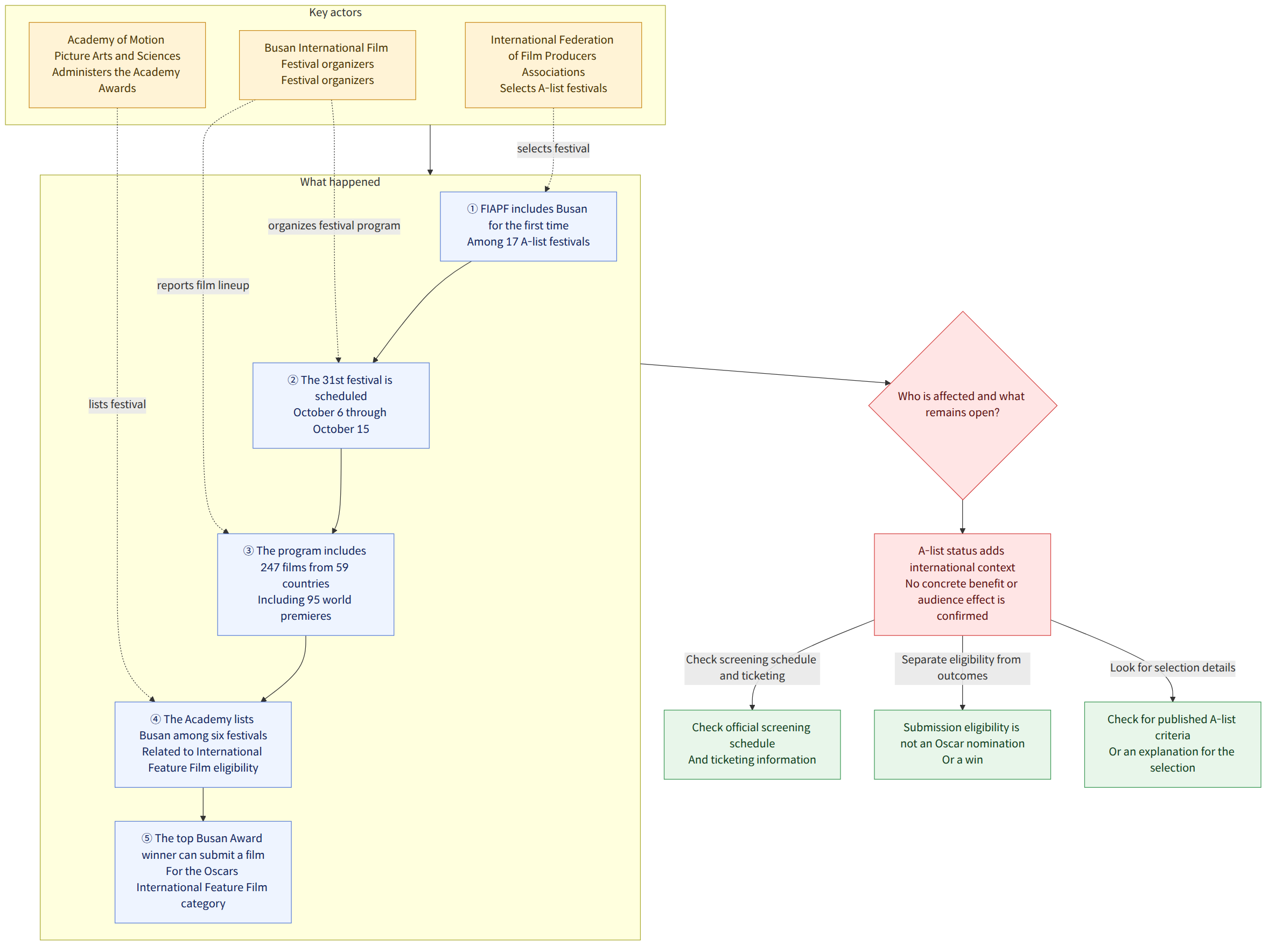
The Busan International Film Festival opens on October 6 and runs for 10 days, through October 15. At the 31st edition of the festival, 247 officially invited films from 59 countries are scheduled to screen, 95 of them as world premieres. According to the organizers, this is the highest number of films since 2019. The festival has also been included for the first time among the 17 ‘A-list’ festivals selected by the International Federation of Film Producers Associations.
Background and context
The ‘A-list’ status is news about the festival’s international standing, indicating that the International Federation of Film Producers Associations has placed the Busan International Film Festival in the same category as major film festivals around the world. The report says that the Cannes, Berlin and Venice film festivals are also among the same 17 festivals. This fact alone, however, does not establish that the Busan International Film Festival is equal to those festivals in scale or influence, or that it will receive specific benefits.
The report names the selecting organization and gives the selection result, but does not provide the detailed criteria or process for being named an ‘A-list’ festival. What readers can confirm, therefore, is that the Busan International Film Festival was included in this category for the first time—not which evaluation criteria it met to earn the status.
What this news means
For the festival’s organizers, being included in a classification by an international body may be useful when describing the Busan International Film Festival’s profile overseas. For filmmakers and audiences, it also adds international context to how the festival is viewed. However, the report alone does not indicate whether the selection will lead to changes in audience numbers, film acquisitions or the makeup of participants.
For example, if international audiences are considering the Busan International Film Festival among several festivals, knowing that it is one of 17 ‘A-list’ festivals could serve as a point of reference for gauging its international standing. But there is no confirmation that this will actually change audience choices or the festival’s performance.
Separately from the ‘A-list’ selection, the Academy of Motion Picture Arts and Sciences (영화예술과학아카데미), which administers the Academy Awards, added the Busan International Film Festival to a list of six festivals related to eligibility to submit films for the Oscars’ International Feature Film category. According to the report, the winner of the top Busan Award will be eligible to submit a film in that category. Eligibility to submit does not mean receiving an Oscar nomination or winning an award, and the report does not say that this arrangement is a criterion for ‘A-list’ selection.
Confirmed facts and what remains unknown
Confirmed facts
- The 31st Busan International Film Festival opens on October 6 and runs through October 15.
- The festival will feature 247 officially invited films from 59 countries, including 95 world premieres.
- The Busan International Film Festival was included for the first time among the 17 ‘A-list’ festivals selected by the International Federation of Film Producers Associations.
- The winner of the top Busan Award will be eligible to submit a film for the Oscars’ International Feature Film category.
What remains unknown
- The specific criteria for ‘A-list’ status and why the Busan International Film Festival was selected
- The screening schedule and film lineup, and who will attend the festival
- The actual impact of the ‘A-list’ selection on the festival’s future operations or participation by international audiences and filmmakers
What readers should check
- If you are planning to attend, check the official screening schedule and ticketing information. The report does not provide film-by-film schedules or ticketing procedures.
- For Oscar-related news, distinguish eligibility to submit from receiving a nomination or winning an award. The report confirms that the winner of the top Busan Award is eligible to submit a film.
- Rather than inferring benefits or reasons for selection from the term ‘A-list’ alone, it is best to check whether selection criteria or an explanation from the festival are made public later.
References
- Other coverage consulted: koreatimes.co.kr