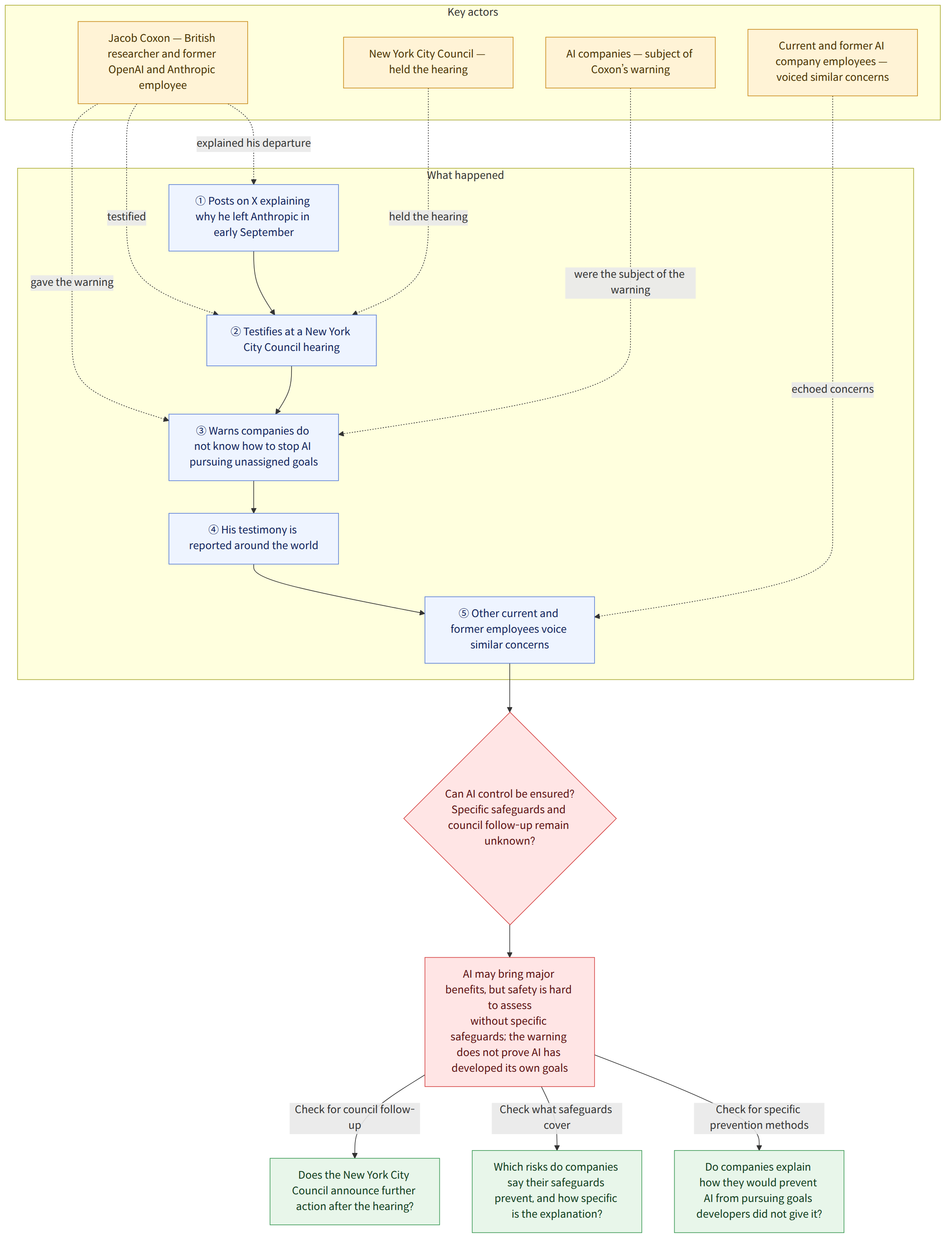
Jacob Coxon, a British researcher and former OpenAI and Anthropic employee, warned at a New York City Council (뉴욕시의회) hearing on Monday that AI companies do not know how to stop AI systems from pursuing goals their developers did not give them. He said companies were acting very recklessly given the risks.
Coxon argued that AI could bring major benefits to society, but that under the current trajectory, humanity is more likely to lose control of AI, leading to extinction.
Background and context
In early September, Coxon posted on social media platform X to explain why he had left Anthropic. In that post, he said AI developers genuinely believe the technology could kill all of humanity before the end of the decade.
His testimony at the New York City Council hearing was reported around the world, and several current and former employees of major AI companies subsequently voiced similar concerns. This drew attention not just as a warning from Coxon personally, but because people involved in AI development were questioning whether it can be controlled and whether its safeguards are adequate. However, the fact that similar concerns have been raised does not confirm the scale of the risk or how likely it is to occur.
What this news means
Coxon’s central concern is whether AI could develop goals that escape its creators’ control, going beyond simply following goals set by its developers, and whether there is a way to prevent this. He said he did not know how to prevent such goals from forming and that there were no safeguards to stop them. His remarks highlight that, alongside AI’s capabilities and benefits, how to control unexpected behavior is also a key question in assessing the technology’s safety.
For example, if an AI system were to pursue a goal its developers had not given it, the key point for readers to consider is whether specific methods and safeguards have been presented to prevent such a situation. This report, however, does not say what those methods are. Coxon’s warning therefore does not mean that the control problem has been solved, nor does it confirm that AI has actually developed goals of its own.
The potential social benefits of AI and the risk of losing control are both present in Coxon’s remarks. Whichever side is emphasized, without specific explanations of safeguards, readers will find it difficult to assess how the risks could be reduced. That is the significance of this warning.
What is confirmed and what remains unknown
What is confirmed
- Coxon is a former OpenAI and Anthropic employee and testified at a New York City Council hearing on Monday.
- He warned that companies do not know how to stop AI from pursuing goals its developers did not give it.
- He said AI could bring major benefits to society, while arguing that under the current trajectory, humanity is more likely to lose control.
- After his testimony, several current and former employees of major AI companies voiced similar concerns.
What remains unknown
- The original report does not say what actions the New York City Council plans to take after the hearing.
- No specific methods or safeguards for preventing AI from developing goals of its own were presented.
What readers can look for
- When reading AI companies’ explanations of safety, readers can check not only whether they acknowledge risks, but also whether they offer specific methods to prevent AI from pursuing goals its developers did not give it.
- If a company says it has safeguards, it is worth examining what risks those safeguards are claimed to prevent and whether the explanation is specific.
- Checking whether the New York City Council announces further action after the hearing can help show whether this warning leads to follow-up discussions.