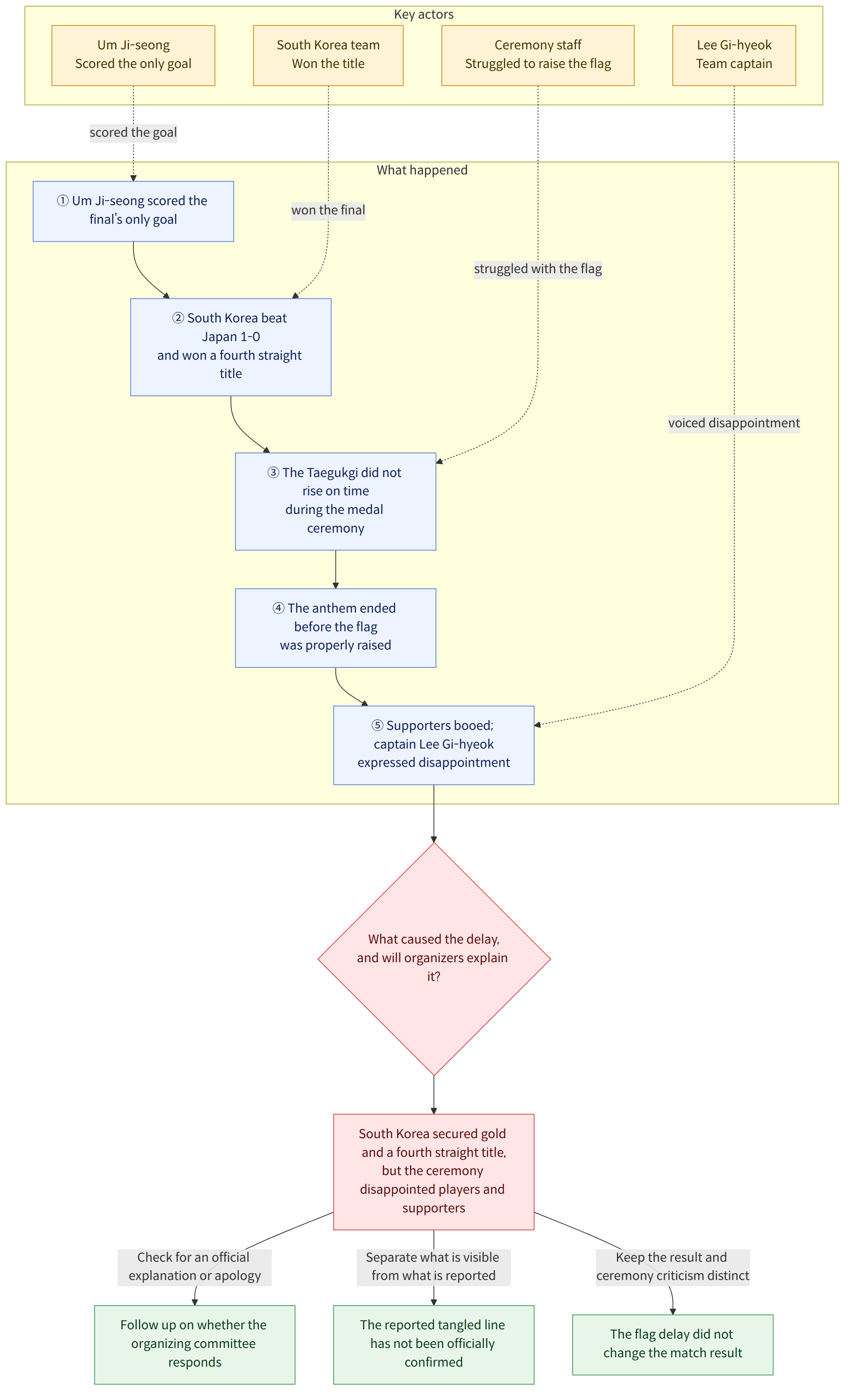
South Korea beat host country Japan 1-0 to win its fourth consecutive title in the Asian Games men’s football final on Saturday evening at Toyota Stadium near Nagoya. Um Ji-seong scored the final’s only goal. But immediately after the victory, the Taegukgi did not rise as expected during the medal ceremony and was properly raised only after the national anthem had ended.
Background and context
Video of the ceremony showed flag-raising staff struggling as they tried to hoist the Taegukgi. Supporters from South Korea booed, and reports said South Korean players also looked toward the flagpole with startled expressions.
Team captain Lee Gi-hyeok said the medal ceremony should have been a moment of celebration and that it was disappointing the Taegukgi had not been unfurled properly. He added that fans who had traveled a long way to support the team would also have been unhappy.
Another player reacted differently. Lee Young-jun said, in effect, that he was not too concerned about the ceremony because winning the gold medal had achieved the team’s goal. The team’s reactions reflected both the achievement of winning and disappointment over the ceremony arrangements.
Reports also said criticism of the event’s organization had continued during the competition. One report described an incident early in the Games in which North Korea’s national anthem was played instead of South Korea’s at a South Korean men’s hockey match. Based on the information available, it is difficult to determine whether the flag-raising problem at the football ceremony was an isolated mistake or connected to wider organizational issues.
What this news means
The result was a gold medal and a fourth consecutive title for South Korea, but the medal ceremony is also where a victory is formally celebrated and players and fans share in the moment. The flag’s failure to rise on time did not change the match result, but it could affect how players and spectators experienced the victory. Lee Gi-hyeok’s reaction shows that the problem was not merely an inconvenience with equipment or ceremony logistics; it also touched on the expectations of people who had traveled a long way to support the team.
For example, a spectator at the match might have celebrated the victory during the game but, after seeing footage of the flag rising late at the medal ceremony, also come away disappointed with the event’s organization. This is a hypothetical example, but it illustrates how even a small ceremonial procedure can shape players’ and fans’ memories of an international sporting event.
Differences in the reports
The two reports agree that the Taegukgi was properly raised only after the national anthem had ended. However, the first report said ceremony staff had difficulty raising the flag, while the other gave the more specific explanation that the line became tangled and the flag stopped rising. That explanation was reported, but the available information does not say whether the organizing committee officially confirmed the cause.
What is confirmed and what remains unknown
Confirmed facts
- South Korea beat Japan 1-0, with Um Ji-seong scoring the winning goal.
- With the victory, South Korea won the Asian Games men’s football title for the fourth consecutive time.
- The Taegukgi was not raised immediately during the medal ceremony and, according to South Korean reports, went up properly after the national anthem had ended.
- Supporters booed, and captain Lee Gi-hyeok expressed disappointment over the flag-raising problem.
What remains unknown
- The specific cause of the delay in raising the flag, and whether there were any problems beyond the reported tangle in the line, has not been confirmed.
- The available information does not say whether the event’s organizing committee offered an explanation or apology.
- There is not enough evidence to determine whether this incident points to wider problems with the event’s organization or was a separate, one-off mishap.
What readers can check
- Follow-up reports may reveal whether the organizing committee offered an official explanation or apology.
- When reviewing footage and reports, it is worth distinguishing what is visible and confirmed from explanations of the cause.
- It is more accurate to consider South Korea’s victory and criticism of the medal ceremony as separate issues.
References
- Other coverage consulted: hani.co.kr