OpenAI will apply invisible watermarks to text generated by ChatGPT and Codex in the European Union (EU). In a blog post on Monday, the company said it would roll them out to eligible users in the EU over the coming weeks. The rollout will cover eligible users on all plans, but the available information does not specify the eligibility criteria.
Background and context
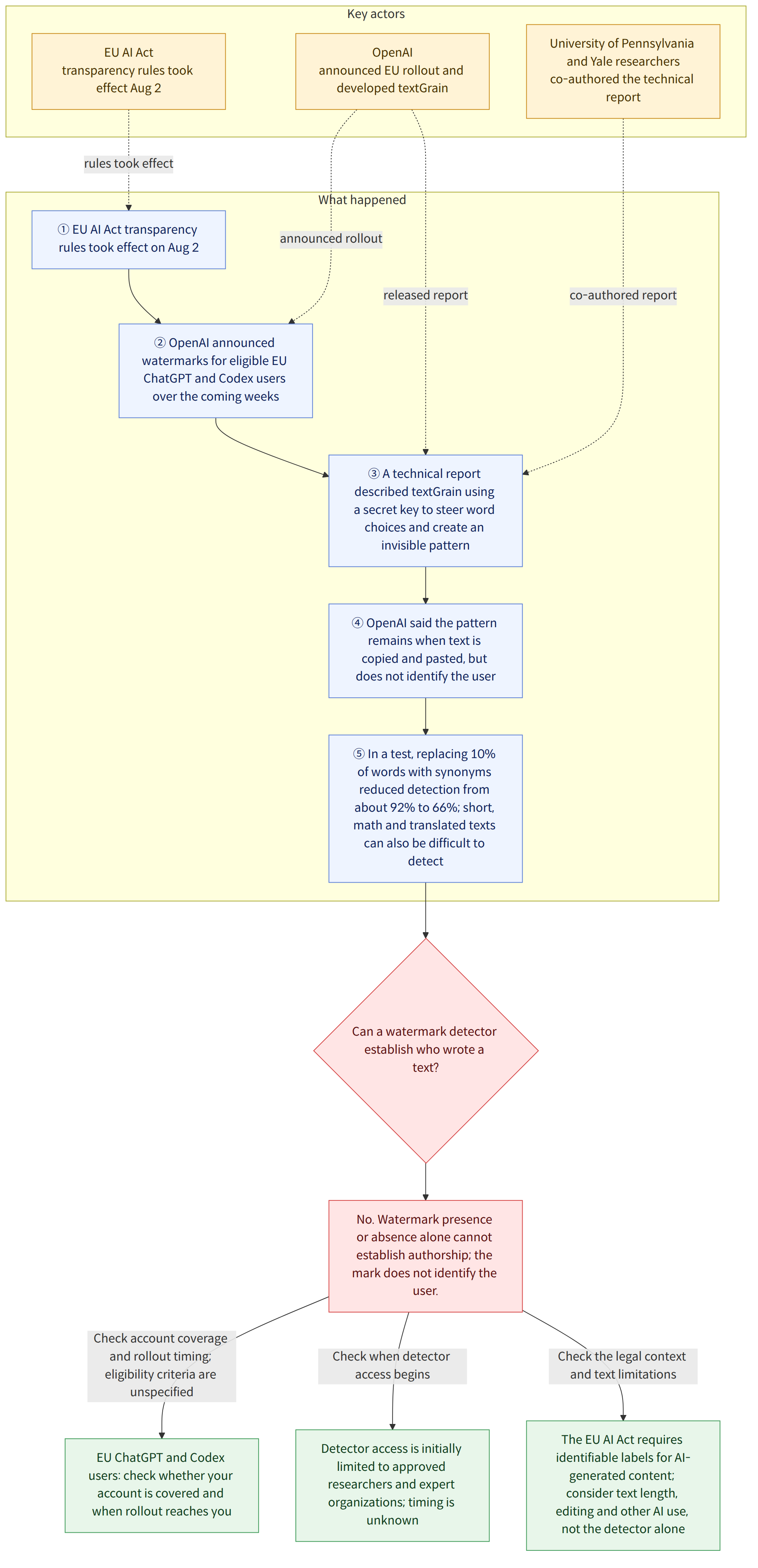
The transparency rules in the EU AI Act took effect on August 2 and require AI companies to label AI-generated content in a way that other systems can identify. OpenAI said it would apply watermarks in the EU in response to the rules.
The watermarks do not work by adding visible symbols to text. Instead, they subtly adjust how the model chooses words, creating a pattern that a detector can recognize. Because the mark is embedded in the text itself, it remains when the text is copied and pasted. OpenAI says, however, that this method does not identify the user.
Along with the announcement, OpenAI released a technical report on its textGrain technology. The report, co-authored by researchers at the University of Pennsylvania (펜실베이니아대학교) and Yale University (예일대학교), describes an approach that uses a secret key to steer next-word predictions. The report says that after hundreds of such adjustments, the text and the key can be used to detect AI-generated content. OpenAI said enabling the watermark did not produce a meaningful change in model performance.
The move also contrasts with approaches taken by other companies. Anthropic announced two months earlier that it would watermark Claude-generated text worldwide, and some users reportedly objected that they had provided the instructions, context, and decisions. In 2024, it was reported that OpenAI had developed a text watermark but held off on releasing it, partly over concerns that users might switch to competitors without watermarks. Anthropic, Google, Meta, Microsoft, and OpenAI are among the companies that have pledged to follow the EU Code of Practice on AI-generated content.
What this means
EU users may have a way to identify text made by AI. But a watermark is not a marker that can always be detected reliably in every piece of writing. In one OpenAI test, replacing 10% of the words with synonyms reduced the detection rate from about 92% to 66%. The company said short texts, mathematical answers, and translated text can also be difficult to detect.
This limits the use of detection results as the sole basis for verifying authorship or determining misconduct. The absence of a watermark does not prove that a person wrote the text. It may be too short or heavily edited, or it may have been generated by another company’s AI. Conversely, a watermark may indicate only that an OpenAI system generated or processed part of the text; it does not show how much human judgment, editing, or creativity went into it.
For example, if a detector does not find a watermark in a piece of writing, that result alone is not enough to conclude that a person wrote it. The text’s length, the extent of editing, and the possibility that other AI tools were used should also be considered.
Separately from the EU rollout, OpenAI API developers worldwide can enable watermarks on some models. The feature is off by default, and OpenAI said that, at launch, it would not make text watermarking a global default. In other words, the rollout for EU users should be distinguished from the optional use by API developers.
What is confirmed and what remains unknown
What is confirmed
- The rollout is planned over the coming weeks for eligible ChatGPT and Codex users in the EU.
- The EU rollout is planned for eligible users on all plans.
- API developers worldwide can enable watermarks on some models, but the default setting is off.
- The watermark leaves an invisible pattern in word choices and does not identify the user.
- Initial access to the detector will be limited to approved researchers and expert organizations to help assess its reliability and responsible use.
What remains unknown
- What are the specific criteria for being an “eligible user” in the EU?
- When will approved researchers and expert organizations be able to use the detector?
- Which specific models will receive watermarks, and what is the rollout schedule?
What readers should check
- If you use ChatGPT or Codex in the EU, check whether your account is covered and when the service says the rollout will reach you. The available information does not specify the eligibility criteria.
- If you need to determine who wrote a text, do not rely on a watermark detection result alone. OpenAI said initial access to the detector will be limited to approved researchers and expert organizations.
- Developers using the API should note that watermarks are off by default and that only some models are listed as eligible. The available information does not specify the model list or schedule.