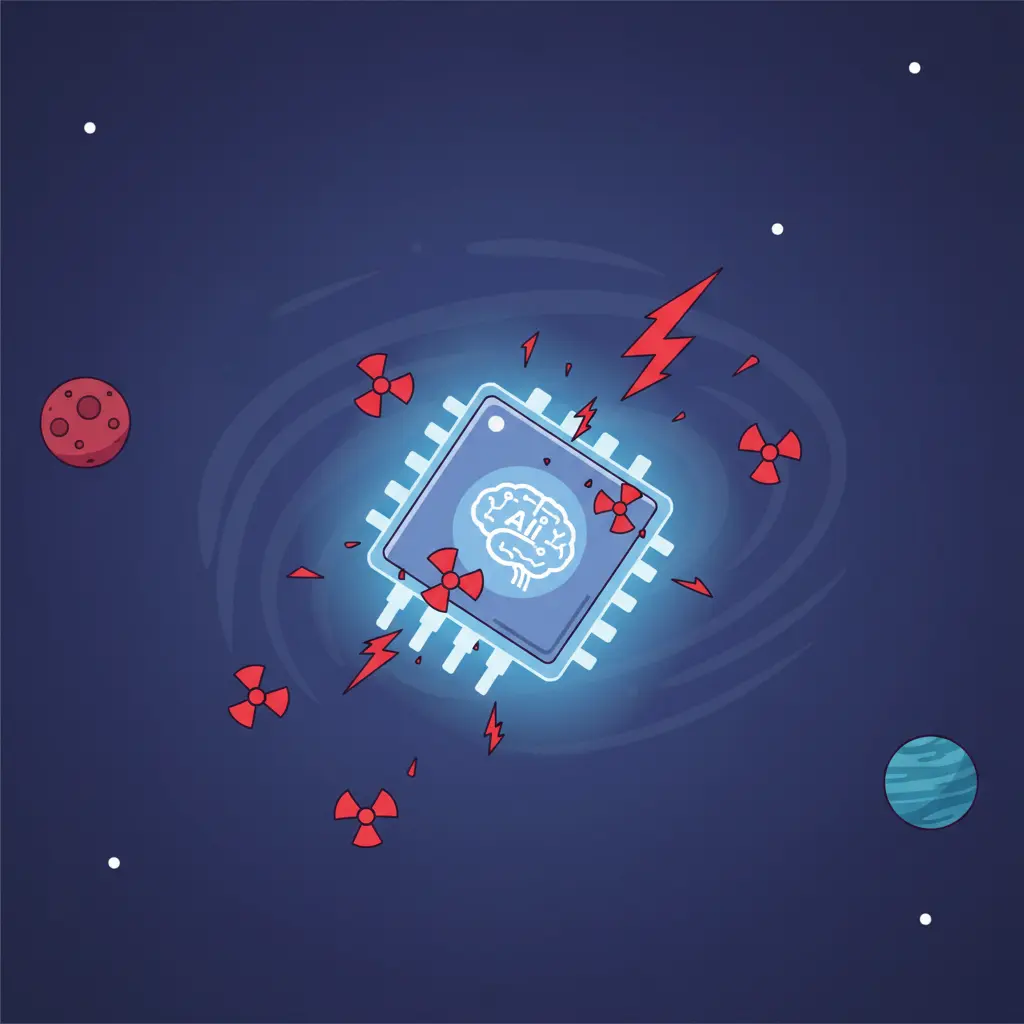
A 'Steel Brain' for the Infinite Vacuum of Space
A joint research team has successfully developed the world's first artificial intelligence (AI) semiconductor that can operate without errors in the harsh environment of space. This chip is based on Neuromorphic technology.
Neuromorphic semiconductors are chips designed to mimic the human brain's neural network. Think of it as a computer that "thinks" like a human, allowing it to process vast amounts of data using very little energy compared to traditional computers.
Why Normal Computers Fail in Space
Outer space is filled with Cosmic Radiation, which consists of high-energy particles traveling at near-light speeds. Imagine invisible, microscopic bullets constantly hitting electronic parts.
"Cosmic radiation is the greatest enemy of electronics in satellites and spacecraft. This research marks a breakthrough in overcoming that barrier."
When standard chips are hit by these particles, their circuits can break or their stored data can be wiped, leading to catastrophic mission failures.
Smart Chips That Heal Themselves
The newly developed AI chip is designed to overcome data damage caused by radiation. Much like how a human brain can still function even if a few cells are damaged, this chip maintains its performance despite radiation interference.
- High Performance, Low Power: Since electricity is scarce in space, this chip is optimized for minimal power consumption.
- Enhanced Durability: Internal data remains stable even under intense radiation stress.
- Self-Sufficiency: It allows spacecraft to make decisions on their own without waiting for instructions from Earth.
Opening a New Era of Space Exploration
Once commercialized, this technology will allow AI to be installed directly on Mars rovers and long-distance satellites. Previously, data had to be sent back to Earth for analysis, which took a long time. Now, we are entering the era of 'Autonomous Spacecraft' that can analyze their surroundings and act instantly in the deep reaches of space.