
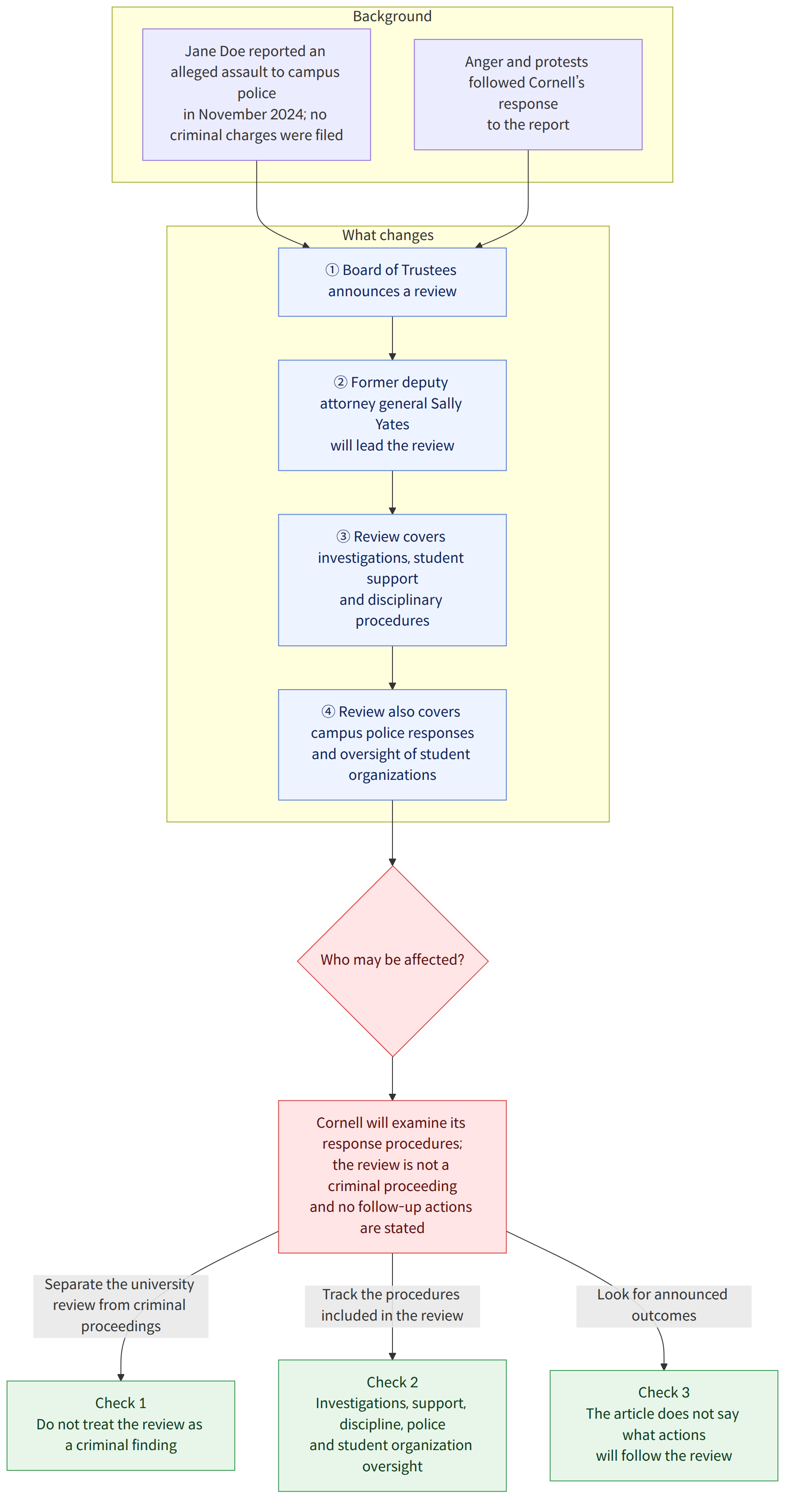
Cornell University (코넬대)’s Board of Trustees announced Tuesday that it would review how reports of sexual misconduct are handled. The review will be led by Sally Yates, a former senior official who served as deputy attorney general in the Obama administration. Its scope will include investigations of sexual assault and harassment reports, student support, disciplinary procedures, campus police responses, and oversight of student organizations such as fraternities and sororities.
The announcement came after days of anger and protests over Cornell’s response to allegations of a group sexual assault at a fraternity in 2024. A woman known only as Jane Doe reported to campus police in November 2024 that she had been sexually assaulted. She alleged that the incident occurred the previous month and that several members of the Chi Phi fraternity sexually assaulted her after pressuring her to drink alcohol and take drugs. According to the article, no criminal charges were filed.
Background and context
The review is not limited to the handling of a single report; it will also examine several university response procedures together. Its scope includes how reports are investigated after they are received, what support is provided to the students involved, and how disciplinary procedures work, as well as campus police responses and oversight of student organizations. In this respect, the review’s focus spans multiple stages of report handling and the roles of the organizations involved.
However, the review announced by the Board of Trustees should be distinguished from criminal proceedings. The article reports that a review of Cornell’s response has been announced and recounts Jane Doe’s allegations, but says no criminal charges were filed. The fact that a university-level review is taking place does not, by itself, establish whether a criminal investigation occurred or what legal conclusions were reached.
What this means
For students, it matters that support, investigations and discipline after a report are not separate issues. The review will cover not only how reports are received, but also the investigation process, student support and disciplinary procedures. This means attention is focused on the procedures the university uses to respond to reports of sexual violence and how those procedures deal with the students and student organizations involved.
It is also notable that the review includes campus police responses and oversight of student organizations. Since allegations of an incident at a fraternity led to controversy over the university’s response, the review will examine whether the university’s procedures address not only the handling of an individual report but also the roles of student organizations and police. The available information does not establish what actions, if any, will follow from the review.
For example, suppose a student reports sexual assault to a university. From the perspective of this review, it may be possible to examine how the report is investigated, whether support is available, how disciplinary procedures proceed, and how campus police and student organizations respond—all as connected issues. This is a hypothetical example to explain the scope of the review, not a finding that Cornell has mishandled any particular procedure.
Related procedures and support information
The information below summarizes procedures and legal explanations in South Korea from materials based on consultation cases from the Korea Legal Aid Corporation (대한법률구조공단). These are not standards that can be directly applied to the Cornell case or to U.S. laws and procedures, and the materials alone cannot establish which procedures under South Korean law would apply to the report described in the article.
In South Korea, a criminal complaint is a procedure through which a victim or another person informs an investigative agency of an alleged crime and requests punishment. A complaint or accusation may be submitted to a prosecutor or judicial police officer in writing or orally. If it is made orally, a record must be prepared. Therefore, the phrase “reported it to campus police” in the article should not be assumed to mean the same thing as filing a criminal complaint under South Korean law or as criminal charges being filed.
The effect that withdrawing a complaint or signing a settlement agreement between the parties may have on an investigation or punishment can also vary depending on the type of crime and the stage of the proceedings. The materials explain that a settlement agreement alone is not considered an expression of intent to withdraw a complaint to an investigative agency or court. In an actual case, the laws in effect at the relevant time and the specific facts must be checked.
Whether a sexual offense has occurred cannot be determined from an allegation alone. A South Korean legal guide explains that the assessment considers the specific circumstances as a whole, including the nature of the conduct, the victim’s condition and relationship to the other party, and the surrounding circumstances. Accordingly, the woman’s account in the article should be presented as an allegation reported in the news; the article alone cannot establish whether it is true or determine legal responsibility.
What is known and what remains unclear
What is known
- Cornell University’s Board of Trustees announced a review of how reports of sexual misconduct are handled.
- The review will be led by Sally Yates, who served as deputy attorney general in the Obama administration.
- The review will include investigations of reports, student support, disciplinary procedures, campus police responses and oversight of student organizations.
- Jane Doe reported the incident to campus police in November 2024 and alleged that it occurred the previous month.
- According to the article, no criminal charges were filed.
What remains unclear
- No timeline was given for when the review’s findings are expected to be released.
- It is unclear whether Cornell has decided what actions it will take after the review is completed.
- The article does not say whether a police investigation or other investigative procedure is underway.
What readers should watch for
- Follow-up announcements may provide the release date for the review’s findings and details of any steps the university plans to take.
- Readers should distinguish what reports mean by “report,” “investigation” and “charges.” Anyone in a similar situation in South Korea should separately check the procedures for filing a complaint or accusation and the laws applicable to their case.
- If information about South Korean complaint procedures or laws related to sexual violence is needed, do not draw conclusions based only on the explanations in this article. Check the laws in effect at the relevant time and the specific circumstances with a legal professional or relevant agency.