
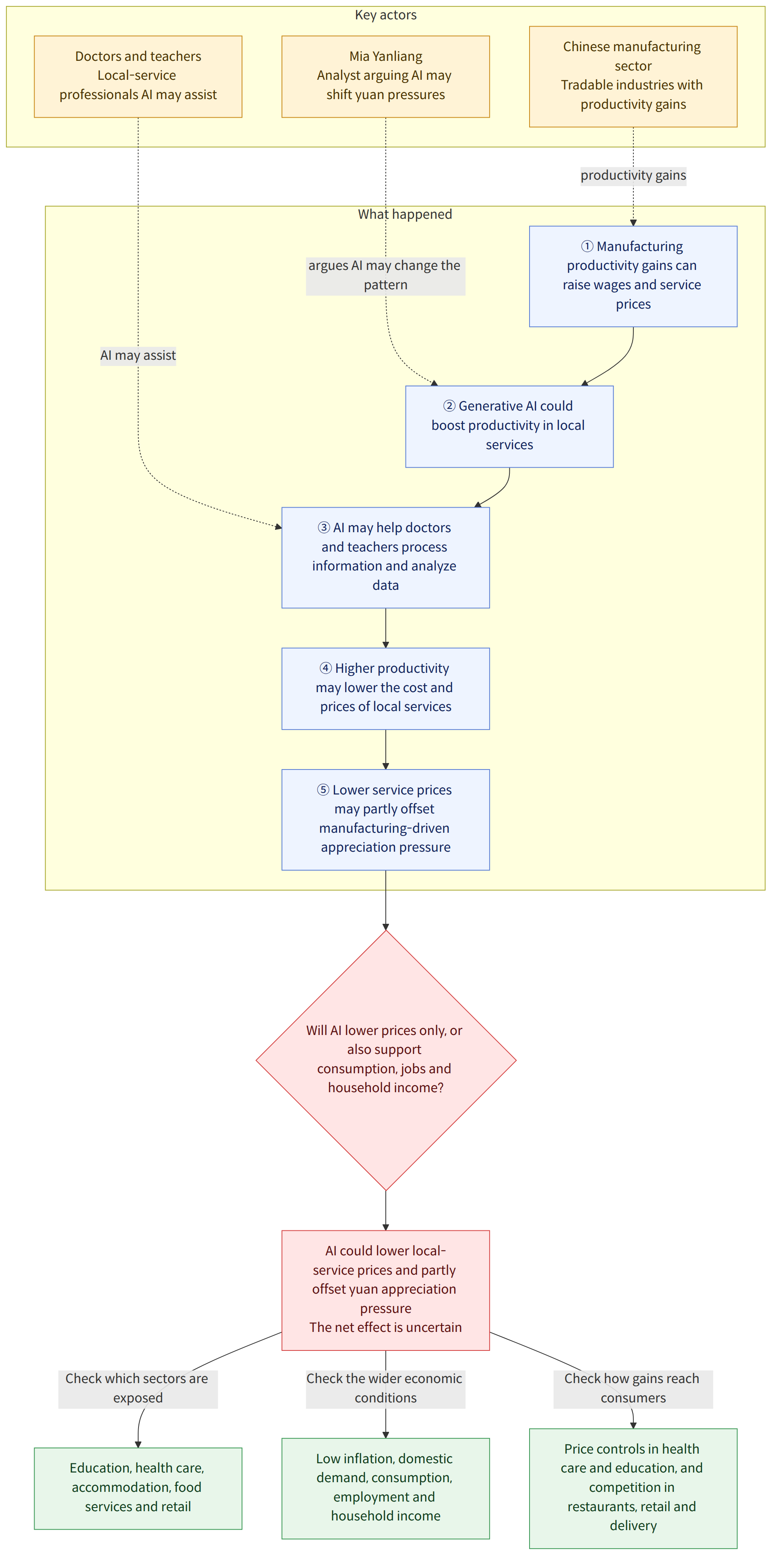
The yuan has recovered noticeably against the dollar since the second half of 2025. Some link this movement to productivity gains in Chinese manufacturing, but Mia Yanliang argues that generative artificial intelligence (AI) could put pressure on the yuan in the opposite direction if it boosts productivity in services rather than manufacturing. The question is whether AI will merely lower prices or also support consumption, employment and income amid low inflation and weak domestic demand.
Background and context
As an explanation linking yuan appreciation to manufacturing productivity, the commentary introduces the Balassa-Samuelson effect. This refers to the possibility that when productivity rises in tradable-goods industries—industries that produce goods that are relatively easy to trade across borders—and wages increase, wages and prices may also rise in nontradable services, which are consumed mainly within a local area and whose workers may move between sectors. If service-sector productivity does not rise as much, services become relatively more expensive, potentially leading to a real appreciation of the exchange rate.
China’s electric vehicles, renewable-energy equipment and shipbuilding industries are tradable-goods sectors often cited in discussions of productivity gains. According to the commentary, the Chinese yuan appreciated by about 35% against the dollar between 2005 and 2013. This historical example supports the argument that manufacturing productivity gains can be linked to exchange-rate movements, but it does not prove that the same pattern will recur in the age of AI.
Yanliang’s argument is that AI could change the assumptions underlying the Balassa-Samuelson effect. Earlier technological changes mainly transformed activities that could be mechanized, standardized or scaled up, while the information and communications technology (ICT) revolution made services such as finance, telecommunications and e-commerce more tradable, the commentary explains. By contrast, locally based services such as health care and education have relied heavily on people’s time and judgment.
The commentary reports that the number of patient consultations per doctor per day at Chinese public hospitals fell from 7.5 in 2014 to 7.2 in 2024. Yanliang argues that generative AI could raise productivity in these local services by helping professionals such as doctors and teachers process information and analyze data. Higher productivity could lower the cost of each unit of service, creating a possible reversal of the established “higher manufacturing productivity → higher service prices” pattern.
What this means
The potential effects of higher service-sector productivity on exchange rates differ from those of manufacturing. A more productive automobile factory can increase overseas sales, but even if a hospital becomes more productive at providing care, it cannot export that care overseas in the same way. The commentary explains that productivity gains in local services are likely to remain within the country and could therefore show up as lower prices. Its example is food delivery: even if order processing becomes more efficient, Beijing’s delivery network will not deliver dinner to New York.
If productivity gains in nontradable services lower their relative prices, they could put downward pressure on the real exchange rate or partially offset the real appreciation pressure stemming from manufacturing productivity gains. The commentary describes this as the “reverse Balassa-Samuelson effect.” However, this is an analysis of a possible pathway, not a quantitative forecast of how much AI will actually move the yuan.
The sectors in China that may be highly exposed to AI include education, health care, accommodation, food services and retail. The commentary says that the information, finance and professional services it cites as examples from the United States differ structurally from China’s local services, because those U.S. sectors became more tradable during the ICT revolution. In the commentary’s view, the same AI advances are therefore unlikely to affect service prices and exchange rates in the two countries in exactly the same way.
Lower prices do not necessarily mean that all the effects will benefit consumers. The commentary says that health care and education are subject to substantial price controls, while restaurants, retail and delivery face fierce competition. Under these market conditions, productivity gains may be more likely to lead to lower prices than to higher profits. Consumers may benefit from lower prices, but if demand does not increase enough amid weak domestic demand, falling prices could also weaken nominal income and lead to disinflation—slower inflation or downward pressure on prices.
For example, suppose AI assistance improves the efficiency of medical services and lowers their prices. Greater household use could mean that productivity gains boost both the volume of services used and income. But if demand is not very responsive to lower prices, prices could fall faster, potentially weakening nominal income. The commentary alone cannot establish which outcome will occur.
What is known and what remains uncertain
What is known
- The commentary reports that the yuan has recovered noticeably against the dollar since the second half of 2025.
- The commentary says the Chinese yuan appreciated by about 35% against the dollar from 2005 to 2013, and that the number of daily consultations per doctor at public hospitals fell from 7.5 in 2014 to 7.2 in 2024.
- Yanliang argues that AI could help professionals process information and analyze data, raising productivity in local services.
- The commentary says China is experiencing low inflation and weak domestic demand, and argues that the effects of higher service-sector productivity on prices, demand and nominal income could vary depending on the circumstances.
What remains uncertain
- No data are presented that quantitatively estimate the scale of AI productivity gains’ impact on the yuan’s exchange rate.
- The original commentary does not establish how the adoption of AI will actually change service prices and household nominal income in China.
- It has not been determined whether lower service prices will lead to greater demand, employment and income, or instead intensify downward pressure on prices and domestic demand.
What readers should watch
- When following discussions of AI adoption in China, it is worth looking not only at productivity gains themselves but also at how service prices and household nominal income move alongside them.
- Distinguishing between sectors with price controls, such as health care and education, and highly competitive sectors, such as restaurants, retail and delivery, can help clarify how productivity gains might be passed on through lower prices.
- When considering exchange-rate forecasts, it is worth weighing not only the appreciation pressure from manufacturing productivity but also the opposing possibility that service-sector productivity could lower relative prices. Yanliang proposes using exchange-rate flexibility in the short term and, over the long term, opening service markets to increase the tradability of services and distribute productivity gains more broadly.
Yanliang previously served as chief economist at China’s State Administration of Foreign Exchange (中国国家外汇管理局) and is currently a managing director and chief strategist at China International Capital Corporation (中国国际金融公사, CICC). His conclusion is that even if AI sparks the next productivity revolution, it need not produce the same exchange-rate effects as earlier technological changes. The key for China’s economy may be not only how much productivity rises, but also where the gains show up—in prices, income or demand.