
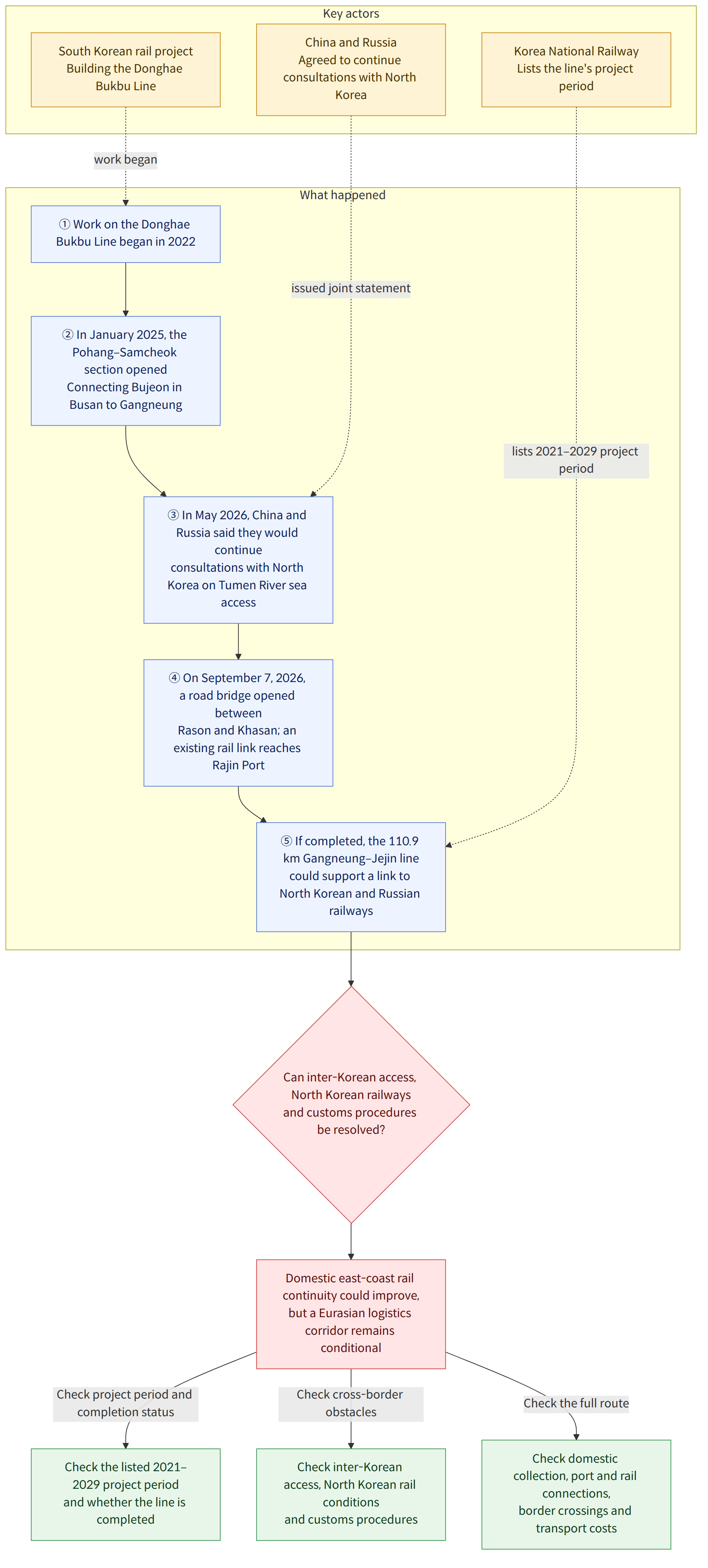
When the Pohang–Samcheok section opened in January 2025, it connected 363.8 km of railway from Bujeon Station in Busan to Gangneung Station. But the line continuing north to connect with North Korea’s railways is not yet complete. Construction is underway on the Donghae Bukbu Line, which will link Gangneung with Jejin in Goseong via Yangyang and Sokcho. Work began in 2022. Once completed, the line could serve as a foundation on the South Korean side for a connection to the Eurasian rail network, going beyond linking sections of the Donghae Line within the country.
The line is drawing attention for reasons beyond the construction of another railway. In addition to the potential to improve regional transport, it could help shift freight now concentrated on roads onto rail, reducing emissions, and give South Korean logistics another option for connecting with the continental rail network. These are possibilities if the connection is established; they do not mean that trains currently run from South Korea through North Korea and Russia to Europe.
Background and context
On September 7, 2026, the first bridge exclusively for road traffic between North Korea and Russia opened between Rason, North Korea, and Khasan, Russia. There is also an existing railway of about 54 km linking Rajin Port, Tumangang Station and Khasan Station. It uses dual gauge—the spacing between the rails—accommodating both North Korea’s standard gauge of 1,435 mm and Russia’s broad gauge of 1,520 mm. According to the article, this arrangement allows Russian freight trains to reach Rajin Port.
China and Russia said in a joint statement issued after their summit in May 2026 that they would continue trilateral consultations with North Korea on access to the sea via the Tumen River. With both road and rail connections in place, and consultations continuing over the mouth of the Tumen River, the area is attracting attention as a junction in the North Korea–China–Russia transport network. These developments, however, do not mean that an inter-Korean railway connection or international train services have been confirmed.
On the South Korean side, the Donghae Bukbu Line is planned as a 110.9 km single-track railway from Gangneung to Jejin. The project period listed in current 2026 project materials from Korea National Railway (국가철도공단) is 2021–2029. If the line connects with North Korea’s railway at Jejin and continues via Tumangang Station to Khasan Station in Russia, the Donghae Line could become a departure point on the South Korean side for connecting with the Trans-Siberian Railway.
What this news means
First, the Donghae Bukbu Line has two roles: it is a domestic project to improve rail connections north of Gangneung, and, in the longer term, a foundation for connecting to inter-Korean and continental railways. Now that rail connects Bujeon Station in Busan with Gangneung Station, closing the remaining gap on the South Korean side could improve continuity along the country’s east coast rail corridor. But if the North Korean section cannot be used, the Eurasian logistics corridor will remain a plan connected to South Korea’s domestic railway network.
Second, shifting freight from roads to rail could be significant for reducing carbon emissions. Under the government-approved 2035 National Greenhouse Gas Reduction Target (2035 국가온실가스 감축목표), emissions from the transport sector were 98.8 million tonnes in 2018 and 97.5 million tonnes in 2024, while the 2035 target is 36.8 million to 39.3 million tonnes. An analysis by the Korea Transport Institute (한국교통연구원) puts emissions from transporting one million tonnes of freight over 1 km at 214 tonnes by road and 7 tonnes by rail. This means rail emissions are lower than road emissions under the conditions of that analysis; it does not mean rail is superior in cost or speed for every type of transport.
Third, rail could give logistics companies and manufacturers a transport option to consider alongside shipping and air freight. By May 2026, China-Europe freight trains had made more than 130,000 trips cumulatively. According to official Chinese data from July 2026, the network connects 129 cities in China with 236 cities in 26 European countries. However, for South Korean freight to use that network, companies would need to consider the entire transport route, including domestic collection, connections to ports and railways, and border crossings.
There is no guarantee that rail will always be cheaper. Since 2018, Japan’s Ministry of Land, Infrastructure, Transport and Tourism has shipped auto parts, precision equipment and other goods to Europe via the Trans-Siberian Railway. In a 2020 trial, transport costs were about 2.3 times the average cost of shipping by sea, while transit time was generally about half as long. The example shows that companies handling freight for which shorter delivery times are important may consider rail, but that costs and the actual route must also be weighed.
South Korea has also tested transport routes toward Eurasia. In 2024, it conducted four trials of international multimodal container transport from Obong Station to Central Asia via Busan Port and Lianyungang, China. The journey was about 6,044 km to Almaty, taking 19 days, and about 7,010 km to Tashkent, taking 22 days. This shows that freight can be sent to Central Asia via an alternative route even when the inter-Korean railway is disconnected. It does not, however, establish the transit time or cost of a future route via the Donghae Line.
Ports and railways are already being used together to move freight within South Korea. The 11.3 km spur line connecting Pohang’s Yeongilman Port with Pohang Station opened in 2019, and commercial freight train operations began in 2020. According to Pohang City data, rail freight volume increased from 6,784 TEU in 2023 to 21,058 TEU in 2024. These figures alone, however, cannot identify the cause of the increase or predict freight volumes after the Donghae Bukbu Line opens.
What is confirmed and what remains unknown
Confirmed facts
- In January 2025, the 166.3 km Pohang–Samcheok section opened, connecting 363.8 km of railway from Bujeon Station in Busan to Gangneung Station.
- The Donghae Bukbu Line is a 110.9 km single-track railway linking Gangneung, Yangyang, Sokcho and Jejin in Goseong. Current 2026 materials list its project period as 2021–2029. Construction began in 2022 and is underway.
- The railway linking Rajin Port, Tumangang Station and Khasan Station is about 54 km long and uses dual gauge to accommodate both North Korea’s standard gauge and Russia’s broad gauge.
- In the Korea Transport Institute analysis cited, greenhouse gas emissions from road and rail freight are 214 tonnes and 7 tonnes, respectively, when the amount of freight and the distance transported are held constant.
What remains unknown
- When will the Gangneung–Jejin Donghae Bukbu Line actually open, and what will its final project cost be?
- On what schedule and by what means will challenges such as modernizing North Korea’s railways and establishing customs procedures for an inter-Korean railway connection be resolved?
- Will international conditions and inter-Korean relations change in ways that make actual train operations possible?
What readers should check
- To check construction progress on the Donghae Bukbu Line and whether its project period has changed, readers should consult current project materials from Korea National Railway. The project period and the actual opening date are not the same thing.
- Companies considering freight transport should compare not only the costs of rail and other modes of transport, but also transit times, the sections requiring transshipment, and the quality of connections between railways, ports and industrial complexes.
- When assessing the carbon impact of shifting freight to rail, readers should check the entire transport route and the conditions of transport. The emissions comparison cited is based on transporting one million tonnes of freight over 1 km.