
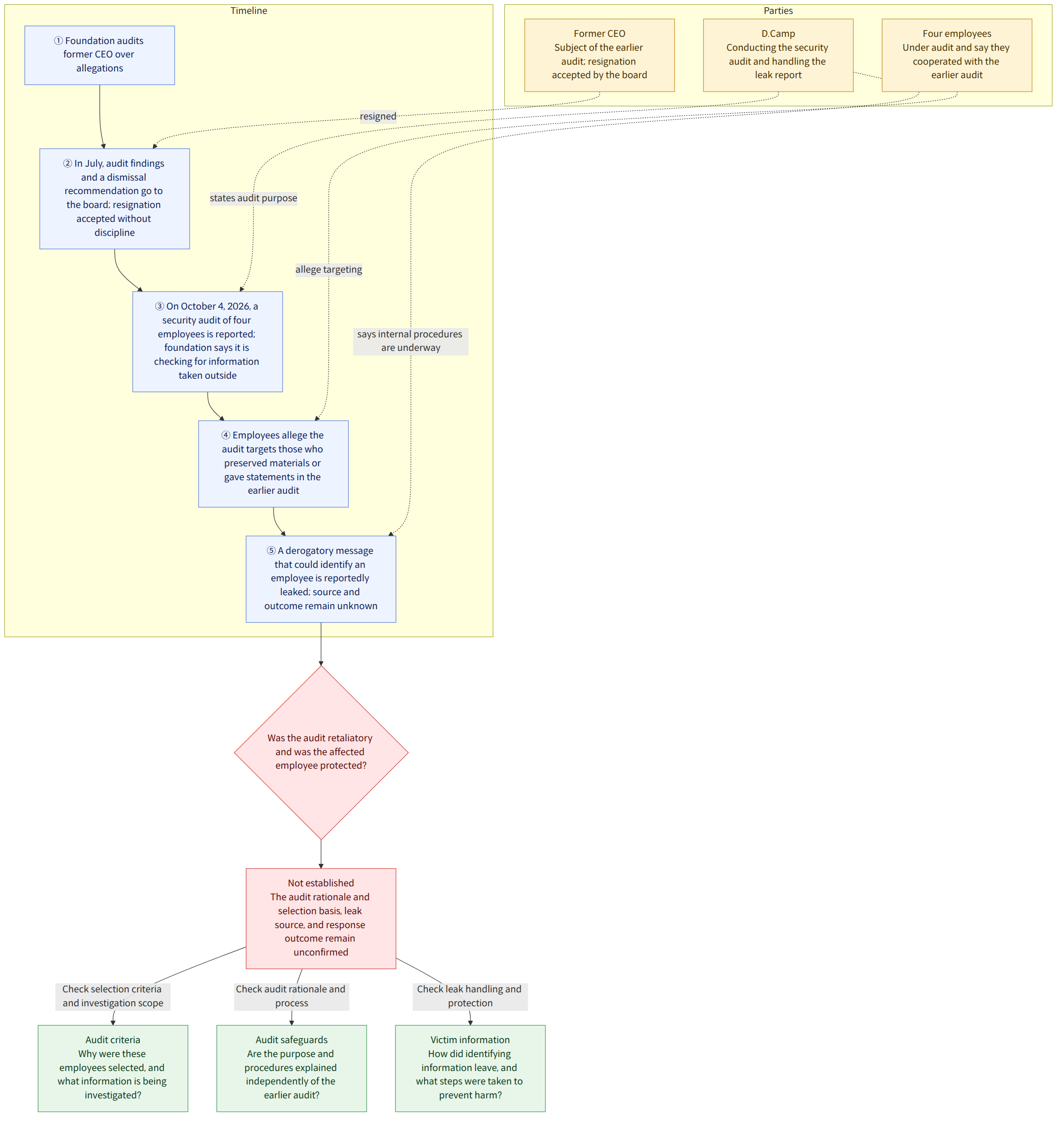
D.Camp (은행권 청년창업재단 디캠프), a youth entrepreneurship foundation established by the financial sector, was reported on October 4, 2026, to be conducting a security audit of four employees. The foundation said the audit is intended to determine whether information related to audit work was taken out of the organization, including through personal accounts. The employees under audit claim that they had cooperated with an ad hoc audit of the former CEO and that the security audit is retaliatory and targeted. Separately, reports have emerged that a derogatory message that could identify an affected employee was leaked outside the foundation.
What has been confirmed so far is the foundation’s account that a security audit is underway, the employees’ claim that they are being targeted, and the foundation’s internal procedures for addressing the leak of a message concerning an affected employee. It has not been confirmed that the audit was conducted for retaliatory purposes or that anyone responsible for the leak has been identified.
Background and context
D.Camp is an early-stage startup investment and support organization established in 2012 with contributions from 19 financial institutions. The chair of the Korea Federation of Banks (전국은행연합회) also serves as its board chair.
The ad hoc audit that the employees reportedly cooperated with concerned allegations involving the former CEO, who took office in 2024. The former CEO had been subject to audits by the foundation since early this year over allegations of workplace bullying, sexually harassing remarks directed at female employees, and the introduction of a program to manage low-performing employees. In July, the audit findings and a recommendation to consider dismissing the CEO were presented to the board, but the board accepted the former CEO’s resignation without disciplinary proceedings.
The employees claim that those who preserved materials needed for the audit or gave statements unfavorable to the former CEO were the main targets of the current security audit. The foundation has said the audit is intended to establish whether information related to audit work was taken outside the organization. Since both accounts are on the record, the criteria for selecting the employees and the scope of the information being investigated are central to the fairness concerns.
What this news means
For employees under audit, the reasons they were selected and the scope of the investigation matter as much as the audit itself. Even if a security review is necessary, confidence in internal audits can be undermined if employees feel they are being investigated because they cooperated with an earlier audit. However, the employees’ claims are the position of the parties as reported, and the available information does not establish that the audit was in fact retaliatory.
The leak of a message that could identify an affected employee is a separate issue. The message reportedly contained derogatory remarks about the affected employee and the employees under audit, but it is not known who sent it outside the foundation or by what means. The foundation said it received a report from an employee last month and is following procedures under its internal rules, but the outcome has not yet been made public. To determine whether the affected employee was adequately protected, it will be necessary to establish how information that could identify them left the organization and what steps were taken to prevent harm.
For example, if an employee became subject to a security audit after preserving materials or giving a statement in an earlier audit, that timing alone does not prove retaliation. It is nevertheless important to examine whether the criteria for selecting employees and the process for investigating the alleged transfer of information are explained. The key is to separately establish the purpose and procedures of the security audit and how the leak of the message concerning the affected employee is being handled.
Relevant policies and support information
The internal legal guide provided (L1·L2) covers labor-related issues such as employee status, transfers and reassignment, severance pay, and changes to work rules, but it does not set out specific procedures for determining whether an internal security audit is justified or for addressing the leak of information about a victim of sexual harassment. This guide alone therefore cannot establish whether the current audit is lawful or what legal rights the employees have.
According to reports, some employees filed a complaint with the Ministry of Employment and Labor (고용노동부) in April, alleging that the audit related to the former CEO was conducted unfairly. It is confirmed that the employees took this step, but the materials provided do not include the complaint’s outcome or any findings. The security audit and the handling of the message leak should likewise be treated as separate matters that are ongoing or whose outcomes have not been confirmed.
What is confirmed and what remains unknown
Confirmed facts
- D.Camp said it is auditing four employees to determine whether information related to audit work was taken out of the organization, including through personal accounts.
- According to reports, the employees under audit had cooperated with an ad hoc audit of the former CEO.
- The employees allege that the current audit is retaliatory and targeted.
- Reports say that a message that could identify an affected employee and contained derogatory remarks about that employee and the employees under audit was leaked outside the organization.
- D.Camp said it received a report about the message leak and is following procedures under its internal rules.
What remains unknown
- What are the specific findings of the security audit, and what measures will be applied to the employees under audit?
- What criteria were used to select the employees, and what evidence supports the allegation that information was taken outside the organization?
- Who leaked the message that could identify the affected employee, and by what means? What will be the outcome of the internal process?
- What was the outcome of the complaint filed in April?
What readers should look for
- In D.Camp’s follow-up statements, readers can look for separate explanations of the security audit’s purpose, the criteria for selecting employees, the findings, and any measures taken.
- It is important to check whether the outcome of the internal process concerning the message about the affected employee and the steps to protect that person are made clear.
- Readers can also watch for whether the progress and outcome of the complaint filed by the employees are made public.