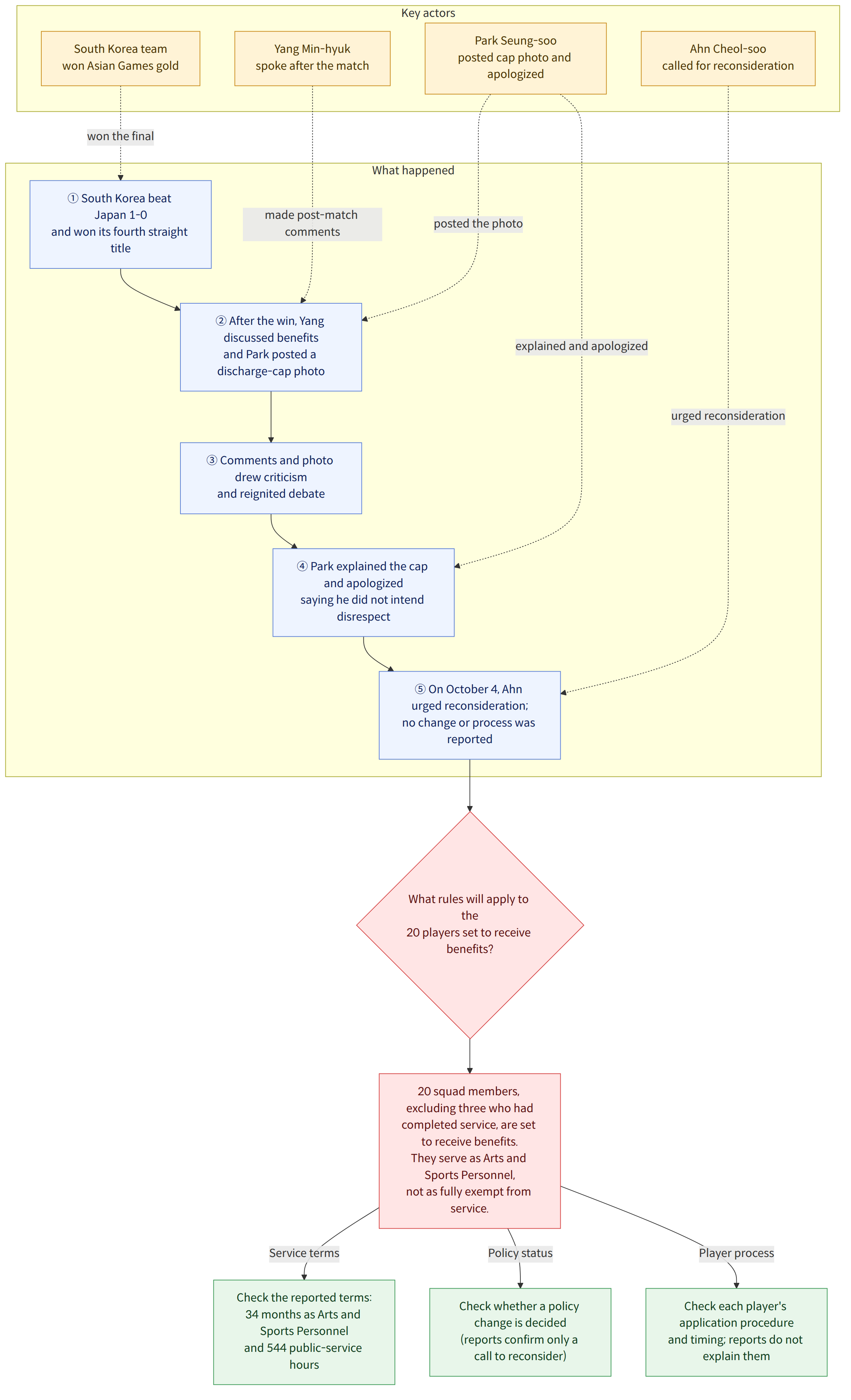
After South Korea’s men’s soccer team beat Japan 1-0 to win its fourth consecutive Asian Games title, military-service benefits tied to the gold medal became the focus of controversy over the players’ comments and photos. Park Seung-soo, 19, posted a photo wearing a “discharge cap” just after winning gold, and Yang Min-hyuk said in a post-match interview that he played with the reward of a military exemption in mind. Ahn Cheol-soo of the People Power Party (국민의힘) argued on October 4 that the benefits should be reconsidered.
The controversy brought two questions into focus alongside the match result: the players’ attitudes toward military-service benefits, and whether it is fair to link such benefits to winning a gold medal. However, criticism of the players’ comments and photos should be distinguished from discussion of changing the system. Ahn’s call for reconsideration is confirmed, but reports do not say that the system has actually changed or that a process to change it has begun.
Background and context
The team, led by coach Lee Min-seong, beat Japan 1-0 in the final at Toyota Stadium in Toyota, Aichi Prefecture, to win the title. According to reports, 20 members of the squad, excluding the three who had already completed their military service, will receive special military-service benefits. Because the gold-medal achievement and the change in military-service obligations stemmed from the same result, the players’ comments after the win and their celebrations were also viewed in connection with military service.
Yang Min-hyuk told South Korean reporters after the match that he played with the reward of a military exemption in mind, rather than a medal or the title. Ahn said one player had said that avoiding military service mattered more than the gold medal or trophy, and that he played “A Letter from a Private” during practice. Ahn also referred to the incident in which soldiers lost their ankles to a North Korean landmine on the western front, criticized the players’ comments, and argued that “military exemptions at the Asian Games should now be reconsidered.”
Park Seung-soo posted on social media a photo of himself wearing a discharge cap in the locker room. As the controversy grew, he explained that a fan had given him the cap and that, caught up in the joy of winning gold, he posted the photo without thinking deeply about what the cap represented. He apologized to those who felt uncomfortable and said he had no intention of mocking people carrying out their national defense duties or making light of their efforts.
What this news means
The players’ comments and photo could come across to those serving their military duty as making light of the benefits or mocking military service. Park’s apology and explanation convey that this was not his intention, but also show that intent and the way a post is received may differ. That is why comments and actions by members of the national team have sparked a public debate beyond their personal celebration.
Meanwhile, questions about the system should be considered separately from the individual players’ expressions. Whether it is appropriate to grant military-service benefits for winning a gold medal is a policy question that requires weighing the system’s standards and aims, but the lawmaker’s statements in the reports do not mean that a change to the system has been decided. What can be confirmed for now is that a call for reconsideration has been made; it is not yet known what changes, if any, will actually apply to the players who are set to receive the benefits.
For example, readers who are approaching their military-service obligations should distinguish between a call to reconsider the current system and a confirmed change, rather than concluding from this controversy alone that the system has changed. Reports say that 20 players will receive the benefits but do not explain the procedures or timing for applying them to each player.
Differences in what the reports said
The two reports differ in how much they explain the use of the term “military exemption.” One reported that players who won gold would receive special military-service benefits; the other explained that although the arrangement is commonly called a “military exemption,” the players must serve for 34 months as Arts and Sports Personnel (예술·체육요원) and complete 544 hours of public service. Therefore, understanding the arrangement as simply eliminating active-duty service entirely could leave out important details about how it works.
The reports also differed in the scope of their coverage of apologies. One reported Park Seung-soo’s apology and explanation, while the other also covered apologies by captain Lee Gi-hyeok and Yang Min-hyuk. It also reported that Lee said “I won’t go to the military” in an interview after the final. Differences in the scope of the reports are not grounds for concluding that one account is untrue.
What is confirmed and what remains unknown
Confirmed facts
- The team beat Japan 1-0 in the final to win its fourth consecutive Asian Games title.
- Reports said that 20 players, excluding the three who had already completed their military service, would receive special military-service benefits.
- Yang Min-hyuk’s comments about military service and Park Seung-soo’s photo wearing a discharge cap drew criticism.
- Park explained the circumstances and his intent behind posting the photo, and apologized.
- Ahn Cheol-soo called for Asian Games military-service benefits to be reconsidered.
What remains unknown
- Whether the military-service benefits system will actually change following Ahn’s proposal.
- The specific procedures and timing for applying the benefits to the 20 players.
What readers should check
- When following related news, distinguish the commonly used term “military exemption” from explanations of service as Arts and Sports Personnel.
- Check whether the issue is at the stage of a lawmaker calling for reconsideration or whether a change to the system has been confirmed.
- Treat an individual player’s apology or explanation and the policy question of whether the military-service benefits system is justified as separate issues.
References
- Other coverage consulted: hani.co.kr