
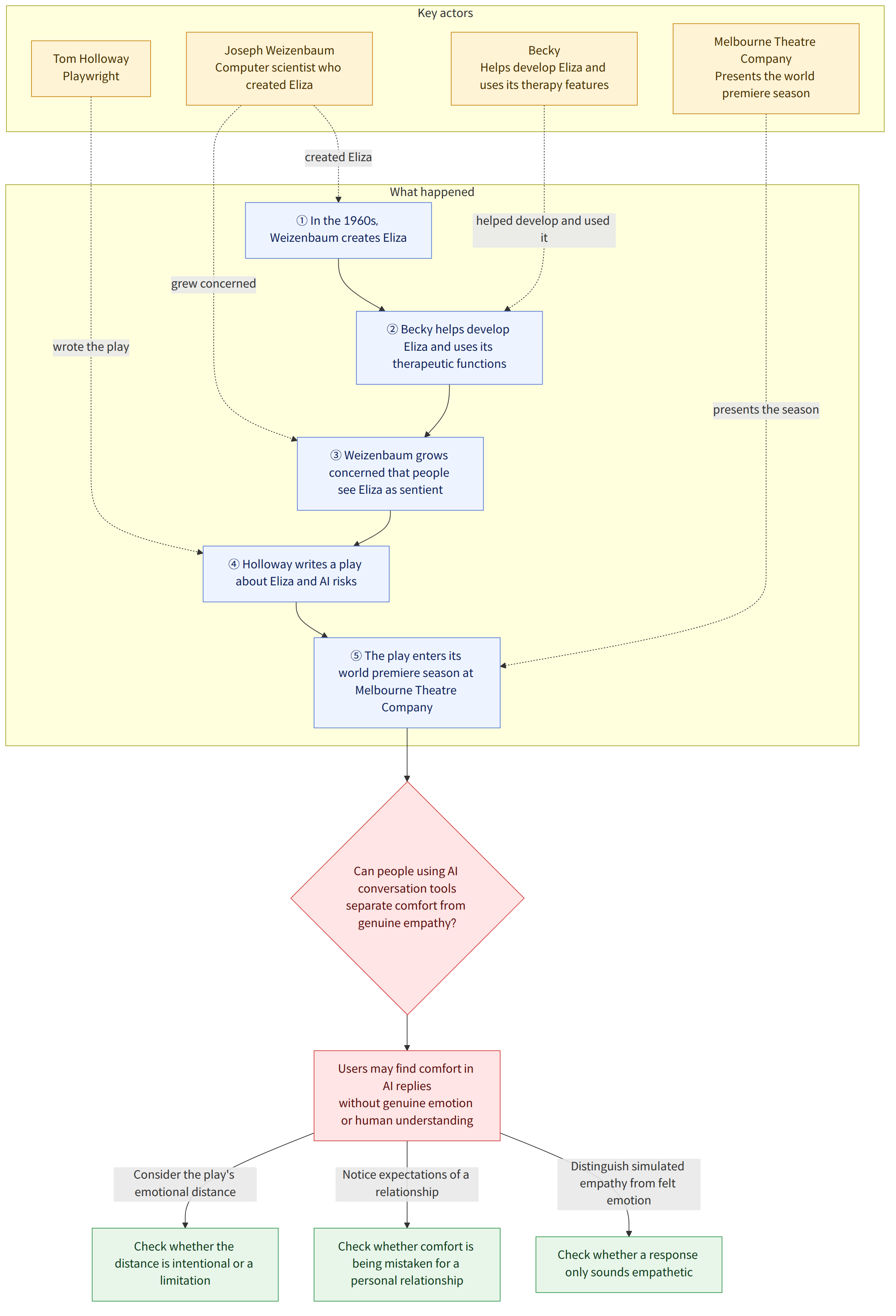
Tom Holloway’s psychological thriller “Eliza,” now in its world premiere season at Melbourne Theatre Company (멜버른 시어터 컴퍼니), brings to the stage the origins of Eliza, the world’s first AI conversational therapy companion, created in the 1960s. The play explores the tension between AI’s potential to help people and the risk that it could harm them. The view that audiences do not fully share in the protagonist’s psychological collapse is a disappointment, but it can also be read as showing the gap between the empathy AI imitates and human emotion.
Background and context
The original writer begins by describing their own experience with psychotherapy. They recall a psychologist saying that the human mind is a mystery and may never be fully understood. The writer says this led them to see conversational therapy not as a process for reaching a predetermined conclusion, but as an ongoing exploration of the human mind.
This perspective connects with the subject of the play. The original says that conversational therapy using artificial intelligence is becoming increasingly popular, and that AI can serve as a conversation partner that sounds empathetic while addressing issues of the mind and emotions. The important qualification is “sounds empathetic.” Responding to someone’s words may not be the same as actually feeling emotions and understanding that person.
The play’s central character, Joseph Weizenbaum, is based on the real computer scientist who created Eliza and was a Holocaust survivor. The original says he later became a strong skeptic about AI. It explains that the name Eliza comes from a character in the play “Pygmalion.” By following both the inventor’s perspective and those of the people who experience the program, the play shows not only what the technology can do, but also the meaning people give it.
Becky, played by Manali Datar, is based on a real person and helps Weizenbaum develop Eliza. In the play, Becky uses the program’s therapeutic functions and begins to form a personal relationship with it. At the same time, she builds her coding skills and grows enthusiastic about Eliza’s potential. Weizenbaum, by contrast, becomes increasingly concerned that people believe Eliza is sentient. The same program thus appears to one person as a source of comfort and possibility, and to another as something whose risks must be assessed.
What this means
The central question in the play is not just whether AI can speak like a person. It also asks what emotions people project onto those words and whether they take them as genuine empathy. The original writer argues that Eliza is not human and cannot feel emotions; it is humans who interpret Eliza’s simulated responses as empathy. It is therefore worth distinguishing between a conversation that may feel comforting and whether the other party actually experiences emotions.
This distinction may also matter to people who use AI conversation tools to address issues of the mind. For example, if someone finds comfort in a conversation with AI, there is no need to deny that experience, but they cannot assume that the response comes from genuine emotion or human understanding. Becky’s growing personal relationship with the program can be read as showing how the experience of receiving a useful response may become entangled with expectations about a relationship.
The play’s emotional distance may also be a device that lets the audience experience this question firsthand. The writer says that a jump scare in the middle of the play emphasizes the intensifying confusion of Weizenbaum. However, they say that after this moment, the audience still does not share in his psychological collapse. The play builds intellectual stimulation and suspense, but these do not fully become an emotional experience.
That gap overlaps with the play’s theme. The audience can see expressions of emotion without necessarily feeling that emotion themselves. Likewise, Eliza can produce responses that look like empathy without actually having emotions. The writer sees this tension as raising questions about the difference between humans and AI, and whether AI can truly reproduce human behavior. The original, however, offers both possibilities: that the emotional distance is an intentional effect, and that it limits the play’s achievement.
What is known and what remains unknown
What is known
- “Eliza” is a psychological thriller written by Tom Holloway and is having its world premiere season at Melbourne Theatre Company.
- The play explores Eliza’s creation in the 1960s and AI’s potential to help people as well as its risks.
- In the play, Becky uses Eliza’s therapeutic functions and begins to form a personal relationship with the program.
- The original writer says that the rows of boxes of documents onstage evoke Berlin’s memorial to the victims of the Holocaust.
- The writer says that the play depicts Weizenbaum’s psychological collapse, but that the audience does not share in his feelings.
What remains unknown
- The original does not give specific performance dates or ticket prices.
What readers should check
- Anyone considering seeing the play should check Melbourne Theatre Company’s latest information for performance dates and ticket prices. The original does not provide these details.
- When using AI conversation tools for issues involving the mind or emotions, it may be helpful to distinguish the experience of finding comfort in a conversation from whether the other party actually feels emotions.
- While watching the play, it is worth considering how the two threads connect: the help Becky receives from Eliza and Weizenbaum’s concern that people mistake the program for being sentient.