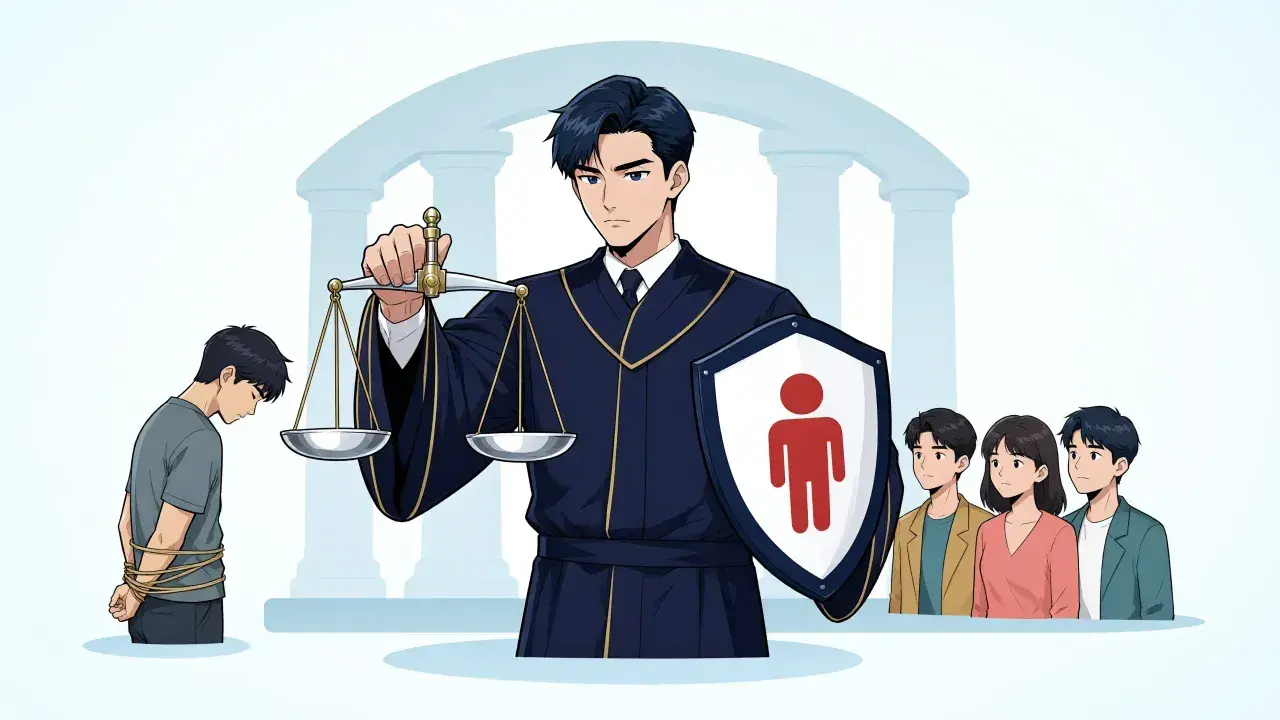
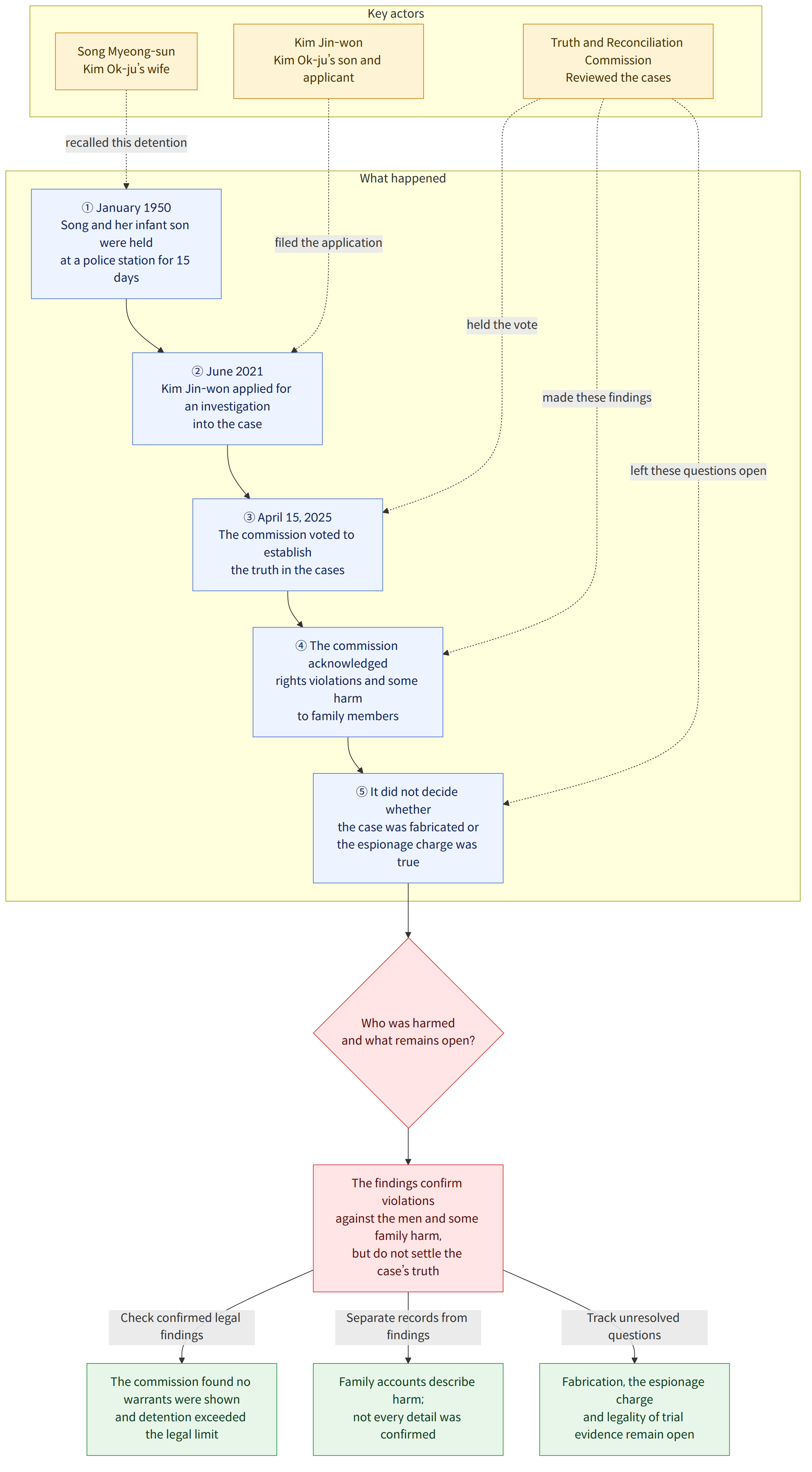
After former National Assembly member Kim Ok-ju was arrested in connection with the National Assembly Faction Case (국회프락치 사건), his wife, Song Myeong-sun, cared for their three children in her hometown of Gwangyang. On April 15, 2025, the Truth and Reconciliation Commission (진실화해위원회) voted to establish the truth in the cases of Kim Ok-ju and Kim Byeong-hoe. It acknowledged that the two men were not shown warrants when arrested by military police, were detained beyond the legally permitted period, and were subjected to harsh treatment, including being forced to confess. However, it did not determine whether the case was fabricated or whether the charge that Kim Ok-ju was a spy for the South Korean Workers’ Party (남로당) was true.
Background and context
In June 2021, Kim Jin-won, Kim Ok-ju’s son, applied to the Truth and Reconciliation Commission to investigate evidence fabrication and other issues in the National Assembly Faction Case. In April 2025, the commission voted to establish the truth at a plenary meeting, but the scope of its decision did not extend to determining whether the case had been fabricated—a question the applicant had asked it to address as a priority. The commission also concluded that it could not determine whether the use of interrogation records prepared by investigative authorities as evidence at trial was unlawful.
More than 20 years ago, Kim Jin-won spent a year writing down his mother Song Myeong-sun’s recollections. The account was included in a family autobiography and also given to an investigator at the Truth and Reconciliation Commission. Song Myeong-sun recalled that the village head told police a rumor that she had hidden guns and knives under the floor of a storeroom so she could give them to communists. She wrote that she asked the police to search her house, but they did not do so, and that she had been framed.
According to the recollections, in January 1950 Song Myeong-sun was held in a police-station warehouse for 15 days with Kim Jin-won, who was just over a year old. Kim Jin-won said that he, his mother and his cousin also suffered human rights violations after the case. He said he had heard that his cousin, Kim Jin-seok, was tortured with electricity and pressured to confess that he had received instructions from his father to organize an anti-government group. This is a family experience recounted through Kim Jin-won’s testimony; it does not mean that each detail was confirmed in the commission’s decision.
The commission acknowledged human rights violations during the arrest, detention and confession process involving Kim Ok-ju and Kim Byeong-hoe, as well as some of the harm that extended to their descendants. Song Myeong-sun’s experiences were also included in the decision as a record of harm to the family. But the acknowledged violations and the question of whether the case itself was fabricated remained separate issues.
What this news means
The decision shows that investigations into past events do not answer every question in a single ruling. The commission acknowledged that the men were not shown warrants at the time of arrest, were detained beyond the legally permitted period, and were subjected to coerced confessions and harsh treatment. Those findings, however, do not also settle whether the charges at the time were true or whether the case was fabricated. To understand the significance of the decision, it is therefore important to consider not only what was confirmed but also what fell outside the scope of its findings.
The harm to the family did not end with the detention of the individuals directly involved. Song Myeong-sun’s account describes the experience of a young child held at a police station and the suspicion and stigma faced by the family. Kim Jin-won said that security screening prevented him from traveling abroad several times. He said he passed on his sixth screening and then worked as a site manager in Saudi Arabia for 20 years. This is a personal experience he recounted, and an example of the restrictions the family faced after the case.
For example, a family preparing to request an investigation into harm caused by a past state institution could separately organize recollections and records relating not only to the person directly affected, but also to the detention, surveillance or career restrictions experienced by family members. However, the existence of a record should be distinguished from the confirmation of its contents by an investigative body. Kim Jin-won rated the 2025 decision 50 out of 100, while also saying that the investigators had done their best. He said he had reapplied to the newly established third Truth and Reconciliation Commission to have the question of whether the case was fabricated investigated.
Related procedures and support information
The issues raised by this decision—arrest and detention without a warrant and the admissibility of interrogation records—must also be considered separately in current criminal proceedings. The procedures below are general information about current criminal procedure, as described in an in-house legal guide. They do not mean that current procedures apply retroactively to past cases or change the conclusions of this commission’s decision.
- A review of the legality of detention (구속적부심사) is a procedure through which a court is asked to review whether detention is lawful and remains necessary. A suspect detained during the investigation stage, as well as those legally entitled to file a petition, may request this review. Eligible petitioners include a spouse, lineal relatives and siblings. The court decides whether to release the suspect after a hearing. Challenging the issuance of an arrest warrant and requesting a review of the legality of detention are separate procedures.
- A defendant who has been indicted may apply for bail (보석), which allows release subject to conditions while the case is being tried. The court decides whether to grant bail and what conditions to impose based on the circumstances of the individual case. Bail may be revoked or the bail deposit forfeited if the conditions are violated or the defendant fails to appear in court without a valid reason.
- The admissibility of evidence (증거능력) depends on factors such as the procedures by which the evidence was collected or prepared and whether there was an opportunity to challenge its contents and how it was prepared in court. Illegally obtained evidence generally cannot be used to prove guilt, but the specific circumstances and possible exceptions must be considered. The Truth and Reconciliation Commission said it could not determine whether the use of interrogation records prepared by investigative authorities at the time was unlawful. Its position should not be read as a finding that the records were either lawful or unlawful.
What is confirmed and what remains unknown
Confirmed facts
- In June 2021, Kim Jin-won applied to have evidence fabrication and other issues in the National Assembly Faction Case investigated.
- On April 15, 2025, the Truth and Reconciliation Commission voted to establish the truth in the cases of Kim Ok-ju and Kim Byeong-hoe.
- The commission acknowledged that the two men were not shown warrants when arrested, were detained beyond the legally permitted period, and were forced to confess and subjected to harsh treatment.
- The commission did not address whether the case was fabricated or whether the espionage charge involving the South Korean Workers’ Party was true. It also did not determine whether the use of the interrogation records as evidence was unlawful.
- Kim Jin-won wrote down Song Myeong-sun’s recollections, which were included in a family autobiography and given to an investigator. Kim Jin-won said he had reapplied to the third Truth and Reconciliation Commission to have the question of whether the case was fabricated investigated.
What remains unknown
- It has not been confirmed whether there were actually guns or knives in the storeroom at Song Myeong-sun’s home.
- The commission’s decision did not establish whether the National Assembly Faction Case was fabricated or whether the espionage charge against Kim Ok-ju was true.
- It is not yet known what conclusion will be reached on Kim Jin-won’s renewed application.
What readers should check
- If you are considering applying to have past events investigated, distinguish the issues raised in the application from the scope of the decision. As this case shows, human rights violations may be acknowledged even if the question of whether the case was fabricated is not addressed.
- Organize family recollections, autobiographies and materials submitted to investigative bodies, and clarify what each supports. Claims contained in recollections are not necessarily the same as facts acknowledged by a commission.
- If you are looking into procedures for a family member currently in detention, distinguish a review of the legality of detention at the investigation stage from bail after indictment, and consult a legal professional about eligibility to apply and the conditions set by the court.