Even after the government announced results of its response, including the shutdown of 66 sexual exploitation sites, reports said sites using the same names as two of them remained accessible. Police consider them “impersonation sites,” rather than an official resumption of operations by the original sites. However, whether the operators of the original sites and the impersonation sites are the same people remains under investigation.
Background and context
According to reports, “ㄱ” and “ㄴ” could be accessed on the 4th without a virtual private network (VPN, a technology that routes or protects an internet connection). The two sites uploaded new sexual exploitation material about every five minutes, and videos had as many as 1.15 million views. They also displayed 40 and 28 promotional banners for gambling sites, respectively.
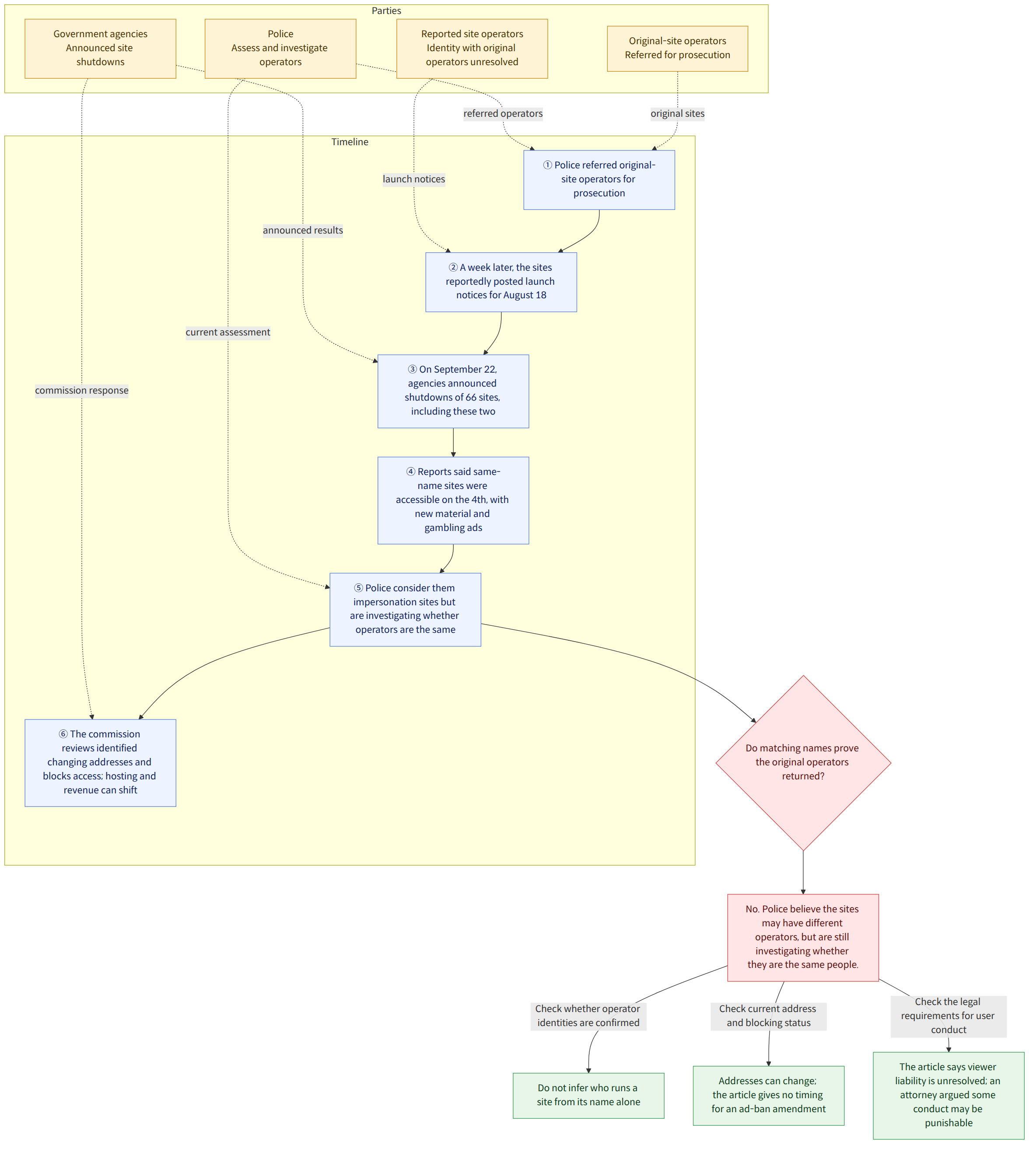
The timing of the sites’ reappearance has also drawn attention. A week after police referred the original site operators for prosecution, “ㄱ” and “ㄴ” reportedly posted notices announcing their launch on August 18. Later, on September 22, the Ministry of Gender Equality and Family (성평등가족부), the National Police Agency (경찰청), the Broadcasting and Media Communications Commission (방송미디어통신위원회), and the Broadcasting and Media Communications Standards Commission (방송미디어통신심의위원회) announced results of their response, including the shutdown of 66 sexual exploitation sites, among them the two sites. The reports said the government was unaware of the sites’ launch announcements when it announced those results.
Police currently believe the two sites are impersonation sites run by different operators who have changed the domain names (internet addresses). An official at the National Police Agency said the videos on the sites differ from those seized during the arrest of the original operators. At the same time, police are investigating the possibility that the operators of the sites they had previously been tracking and those of the impersonation sites are the same. The fact that the sites have the same names, therefore, is not enough to conclude that they have the same operators.
An official at the Broadcasting and Media Communications Standards Commission said the sites keep changing their URLs (internet addresses), and that when new addresses are identified, the commission reviews the sites, makes a decision, and blocks access. But finding and blocking addresses is a different task from cutting off a site’s operating infrastructure and sources of revenue. An official at the Ministry of Gender Equality and Family explained that even if hosting (server rental) is discontinued, operators can enter into agreements with other providers.
What this means
This case shows that blocking access to a single site is not enough to end the distribution of illegal content. If operators change addresses or use servers from other providers, further blocking measures are needed, and identifying new addresses can take time. As the Broadcasting and Media Communications Standards Commission official explained, the process of identifying a new address, reviewing it, making a decision, and then blocking access requires ongoing monitoring.
The revenue model is another part of the response. An official at the Ministry of Gender Equality and Family said most of the illegal sites’ revenue comes from gambling-site advertisements and called an amendment to the law banning ads on illegal sites urgent. This raises the need to block advertising revenue in addition to blocking sites and investigating their operators. However, the reports do not establish when the law might be amended or what measures might be introduced.
For users, the question of whether “just watching” is harmless also remains unresolved. Attorney Lee Kyung-ha (이경하) said viewing sexual exploitation material can also be punishable, but that there have not been many cases involving such conduct. She argued that investigations and penalties should apply not only to operators but also to viewers who download material, leave comments, or sign up for accounts. This is the attorney’s argument; the article alone cannot establish whether or how each specific act is punishable or what legal requirements would apply.
For example, even if you come across a site with the same name as one previously reported on, you should not conclude from the name alone that the original operator has returned or that the site is safe. Police believe the operators may be different, but are also investigating the possibility that they are the same.
Kim Yeo-jin (김여진), head of the Korea Cyber Sexual Violence Response Center (한국사이버성폭력대응센터), said that, beyond measures to prevent distribution, there is a need to improve the education system as a whole so that women are treated as citizens, as well as for the government to set out a vision. Her point is that the response should not be limited to blocking technology or investigations, but should also address the consumption of sexual exploitation material and society’s attitudes toward it.
Related legal framework and support information
An internal legal guide (L1) explains that whether material is obscene should not be determined simply by whether it contains nudity or explicit expression; instead, its content and manner of expression, the scope of its distribution, and the circumstances should be considered together. It also distinguishes among obscenity, whether material is publicly accessible to multiple people, and its distribution through information and communications networks as separate legal issues. Therefore, the guide’s general criteria for obscenity alone cannot establish the legal conclusions that would apply to the videos on these sites or to viewing or downloading them.
The guide also cites a court ruling that obscene computer-program files do not qualify as “documents, drawings, films, or other objects” under the Criminal Act’s offense of public exhibition, and explains that selling obscene material through communications networks may be punishable as a violation of laws concerning information and communications networks. These are points of reference showing that the issues can differ depending on the form of the files and how they are distributed; they do not directly determine the legal liability for viewing, commenting, or signing up for an account, as mentioned in the article. Some provisions and cases cited in the guide are based on the laws in effect at the time, so in an actual situation, the current applicable laws and specific facts should be checked.
What is known and what remains unclear
What is known
- The two sites used the same names as the original sites and were reportedly accessible on the 4th.
- New sexual exploitation material was uploaded about every five minutes, and videos had as many as 1.15 million views.
- Police consider the two sites to be impersonation sites and said that videos different from those on the original sites had been posted.
- Police are investigating the possibility that the operators of the sites they had previously been tracking and those of the impersonation sites are the same.
- On September 22, the relevant government agencies announced results of their response, including the shutdown of 66 sites, among them the two sites.
What remains unclear
- The identity of the impersonation sites’ actual operator has not been established.
- The reports do not say whether an investigation has established that the original site operators and the impersonation site operators are the same people.
- It is not known when or how the government and investigative agencies will block or crack down on the impersonation sites.
- It has not been confirmed when or how an amendment banning advertisements on illegal sites will be pursued.
What readers should check
- If a site using the same name appears, do not determine from the name alone that the original site has resumed operations or identify who is running it. Check the results of the police investigation and statements from relevant agencies about blocking access.
- The legal liability associated with viewing or downloading sexual exploitation material, commenting, or signing up for an account may raise different issues depending on the conduct and the specific nature of the content. Avoid such conduct, and check the laws currently in effect if you need a legal determination.
- Progress on the responses to blocking sites and disrupting their revenue model, which the reports raised, is separate from whether the law is amended. Check separately for follow-up announcements from the relevant government agencies.