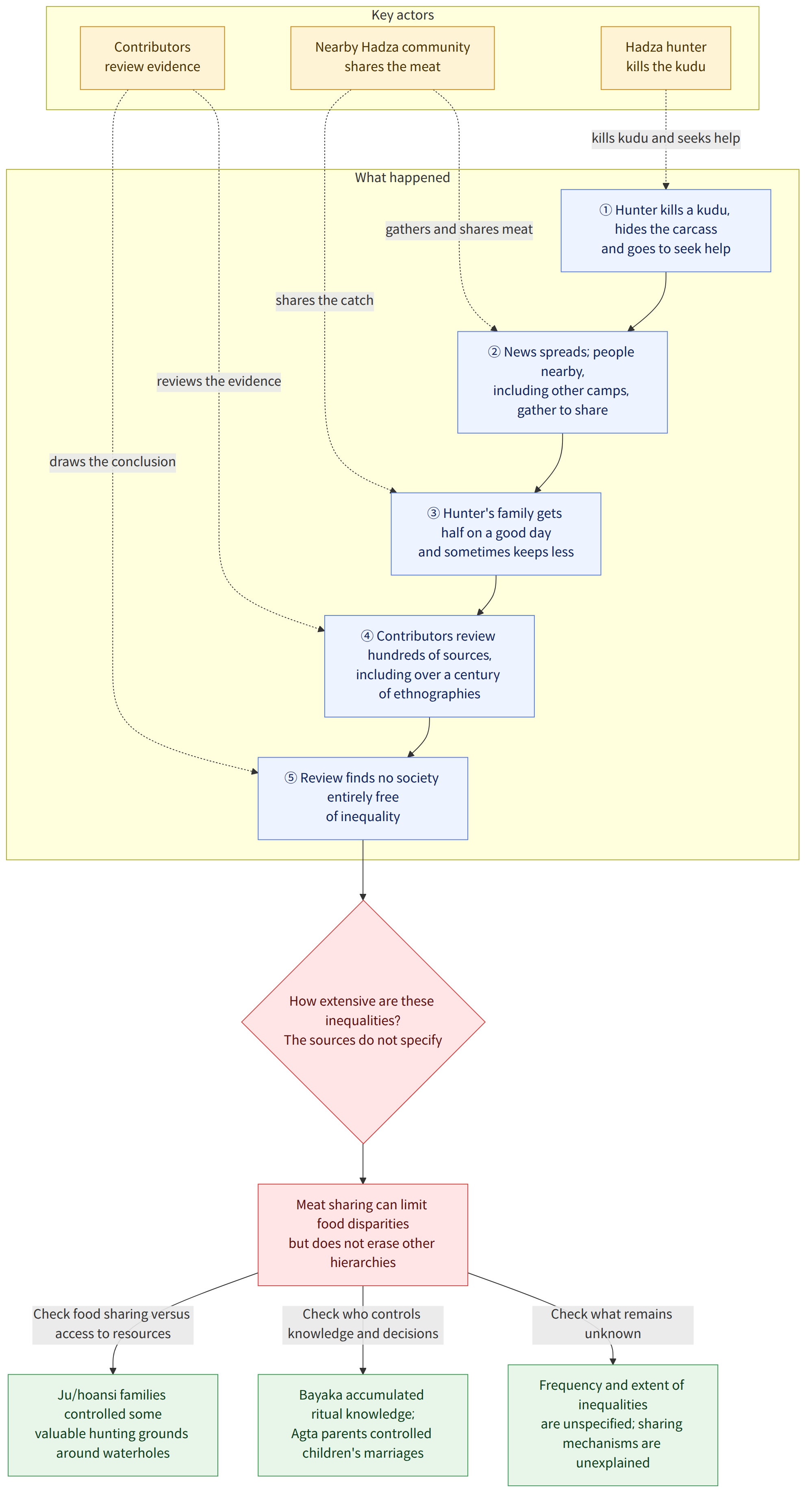
A Hadza hunter near Lake Eyasi in northern Tanzania killed a kudu. Unable to carry it alone, he removed the poisoned arrow, hid the carcass under dry grass and went to seek help. The article describes how, once news of the game spreads, people gather to share the meat, and almost everyone nearby—including people from other camps—has a right to a portion. On a good day, the hunter’s family gets half the meat, but sometimes it keeps less.
This scene shows a community where sharing is widespread. The material the contributors examined comprises hundreds of sources, including more than a century’s worth of ethnographies—records made through field research into the lives and cultures of communities.
Background and context
Hunter-gatherer societies have often been portrayed as communities in which power, wealth and social status are equal. According to the article, traditional subsistence communities limit many forms of inequality. Most families have similar, modest possessions and accumulate little material wealth. Even when leaders emerge, their authority to direct others is greatly limited, and people often make decisions by consensus. If they cannot reach a consensus, families may leave.
But these characteristics alone do not mean that all members are equal in every respect. The contributors reviewed evidence dating from the early 20th century onward and concluded that no society was entirely free of inequality. Practices such as avoiding the accumulation of wealth and sharing food can limit material disparities, but that does not mean other resources or status are distributed equally.
The areas in which inequality appeared also varied from case to case. The Ju/’hoansi of the Kalahari Desert had few possessions and shared food widely, but some families controlled valuable hunting grounds around waterholes. The Bayaka of the Central African rainforest had little material inequality, but bought, sold and accumulated ritual knowledge. In a case involving the Agta of the Philippines, parents controlled their children’s marriages, and orphans faced severe discrimination.
Gender, age and reputation also created differences. The article says the Hadza reserve certain cuts of meat for older men and show greater respect for people who are better hunters. In many societies, women did more direct child-rearing, while men participated more often in community-level decision-making. According to the article, no society lacked informal leadership, and age was also a source of inequality.
What this news means
The question raised by this research is not whether a community can be labeled equal or unequal in a single word. The key is to consider what is shared, who takes part in decision-making, and who controls particular resources or knowledge. Widespread meat sharing can reduce disparities in food distribution, but it does not eliminate hierarchies in other areas, such as cuts reserved for older men or the greater respect accorded to more skilled hunters.
For example, even if a community shares game among several families, if only certain families control valuable hunting grounds, equality in food sharing and equality in access to resources remain separate issues. This is a hypothetical explanation that reflects the distinction illustrated by the Ju/’hoansi case in the article. Rather than concluding that a community is equal as a whole based on one egalitarian practice, it is therefore necessary to examine the areas in which equality exists and the extent to which it does.
The contributors argue that the equality that exists often stems from self-interested motives. However, the article does not explain the specific processes through which those motives lead to sharing or limits on authority. It is therefore more appropriate to read this as raising the possibility that egalitarian practices need not be assumed to arise solely from altruism, rather than generalizing it as the reason for all sharing.
What is confirmed and what remains unknown
What is confirmed
- The Hadza share meat from their hunts. Even on a good day, the hunter’s family gets half the meat, and sometimes it keeps less.
- The cases reviewed show differences related to hunting grounds, ritual knowledge and family relationships, even in communities with few material possessions or practices of food sharing.
- In the Hadza case, certain cuts are reserved for older men, and people who are better hunters receive greater respect.
- The contributors reviewed hundreds of sources, including more than a century’s worth of ethnographic material, and concluded that no society was entirely free of inequality.
What remains unknown
- The sources reviewed do not specify how frequent or extensive different types of inequality, such as those related to property, gender and age, were.
- The specific processes by which the self-interested motives cited by the contributors produce egalitarian practices are not explained.
- The cases listed in the article make it difficult to compare the impact of inequality on members of each society or the extent of differences across areas.
What readers should check
- When encountering claims that hunter-gatherer societies are equal, readers can check whether they address not only property and food distribution but also control of resources and participation in decision-making.
- When considering a case involving a particular community, it is useful to distinguish between facts observed in the article and the contributors’ interpretations. In particular, the article does not explain what specific processes are meant by “self-interested motives.”
- The conclusion that hundreds of sources were reviewed should also be considered alongside the limitation that the frequency and extent of different types of inequality are unknown. Even when an overall conclusion is presented, that does not establish how common each form of inequality was.