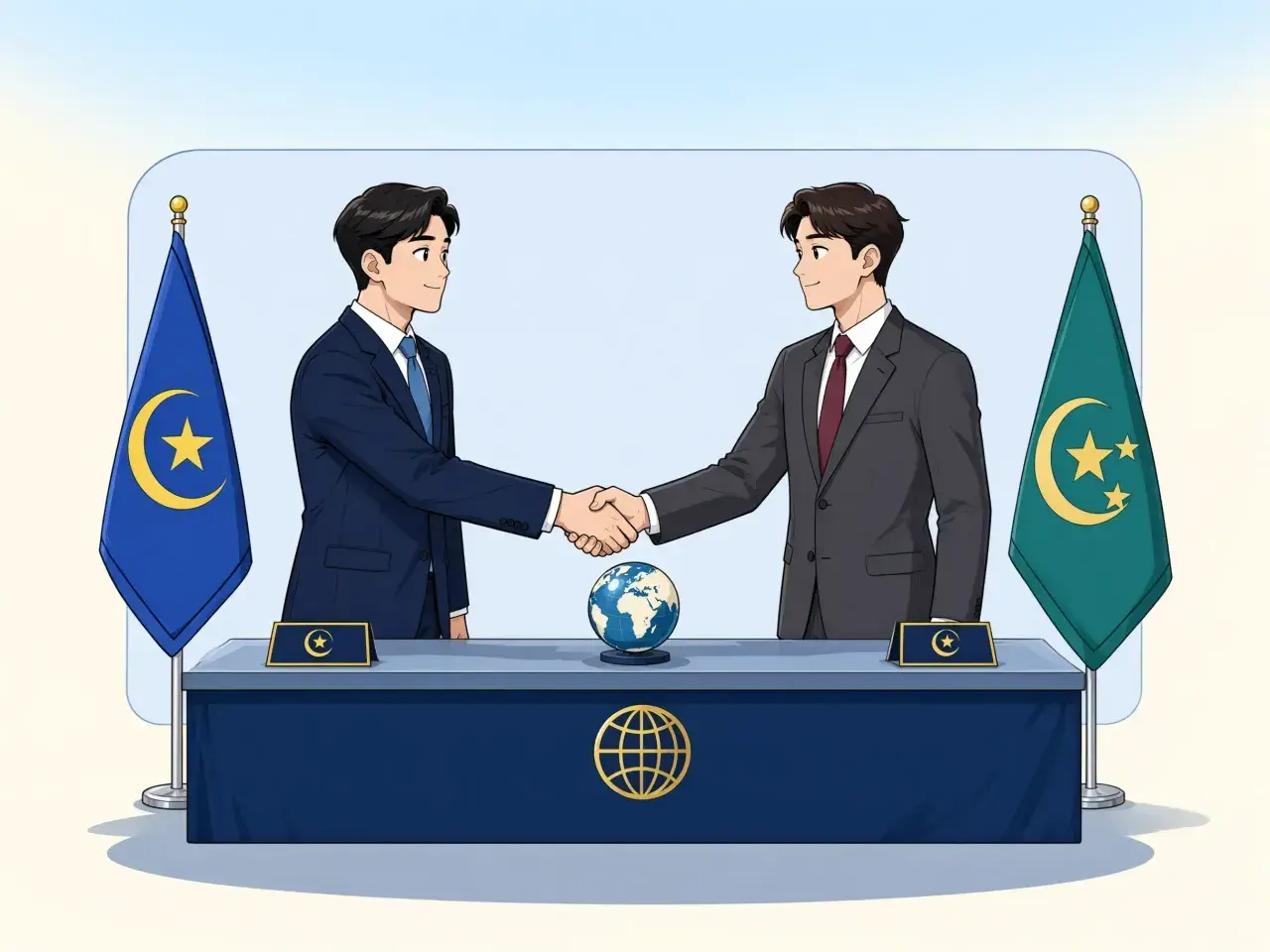


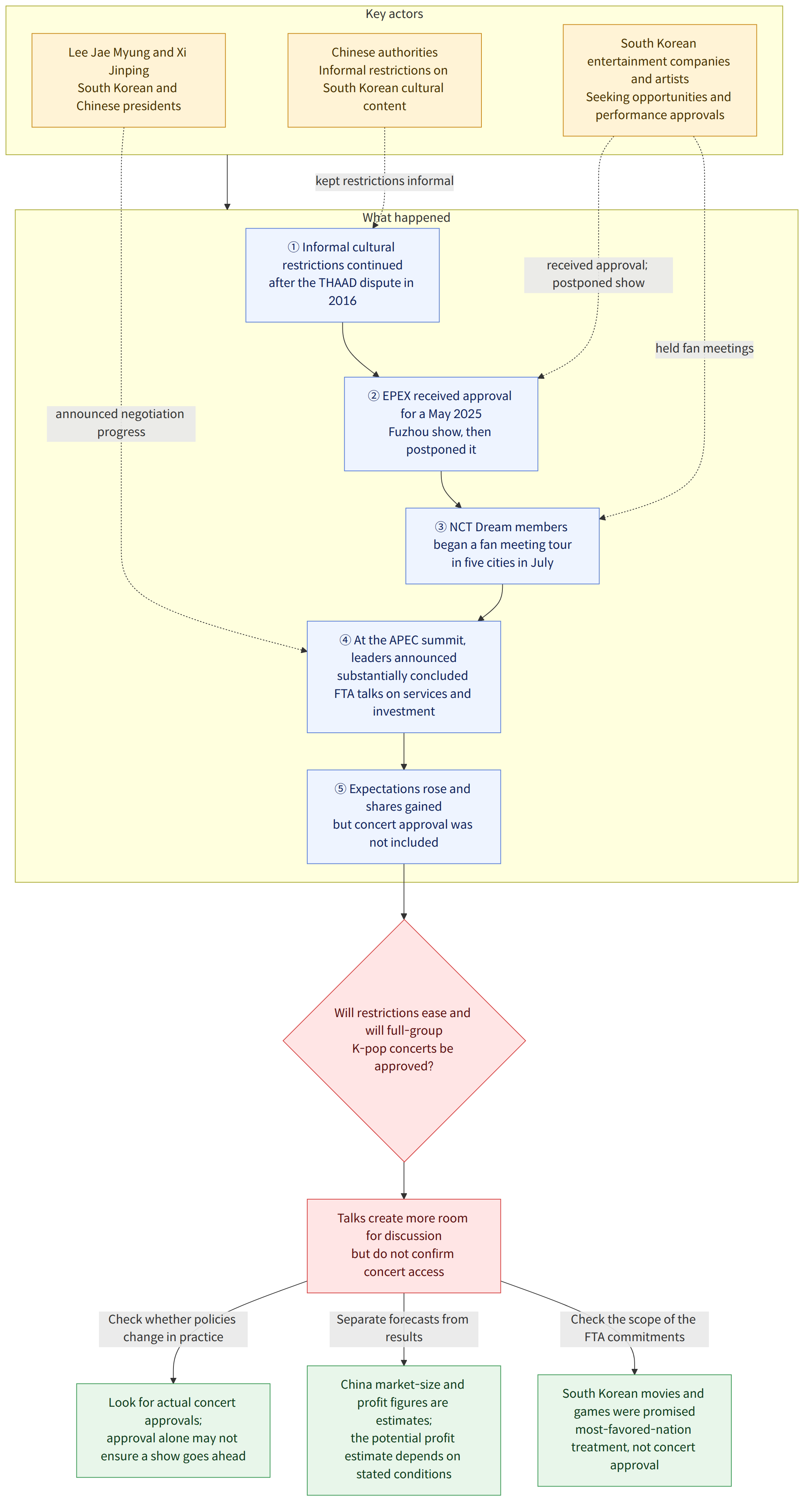
At the Asia-Pacific Economic Cooperation (APEC; 아시아태평양경제협력체) summit in Shenzhen, China, President Lee Jae Myung and Chinese President Xi Jinping announced that they had substantially concluded follow-up negotiations on services and investment under the Korea-China Free Trade Agreement (FTA; 한중 자유무역협정). However, the agreement did not include a provision requiring approval for K-pop concerts. That is why expectations for entering the Chinese market have grown even as some urge caution, saying the resumption of concerts cannot yet be viewed as a confirmed change.
Background and context
The negotiations included commitments related to movies and online games. An official from South Korea’s Ministry of Culture, Sports and Tourism (문화체육관광부) said China had agreed to grant South Korean movies and games most-favored-nation treatment. This means treatment no less favorable than that given to other countries. However, the official said restrictions on South Korean cultural content are informal, so it remains to be seen how the agreement will be applied in practice.
China’s informal restrictions on South Korean cultural content and entertainment activities have continued since 2016, following a diplomatic dispute over South Korea’s deployment of the U.S. Terminal High Altitude Area Defense system (THAAD; 고고도미사일방어체계·사드). Because the restrictions were never formally announced, companies find it difficult to predict whether their performances in China will be approved and how policies might change.
Industry insiders believe that even if restrictions are eased, changes may first emerge in other areas of entertainment before extending to concerts. An executive at a major K-pop agency said that groups with Chinese members already active in China may first expand those activities, with the change potentially extending later to concerts and other events.
Examples of this trend include Seventeen’s Chinese members Jun and The8, who have released solo music and appeared on Chinese variety shows. NCT Dream’s Chinese members Renjun and Chenle began a fan meeting tour in five cities in July, starting in Hangzhou. These activities show that entertainment work is continuing in China, but they do not mean that large-scale concerts by entire groups including Korean members have been approved.
South Korean entertainment companies have continued to expand their business presence in China despite the restrictions. It is also important to distinguish between companies preparing a foothold in the market and actually obtaining permission to hold performances.
EPEX, a boy group made up exclusively of Korean members, received approval for a 1,000-seat performance in Fuzhou in May 2025, but its agency postponed the show several weeks before it was due to take place, citing local circumstances. This case alone does not establish that regulations caused the postponement. It does, however, show that approval does not guarantee that a scheduled performance will go ahead.
What this news means
The size of the Chinese market is one reason the industry is optimistic. In a report released Thursday, Daol Investment & Securities estimated that China’s concert market is about 85% the size of Japan’s and 2.8 times the size of South Korea’s. Hana Securities estimated that profits at South Korean entertainment companies could rise by about 40% if China allows K-pop concerts and the resumption of South Korean entertainment productions, and cultural exchanges expand. These figures are estimates of market size and potential profits under specific conditions, respectively—not results that have already been achieved.
After the negotiations were announced, SM Entertainment shares closed up 14.3% on Wednesday, while HYBE shares closed up 7.6%. This can be interpreted as the market viewing progress in the negotiations as a business opportunity in China. But the share price gains alone do not mean that China’s concert restrictions have been lifted or that improved company performance is assured. There are still steps to verify between market expectations and the actual implementation of policy.
A senior official at the Presidential Office (대통령실) said the agreement between the two countries contains no provision requiring approval for concerts by artists from the other country, but that there is now more room to discuss concert approvals. In other words, according to the South Korean government, the negotiations do not automatically approve concerts, but they have created more space for related discussions. For example, if an agency seeks to stage a group concert in China, it should not assume that the show can proceed based on this agreement alone; it needs to check for individual approval from Chinese authorities and confirm how the agreement is being applied in practice.
What is confirmed and what is still unknown
Confirmed facts
- The leaders of South Korea and China announced that they had substantially concluded follow-up negotiations on services and investment under the FTA.
- The negotiations included commitments related to movies and online games, but no provision approving K-pop concerts.
- Chinese members have pursued solo activities and local fan meetings, among other events, but there is no confirmation that large-scale concerts by entire groups including Korean members have resumed.
- Securities firms have estimated the size of China’s concert market and the potential for profits at South Korean entertainment companies to increase; these are forecasts.
Still unknown
- When Chinese authorities will approve large-scale concerts by South Korean K-pop groups.
- When and how the agreement related to movies and games will actually be implemented.
- How much South Korean entertainment companies’ activities in China will actually expand.
What readers should watch for
- When news emerges about concerts or fan meetings in China, readers should check not only the announced schedule but also whether Chinese authorities have approved the event and what the organizer ultimately announces.
- In the movie and gaming sectors, readers should distinguish between the announcement of negotiations and the actual application of review and distribution rules. It remains to be seen how the measures will be implemented on the ground.
- Securities firms’ forecasts can be useful for gauging the market’s potential, but it is important not to treat the resumption of concerts or an increase in profits as confirmed facts.
References
- Other coverage consulted: korea.net