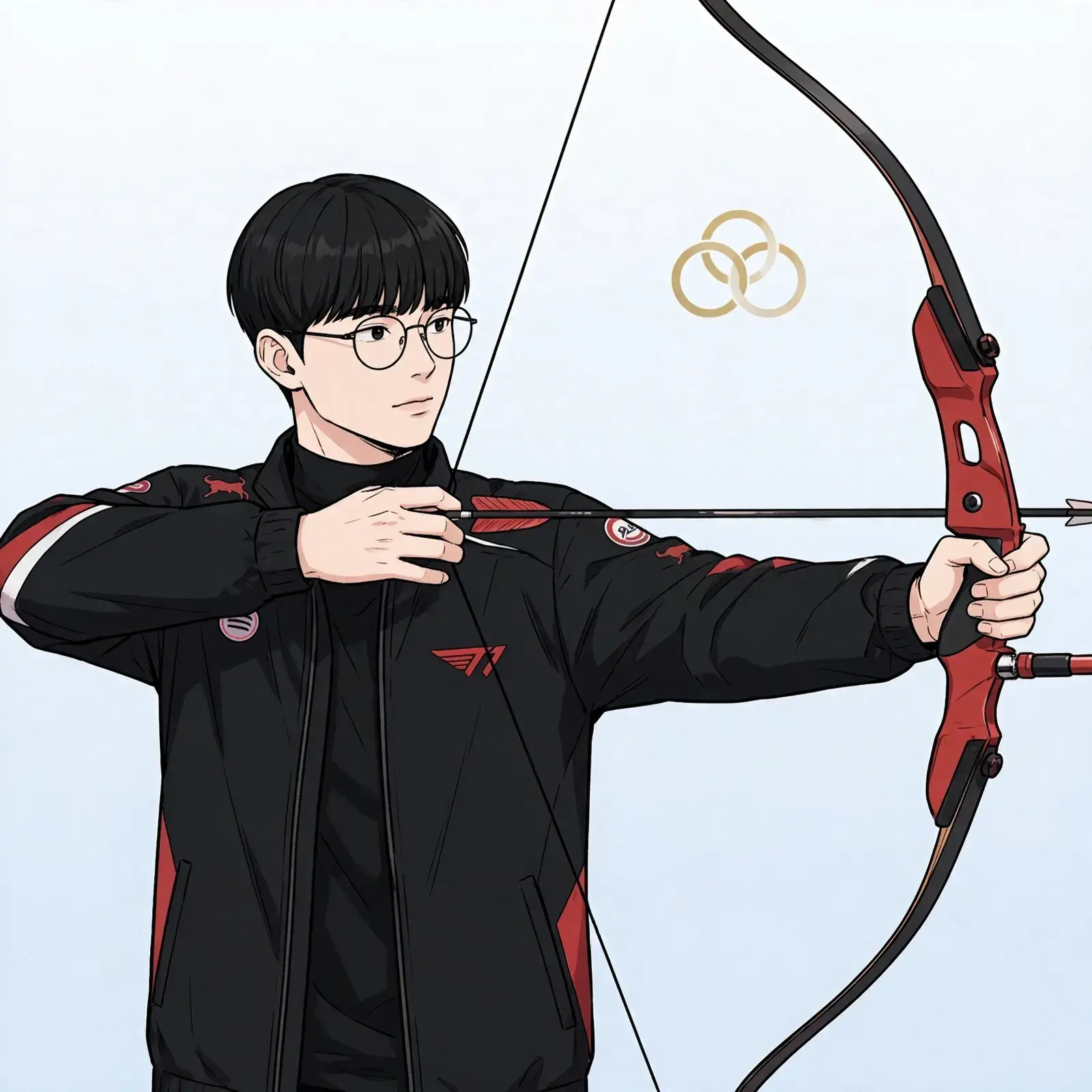
A packed day of medal contests
South Korea faces a busy day at the 2026 Aichi-Nagoya Asian Games, with medal opportunities across esports, archery, judo, taekwondo, boxing and tennis. The schedule also includes a bronze-medal match for the women’s football team. The day’s headline contests feature familiar champions, defending-title ambitions and opportunities to end long waits for gold.
The schedule below is given in local Japanese time. Because the competitions are still ahead on the day covered here, the medal bids are described as goals rather than results.
The day’s two biggest team targets: Faker and South Korea’s League of Legends squad are aiming to retain their Asian Games crown, while the country’s recurve archers are seeking gold in all three team events.
Faker leads South Korea into the League of Legends final
Lee Sang-hyeok, better known by his gaming name Faker, is set to lead South Korea against Taiwan in the League of Legends final at noon. The match is a rematch of the final at the Hangzhou Asian Games, which was held in 2023 after being postponed from 2022. South Korea is seeking a second consecutive title in the event.
Faker is widely regarded as one of the game’s greatest players and has won the League of Legends World Championship six times. He is joined on the national team by Choi Woo-je, known as Zeus; Kim Geon-bu, known as Canyon; Kim Geon-woo, known as Zeka; Lee Min-hyeong, known as Gumayusi; and Ryu Min-seok, known as Keria.
South Korea reached the final after winning all three of its group-stage matches against Taiwan, India and Hong Kong, then defeating Saudi Arabia in the semifinal. The team has reached the final at three consecutive Asian Games, beginning with the 2018 Jakarta-Palembang edition. Faker has represented South Korea at all three tournaments.
“I will stay focused to the end and do my best for the honor of the country, with the goal of bringing home the gold medal,” Faker said before the competition.
League of Legends is a team-based video game in which players control characters with distinct abilities and work together to defeat the opposing team. At an international tournament, the contest is not only a test of individual skill: communication, timing and decisions made under pressure can determine the outcome.
Recurve archers seek a clean sweep
South Korea’s archers are aiming to win gold in the women’s team, mixed team and men’s team recurve events. Recurve bows are the traditional-looking bows whose tips curve away from the archer when unstrung. The discipline rewards accuracy and consistency: competitors shoot at targets from a set distance, and each arrow’s position determines its score.
The three finals and semifinals are scheduled at the Okazaki Central Park multipurpose venue. South Korea won all three team events at the previous Asian Games in Hangzhou, and is now attempting to repeat that sweep. A clean sweep would require the women’s, mixed and men’s teams each to prevail in their respective matchups on the same day.
- Women’s team: Kang Chae-young, Lee Yun-ji and Oh Ye-jin face Indonesia in the semifinal at 9 a.m.
- Mixed team: Kim Je-deok and Kang Chae-young meet China at 11:25 a.m.
- Men’s team: Kim Woo-jin, Kim Je-deok and Lee Woo-seok face Taiwan at 2 p.m. in a semifinal contest for a place in the final.
The mixed event pairs one woman and one man, so athletes must adapt quickly to a format that combines individual shooting routines within a two-person team. In all three events, a single arrow can shift the pressure: a close score makes steady execution especially important in the final rounds.
Judo and taekwondo bring more medal chances
In judo, South Korea’s heavyweight leaders are also seeking the top of the podium. Kim Min-jong, the silver medalist in the men’s over-100-kilogram division at the 2024 Paris Olympics, is looking to improve on the bronze he earned at the previous Asian Games. Rising athlete Lee Hyeon-ji will compete in the women’s over-78-kilogram category.
Judo is a combat sport in which competitors try to throw an opponent onto the mat or control them with holds. In heavyweight divisions, strength matters, but balance and timing can be just as important: a well-timed move can turn an opponent’s forward push into an opportunity to score.
Taekwondo offers a distinctive double challenge for Ahn Hyang-sik. The Games have introduced virtual taekwondo, a competition in which athletes perform movements against a digital opponent, as an official medal event for the first time. Ahn is scheduled to contest its final at 11:30 a.m. and later compete in the men’s 58-kilogram sparring final at 7:35 p.m., giving him a chance to pursue two medals in one day.
The two events test different skills. Virtual taekwondo uses movement and reactions in a simulated setting, while sparring pits athletes against one another directly, with points awarded for permitted strikes and techniques. Competing in both means Ahn must shift between distinct formats and manage his energy across a long day.
Boxing and tennis chase long-awaited Asian Games gold
South Korean boxers Jang Dong-hwan, in the men’s 60-kilogram division, and Kim Min-seong, in the 80-kilogram division, are due to fight in their finals. Jang is scheduled to face Uzbekistan’s Abdumalik Khalokov, while Kim is set to meet India’s Ankush. Both are pursuing a milestone: South Korea is seeking its first Asian Games boxing gold in 12 years.
A boxing final can turn on more than the number of punches thrown. Judges assess clean, legal blows and effective control, so athletes must balance attack with defense and adapt to an opponent’s style over the course of the bout.
In men’s doubles tennis, Nam Ji-sung and Park Ui-sung are aiming to win South Korea’s first Asian Games tennis gold in 12 years. Their match is scheduled for 10 a.m. at the Higashiyama Park Tennis Center in Nagoya. Doubles requires partners to coordinate their positions and cover the court together, making communication and quick reactions central to the contest.
Women’s football team plays for bronze
South Korea’s women’s football team is scheduled to meet China in the bronze-medal match at 3 p.m. at Shizuoka Stadium Ecopa in Fukuroi. A third-place playoff offers a final chance to leave the tournament with a medal after a team falls short of the championship match.
Football is a contest of sustained teamwork: players must defend and attack as a unit, while substitutions and tactical adjustments can shape the closing stages. Against China, South Korea will need to turn its final opportunity into a disciplined performance across the full match.
What makes the day significant
The schedule brings together athletes from sports with very different demands. Esports teams rely on coordinated decisions in a fast-changing digital contest; archers seek repeatable precision; and combat athletes have to respond instantly to an opponent. For spectators, the result is a day in which attention moves from a computer-screen final to target ranges, arenas and a football stadium.
South Korea’s goals also carry different kinds of pressure. Faker’s team is trying to defend a title and extend a run of consecutive finals, while the recurve archers are chasing a three-event sweep after taking all three team golds at the previous Games. In boxing and tennis, the finals offer a chance to end 12-year waits for Asian Games gold.
The outcomes remain to be decided: the key storylines are South Korea’s title defense in League of Legends, its bid for three recurve team golds, and several individual and team opportunities to reach the podium.