
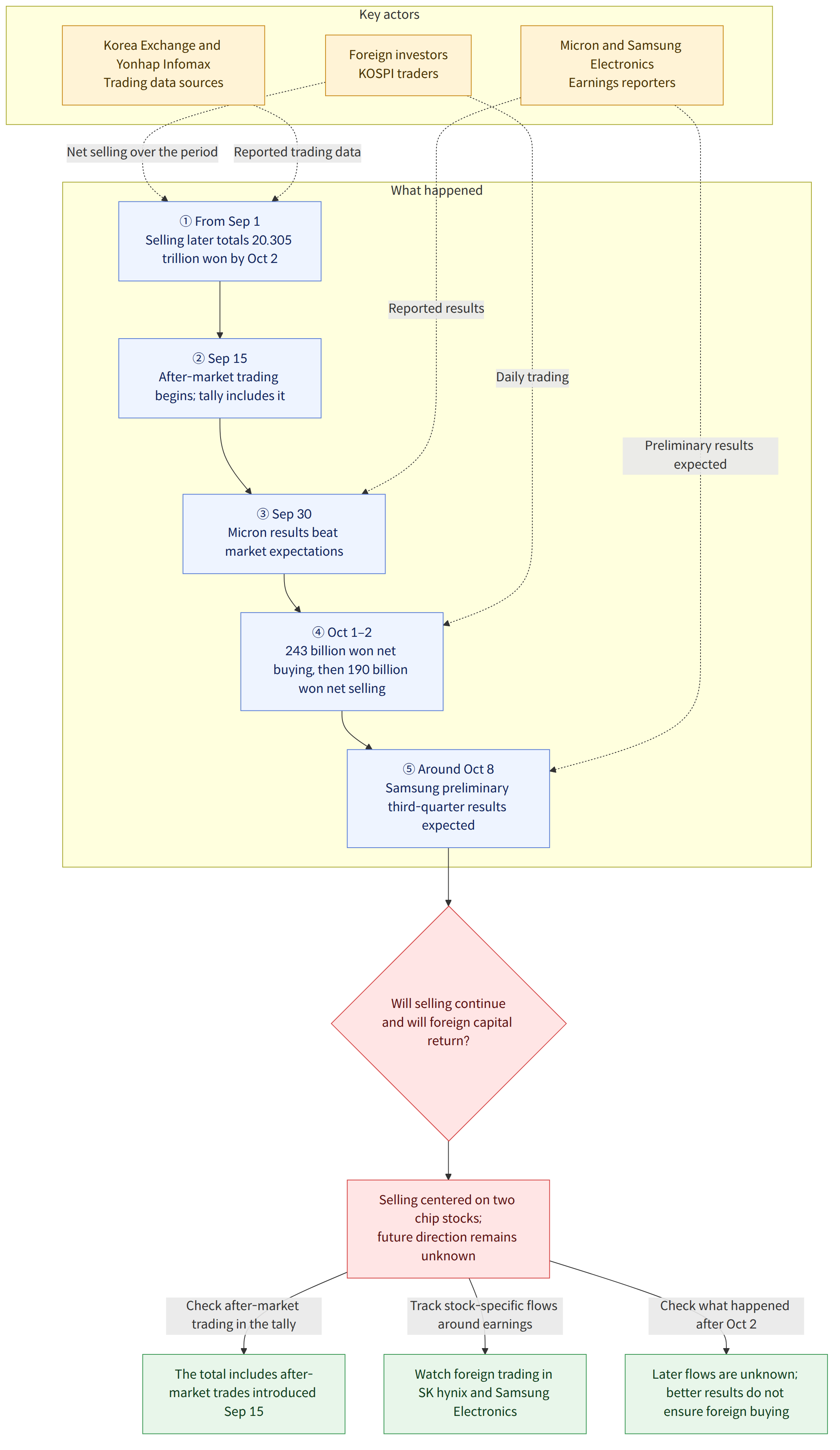
Foreign investors net sold 20.305 trillion won worth of shares on the KOSPI from September 1 to October 2, 2026. SK hynix and Samsung Electronics accounted for most of the sales. Foreign investors were net buyers on only 7 of the 22 trading days, and their net sales exceeded 3 trillion won on September 28 alone.
Background and context
The tally includes after-market trading (trading after regular market hours), which was introduced on September 15. So when considering the net sales over this period, it is important to note that the figures also reflect after-market trading. The headline and article described the amount as about 20.3 trillion won, or $15.1 billion; the specific total, according to data from the Korea Exchange (한국거래소) and Yonhap Infomax (연합인포맥스), was 20.305 trillion won.
Selling was concentrated in large-cap semiconductor stocks. Foreign investors net sold 12.09 trillion won worth of SK hynix shares and 5.186 trillion won worth of Samsung Electronics shares. Together, the two companies accounted for 17.276 trillion won, or about 85% of total net sales. In other words, the outflow was heavily concentrated in these two leading semiconductor stocks rather than spread evenly across the KOSPI.
Foreign ownership stakes also declined. Foreign investors’ share of the KOSPI’s total market capitalization fell to 39.66%. As of October 2, foreign ownership of SK hynix stood at 49.76%, its lowest level since May 2023. Samsung Electronics’ foreign ownership fell to 46.40% on September 30, then registered 46.41% on October 2.
Market analysts said that profit-taking after gains in large-cap semiconductor stocks earlier in the year, the prolonged U.S.-Iran conflict, and rising interest rates in major economies weighed on investor sentiment. This is analysis of the reasons behind the net selling, not a measure of how much each factor contributed to the sales.
What this news means
Investors sensitive to foreign capital flows should look not only at the overall amount of net sales but also at which stocks attracted the selling. In this tally, SK hynix and Samsung Electronics accounted for most of the sales. The decline in foreign ownership stakes in the two companies shows that foreign holdings fell, but these figures alone cannot determine the direction of future share prices or foreign investors’ future trading.
Signs of easing selling emerged briefly. Foreign investors were net buyers of 243 billion won on October 1, then net sellers of 190 billion won the next day, October 2. Trading volumes on both days were lower than in September, but two days of activity are not enough to conclude that the trend has changed.
Earnings announcements are drawing attention as a possible indicator of what comes next. Micron reported results on September 30 that beat market expectations, and Samsung Electronics was expected to announce preliminary third-quarter results around October 8. Han Ji-young, an analyst at Kiwoom Securities (키움증권), said foreign buying could return if macroeconomic uncertainty eases and earnings visibility improves. This is a forecast about what might happen, not confirmation that capital has actually flowed back in.
For example, investors with large positions in SK hynix or Samsung Electronics can look not only at total foreign net sales but also at how foreign trading in the two stocks changes around their earnings announcements. However, the information currently available provides no basis for concluding that foreign investors will necessarily buy the shares even if results are better than expected.
What is confirmed and what remains unknown
Confirmed facts
- Foreign investors net sold 20.305 trillion won on the KOSPI from September 1 to October 2. The tally includes after-market trading, introduced on September 15.
- Foreign investors were net buyers on only 7 of the 22 trading days during the period, and their net sales exceeded 3 trillion won on September 28 alone.
- Net sales of SK hynix and Samsung Electronics were 12.09 trillion won and 5.186 trillion won, respectively.
- Micron reported results on September 30 that beat market expectations. Samsung Electronics was expected to announce preliminary results around October 8.
What remains unknown
- The data do not show how foreign investors’ net sales were divided by investor type or country.
- It is not known how foreign investors’ net trading or ownership stakes changed after October 2.
- This information alone cannot establish whether foreign capital actually returned to the South Korean stock market after third-quarter earnings announcements.
What readers should check
- When reviewing foreign investor trading, check the period covered and whether the figures include after-market trading.
- Compare how foreign investors’ net trading changes around earnings announcements in the KOSPI overall and in SK hynix and Samsung Electronics individually.
- After the earnings announcements, distinguish the announcements themselves from actual foreign capital inflows. Higher earnings expectations alone do not establish that capital has returned.