
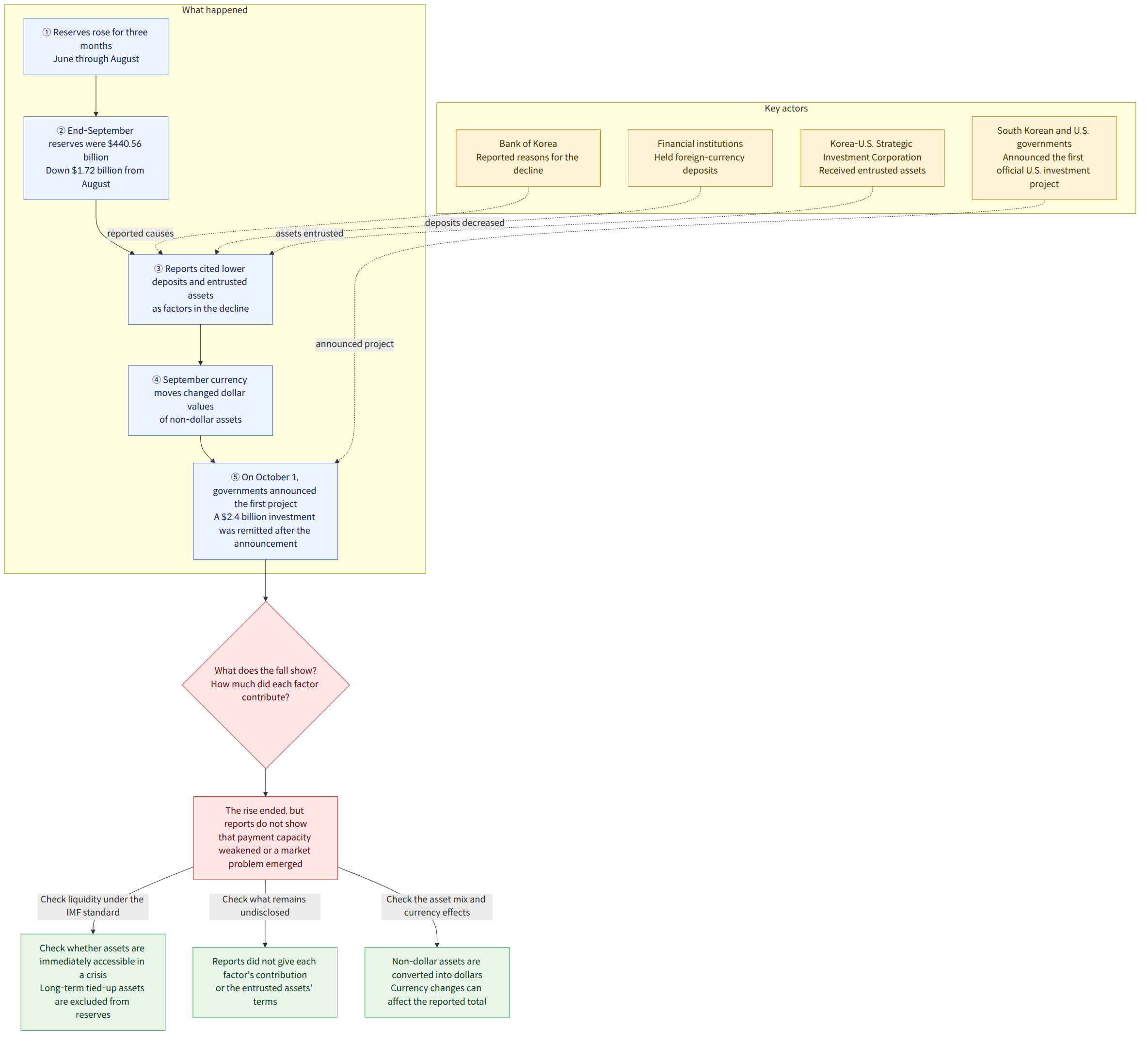
South Korea’s foreign reserves stood at $440.56 billion at the end of September, down $1.72 billion from a month earlier. This ended a three-month streak of increases that had continued from June through August. According to reports, the decline reflected a combination of a decrease in financial institutions’ foreign-currency deposits, assets being entrusted to the Korea-U.S. Strategic Investment Corporation (한미전략투자공사), and a decrease in the dollar-converted value of foreign-currency assets held in other currencies.
Background and context
Foreign reserves are foreign-currency assets held to meet overseas payments and other needs. To interpret this decline, it is important to consider not only the change in the total but also the forms in which the assets are held and how changes in currency values affect their dollar-denominated valuation.
Reports said the Bank of Korea (한국은행) cited a decline in financial institutions’ foreign-currency deposits and assets entrusted to the Korea-U.S. Strategic Investment Corporation as reasons for the decrease. The Korea-U.S. Strategic Investment Corporation is a public institution established in June this year to execute and manage investments in strategic industries in the United States. The governments of South Korea and the United States formally announced on October 1 that construction of the Encinal combined-cycle gas-fired power plant in Texas would be the first official U.S. investment project. Reports said the first investment of $2.4 billion was remitted immediately after the announcement.
The conversion effect on foreign-currency assets is another factor. According to reports, during September the euro depreciated 2.1% against the U.S. dollar, the pound sterling depreciated 2.3%, and the Australian dollar depreciated 2.4%, while the Japanese yen appreciated 1.8%. Since assets held in currencies other than the dollar are converted into dollars for reporting, changes in the value of those currencies can affect the total. However, the reports did not break down how much each factor contributed to the decrease.
What this news means
Foreign reserves are one indicator of a country’s capacity to meet external payments. The end of an upward trend is therefore a development worth noting when assessing foreign-exchange market conditions. However, the reports did not provide grounds to conclude that a one-month decline means the country’s capacity to make external payments has weakened or that a problem has emerged in the foreign-exchange market. The factors cited included asset entrustments, changes in deposits, and currency-conversion effects.
One point to pay particular attention to in these figures is that the “total” value of foreign reserves and actual immediately available liquidity—the extent to which assets can be quickly converted into cash or used for payments when needed—are not the same thing. The reports explained that, under the International Monetary Fund (IMF; 국제통화기금) standard, the key criterion is whether assets can be accessed immediately in a crisis, and assets tied up for a long period are excluded from foreign-reserve statistics. Therefore, the fact that assets have been entrusted to an investment institution does not by itself mean they have disappeared, but whether those assets remain included in foreign-reserve statistics must be considered separately.
For example, readers seeing news that the total value of foreign reserves has fallen can look beyond the amount of the decrease and also examine what the change means for the actual capacity to make foreign-currency payments, as well as changes in the composition of the assets. The reports do not provide enough information to determine the precise contribution of each factor or the specific terms of the entrusted assets, so it is difficult to draw broader conclusions.
Related policy and support information
The key point of the IMF standard described in the reports is liquidity that can be used immediately in a crisis. According to the reports, assets entrusted in a form that ties them up for a long period, as with the Korea-U.S. Strategic Investment Corporation, are excluded from foreign-reserve statistics. This was explained as being the same approach used when some foreign reserves were entrusted to the Korea Investment Corporation (KIC; 한국투자공사).
However, the Bank of Korea did not disclose the amount of assets entrusted to the Korea-U.S. Strategic Investment Corporation, the investment period, or the agreed return. Reports said that the amount and schedule for any additional entrustments had also not been determined. In understanding this decline, it is therefore important to note that, while assets were entrusted, the undisclosed terms make it impossible to fully connect the change in the total with the details of how the assets are being managed.
By asset type, securities accounted for $386.03 billion (87.6%), deposits for $29.95 billion (6.8%), Special Drawing Rights (SDRs; reserve assets allocated to member countries by the International Monetary Fund) for $15.48 billion (3.5%), gold for $4.79 billion (1.1%), and the reserve position in the International Monetary Fund (a claim on the International Monetary Fund) for $4.3 billion (1.0%). Compared with the previous month, securities fell by $1.05 billion, deposits by $350 million, SDRs by $290 million, and the reserve position in the International Monetary Fund by $40 million. Gold remained at $4.79 billion because it is valued at its purchase price.
Reports said that in August the Bank of Korea announced plans to resume buying gold by purchasing physical gold from domestic producers for export, but that no additional purchases had been made since then. This illustrates the need to distinguish between how gold holdings are valued and whether actual purchases have taken place.
What is confirmed and what remains unknown
Confirmed facts
- Foreign reserves stood at $440.56 billion at the end of September, down $1.72 billion from the previous month.
- After rising for three consecutive months from June through August, reserves declined in September.
- The reasons cited for the decrease were a decline in financial institutions’ foreign-currency deposits, assets entrusted to the Korea-U.S. Strategic Investment Corporation, and a decrease in the dollar-converted value of assets held in other currencies.
- Securities accounted for $386.03 billion, or 87.6%, of foreign reserves.
What remains unknown
- The reports did not state how much each of the asset entrustment, the decline in foreign-currency deposits, and changes in converted values contributed to the decrease.
- The amount and investment period of the assets entrusted to the Korea-U.S. Strategic Investment Corporation, as well as the agreed return, have not been disclosed.
- Reports said that the amount and schedule for additional entrustments had not been determined; this material does not establish whether any were subsequently carried out.
What readers should check
- In the next foreign-reserves release, looking at changes by asset type and how the reasons for the decline have shifted, as well as the total, can help determine whether a one-month change is part of a continuing trend.
- In reports on strategic investment in the United States, readers should distinguish whether the amount, period, and return terms for entrusted assets have newly been disclosed from whether a schedule for additional entrustments has been finalized.
- When reading about a decline in foreign reserves, it is important to distinguish dollar-conversion effects from actual changes in asset entrustments and deposits, and not to assume how much each factor contributed when the reports do not specify it.
References
- Other coverage consulted: hani.co.kr