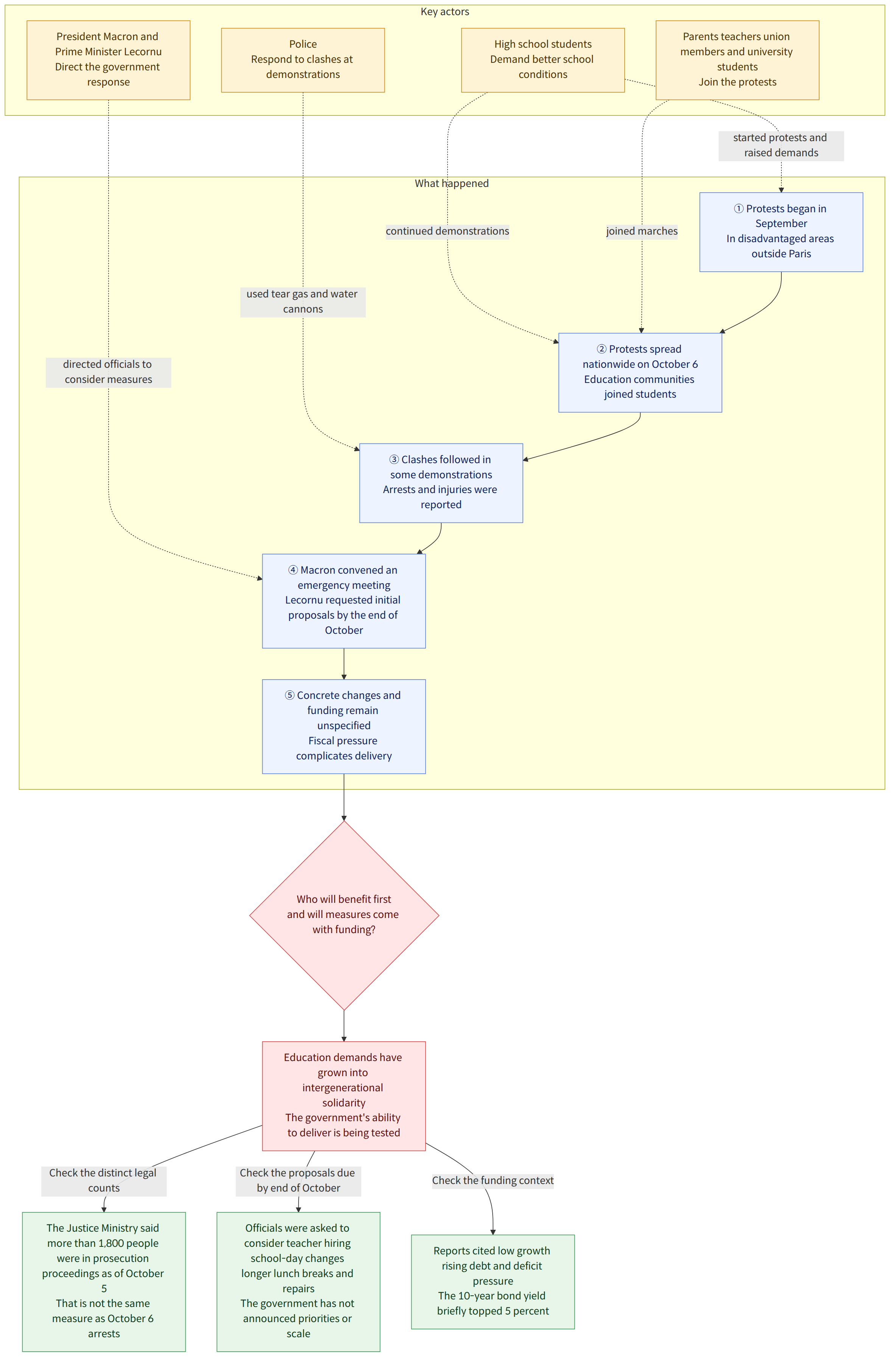
Protests by French high school students demanding improvements to school conditions spread nationwide, with demonstrations held on October 6, 2026, in Paris and elsewhere. Parents, teachers, union members and university students also joined the marches. The government estimated that 256,000 people took part nationwide and 56,000 in Paris, while major unions said turnout across the country exceeded 450,000.
The central demands are to address teacher shortages and overcrowded classrooms and improve aging school buildings. The government has agreed to consider school repairs and hiring more teachers, among other steps, but it has not yet said what will change or on what scale, or how it will fund the measures. As demands from the education community have grown into intergenerational solidarity, the government’s ability to deliver is also being put to the test.
Background and context
The protests began in September in disadvantaged areas on the outskirts of Paris and spread nationwide. Students have raised concerns about aging school facilities and maintenance problems; reports have also mentioned leaks and rat infestations. In Paris, thousands of students and supporters marched about 3.5 kilometers from Place de la République to Place de la Nation.
The protests in Paris and Lyon were largely peaceful, but police used tear gas and water cannons as they sought to separate violent protesters from the rest of the march. The Paris Police Prefecture said about 300 protesters wearing masks or hoods confronted law enforcement and clashed with officers. Demonstrations were also held in Marseille, Nantes and Toulouse.
Figures related to the clashes differ by source and the groups counted. The Interior Ministry said 488 people were arrested and 48 law enforcement personnel were injured on October 6. Prime Minister Lecornu said at least 215 young people and 85 school staff were injured, while the prime minister’s office said more than 700 police officers were also injured. Media reports do not establish the scope of each count or whether the figures overlap.
The high school students’ union said more than half of all high schools in France had been blockaded or closed, and some regional education authorities sought to move classes online. The Justice Ministry said that, as of October 5, more than 1,800 people—including 1,483 minors—were undergoing prosecution proceedings on various charges. Because this figure is from a different date and concerns a different stage of the process than the number of arrests on the day of the protests, it cannot be taken to refer to the same people.
What this news means
The protests are notable because concerns about students’ school lives have moved beyond students’ own demands and grown into shared demands among people connected to education, including parents and teachers. Students have focused on teacher shortages, overcrowded classrooms, aging buildings and maintenance. U.S. President Donald Trump linked the protests to France’s immigration policy and issues surrounding Islam, but the students’ reported demands have focused instead on education staffing and funding.
President Macron convened an emergency meeting with Prime Minister Lecornu and key ministers. The prime minister ordered officials to consider hiring more teachers, reviewing the school day, which runs from 8 a.m. to 6 p.m., extending lunch breaks, and repairing aging school buildings. He asked the relevant ministers to submit initial proposals by the end of October.
However, the financial capacity to implement improvements is a challenge. According to reports, the yield on French 10-year government bonds briefly topped 5% last week, reaching its highest level in 24 years. The article also highlighted low growth, rising debt and pressure to reduce the budget deficit. The proposals due at the end of October could therefore be key to gauging the policy’s effectiveness: which demands from schools they address first and whether they come with actual funding.
For example, if a school in a particular area is dealing with both deteriorating facilities and a teacher shortage, a facilities repair plan alone may not sufficiently improve students’ learning conditions. Conversely, hiring more teachers may have a limited impact if overcrowded classrooms and building maintenance problems remain. This is an analysis based on hypothetical scenarios; the government’s actual priorities have not yet been announced.
Relevant legal and support information
The arrests and prosecution proceedings discussed here took place in France. The following legal information is from an internal resource, a Korean legal guide (한국 법률 안내), and does not explain the procedures or rights that apply to participants in the French protests. It is important to distinguish between the two countries and not assume that their laws and procedures are the same.
The Korean legal guide explains that, during an investigation, a detained suspect may request a review of the legality of their detention, while a defendant who has been charged may apply for bail. In addition to the suspect, people specified by law—including a legal representative, spouse, lineal relatives and siblings—may request a review of the legality of detention. Bail may be requested by the defendant and other legally authorized applicants, including a defense attorney or family members. The court decides whether to release someone and under what conditions based on the circumstances of each case. If bail conditions are not met, bail may be revoked or the bond forfeited.
Under South Korea’s Juvenile Act (소년법), a juvenile is a person under 19, and protective dispositions by the juvenile division are distinct from criminal punishment. The types of protective dispositions and whether they apply depend on the case and the circumstances of the person concerned. This information also cannot serve as a basis for determining what procedures apply to minors who took part in the French protests. (Sources used: L1, L2)
What is known and what remains unclear
What is known
- Protests to improve school conditions took place across France on October 6, with parents, teachers, union members, university students and others joining students.
- Estimates of attendance differed: the government put the nationwide figure at 256,000, while major unions said it exceeded 450,000.
- The government is considering hiring more teachers and repairing school buildings, among other measures, and asked the relevant ministers to submit initial proposals by the end of October.
- The Interior Ministry said 488 people were arrested on the day of the protests, while the Justice Ministry said that, as of October 5, more than 1,800 people—including 1,483 minors—were undergoing prosecution proceedings.
What remains unclear
- What specific education improvements and funding will the government propose by the end of October?
- What is the subsequent condition of those injured in the protests and clashes?
- What specific charges were brought against those arrested, and what happened to them afterward?
- What counting criteria were used for the reported injury figures, and to what extent do they overlap?
What readers should look for
- When the proposals are released at the end of October, readers can look at what they say about hiring more teachers, repairing schools, and adjusting class and lunch hours, including the details and timelines for each.
- When citing attendance figures, distinguish between the government’s and unions’ estimates. It is also worth checking who released the injury figures and whom they count, as these may differ.
- In follow-up reports on arrests and prosecution, distinguish between the dates of announcements and the stages of the proceedings. When consulting Korean legal guidance, do not assume that the procedures apply directly to cases in France.