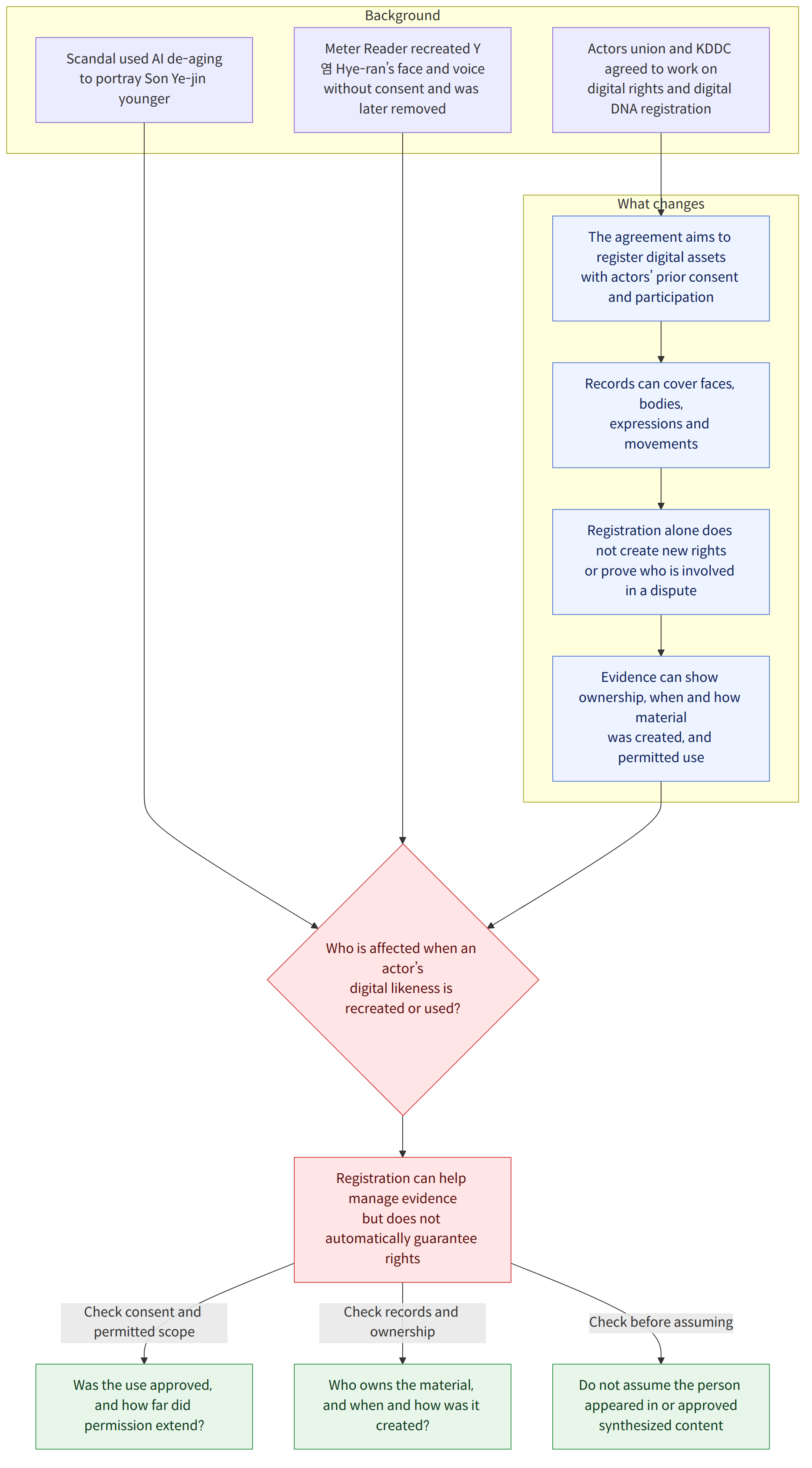
In the Netflix series ‘Scandal,’ artificial intelligence (AI) was used for de-aging—a technology that makes someone appear younger—to portray Lady Cho’s younger years, played by Son Ye-jin. By contrast, the short film ‘Meter Reader’ recreated Y염 Hye-ran’s face, voice and expressions as if she had appeared in it, without obtaining consent from her or her agency; the film was later removed from YouTube. The same technology is being used both to expand the possibilities for performance and to create content without the subject’s consent.
Background and context
Viewers said Son Ye-jin’s appearance in ‘Scandal’ was like seeing her again in the 2003 film ‘The Classic.’ In an interview on the 29th of last month, Son said audiences could become more immersed if she played her teenage and 20s self, and described advances in the technology as groundbreaking and fun. In the 2023 Disney+ series ‘Casino,’ AI was also used to recreate Choi Min-sik’s face in his 30s.
But when the use of faces and voices is separated from consent, the issue changes. Last month, an AI-generated composite image that falsely appeared to show YoonA pregnant circulated online, and her agency, SM Entertainment (에스엠엔터테인먼트), announced that it planned to file a criminal complaint. In August, broadcaster Lee Ji-hye said that fake ads using replicas of her face and voice to sell products were circulating.
A management company representative said that faces are sometimes consumed as a form of play, such as by creating romance dramas that combine actors fans want to see together. The representative added that it is difficult for agencies to find and take legal action against each case individually. This shows that both individuals and their agencies may find it difficult to address the use of their likenesses, whether it is commercial or consumed as a form of play.
What this news means
For actors, AI recreation can offer the opportunity to portray their past selves, but it also brings the risk that their faces, voices and expressions may be used without regard to their wishes. The fact that a technology was used does not, by itself, tell us whether the subject consented or what scope of use they permitted. It is also important for viewers to understand that a synthesized likeness does not mean the person actually appeared in the content or agreed to it.
For example, if you see a scene in which an actor’s past appearance has been recreated using AI, it may be difficult to determine from the production information alone whether it was made with the actor’s participation and consent. Conversely, if you come across a synthesized ad or image, take care not to assume that the person appeared in or approved it.
The issue of actors’ jobs has become a more direct subject of debate with the emergence of AI actors. AI actor Tilly Norwood appears in the comedy film ‘Miss Aligned,’ which Particle6 is producing. In Hollywood, some have said Norwood cannot be recognized as an actor, while others have criticized the technology for taking jobs away from the film industry. In an interview with CNN last month, Norwood said she was not an enemy of humans. However, according to the article, she is still too inexperienced to replace human actors, including because she cannot properly carry out directions for improvised acting. A single current example cannot establish the extent of AI actors’ impact on performers’ jobs.
Related policies and support information
On the 10th of last month, the Korean Broadcasting Actors Union (한국방송연기자노동조합) signed a memorandum of understanding with the Korea Digital DNA Center (한국디지털디엔에이센터, KDDC) on protecting digital rights and registering digital DNA. The agreement aims to establish a system for creating and managing digital assets that records actors’ distinctive characteristics—including their faces, bodies, expressions and movements—with their prior consent and participation.
A union representative explained that registration alone does not automatically create new legal rights or automatically establish that someone is the person involved in a dispute. Instead, the representative said that evidence identifying who owns the material, when and how it was created, and the extent to which the subject permitted its use is important in a dispute. Registration can therefore be understood not as an automatic guarantee of rights, but as an effort to manage records that can help establish how and under what circumstances material was created and used.
The announcement of plans to file a criminal complaint does not mean that a complaint was actually filed or that an investigation or other action took place. The complaint process and the effect of withdrawing a complaint can vary depending on the applicable law and the specific facts of a case.
A union representative said that most performers, with a few exceptions, have little bargaining power in contracts with production companies or casting directors. The union is discussing protections for performers related to AI in recent negotiations. However, no details were provided on what specific protections have been agreed upon or how digital DNA records would be used in an actual dispute.
What is confirmed and what remains unknown
Confirmed
- ‘Scandal’ and ‘Casino’ used AI de-aging to recreate the younger appearances of Son Ye-jin and Choi Min-sik, respectively.
- ‘Meter Reader’ recreated Y염 Hye-ran’s face, voice and expressions without the consent of her or her agency, and was later removed from YouTube.
- The cases of a composite image of YoonA and a fake ad featuring Lee Ji-hye were reported, and YoonA’s agency announced plans to file a criminal complaint.
- The Korean Broadcasting Actors Union and KDDC signed a memorandum of understanding to establish a system for registering and managing digital DNA based on actors’ prior consent and participation.
What remains unknown
- What specific standards will define the scope of consent and compensation when actors’ faces, voices and movements are used in AI content?
- How might digital DNA registration records be used in an actual dispute?
- How significantly will the use of AI actors affect performers’ jobs?
What readers can check
- If you encounter an actor’s likeness recreated using AI, you can check the description of the work or post to see whether the actor’s participation and consent have been confirmed. It is best not to assume that the actor approved an unverified composite image or ad.
- Actors and their representatives may need to keep records that establish the scope of permission to use the material, who owns the records, and when and how they were created. The digital DNA registration described by the union representative is an effort to establish such a record-keeping system, but it does not automatically guarantee rights.
- If you are considering filing a complaint over unauthorized use, check that the process for filing a complaint and the effect of withdrawing it may vary from case to case. The L1 Guide explains procedures for filing a complaint in writing or orally, but each actual case requires separate verification based on the laws in effect at the time and the specific facts.