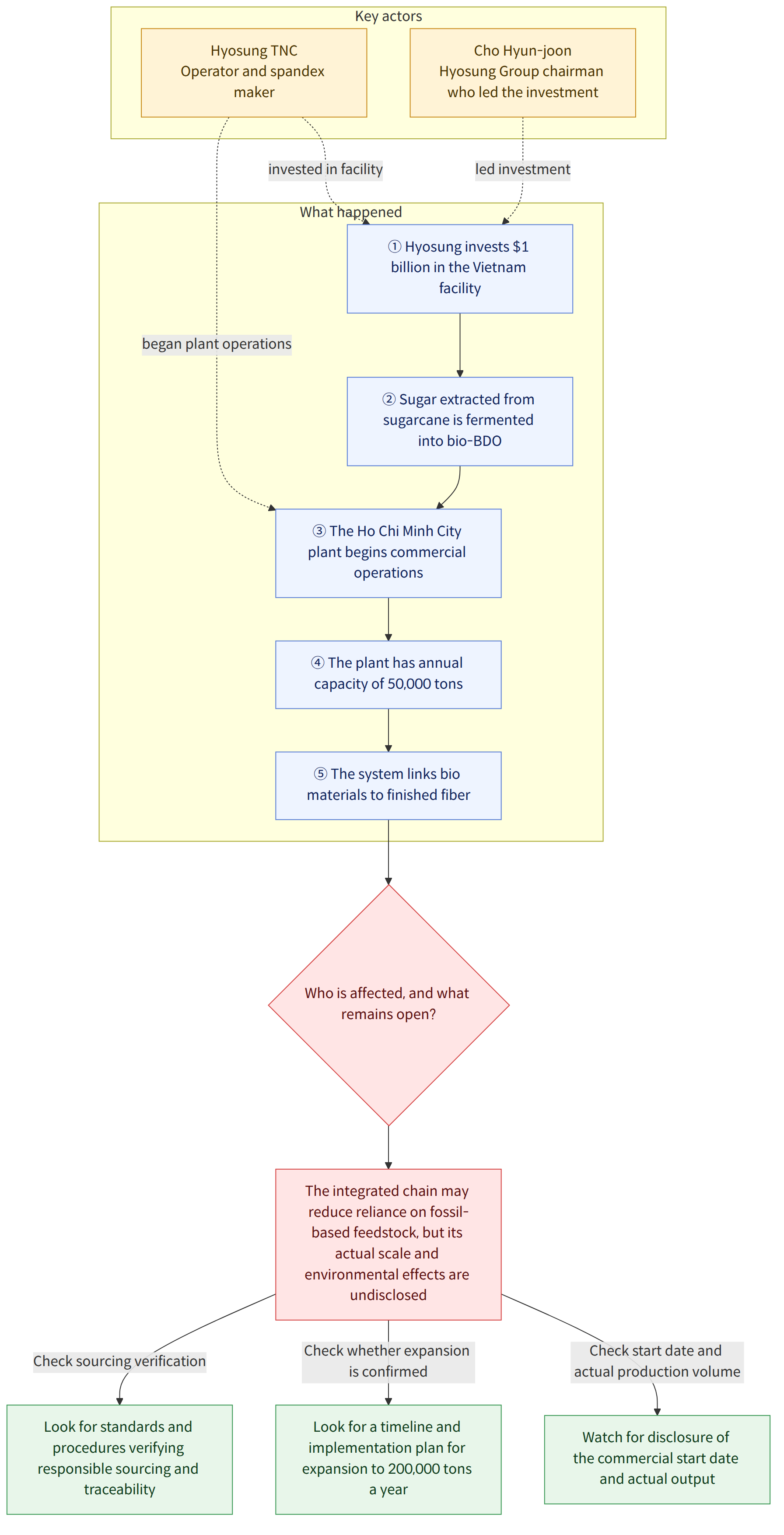
Hyosung TNC has started operating an integrated production system in Vietnam that connects sugarcane-based bio materials to finished fiber. The company said it recently began commercial operations at its bio-butanediol (BDO, a feedstock used to produce spandex) plant in Ho Chi Minh City. The plant has an annual production capacity of 50,000 tons, and the total investment was $1 billion.
Background and context
BDO is a feedstock used to produce spandex and has traditionally been made using petrochemical resources such as coal. This bio-BDO is produced by fermenting sugar extracted from sugarcane. The key point of the project is therefore that the source of the feedstock shifts from fossil fuels to sugarcane-derived materials.
According to the article, Hyosung TNC is the world’s largest spandex manufacturer by market share. The investment was led by Hyosung Group Chairman Cho Hyun-joon, and the company has said its goals are to reduce its reliance on fossil-fuel-based feedstock and bring the supply chain in-house, from raw materials to finished products. Bringing the supply chain in-house means that the company connects and manages multiple stages of production.
What this news means
The production system in Vietnam can be seen as an effort by Hyosung TNC to change how it sources spandex feedstock and expand its sustainable fiber business. Using sugarcane-derived BDO as a feedstock could reduce reliance on conventional petrochemical-based BDO. However, the information made public describes the production system and investment goals, but does not quantify the actual scale of the feedstock shift or its environmental effects.
The system is drawing attention because connecting the process from raw materials to fiber products makes it possible to manage feedstock supply and downstream production together. On the other hand, the company has said only that the decision to increase production capacity will depend on market growth. The fact that the facility could be expanded to 200,000 tons a year should be distinguished from a confirmed plan to actually expand it.
For example, if a company sourcing fiber products wants to verify whether bio-based feedstock is being used, this production system could provide a starting point for examining the feedstock sourcing route. However, the evidence currently available does not specify how responsible sourcing and traceability of the feedstock will be verified.
Confirmed facts and what remains unknown
Confirmed facts
- Hyosung TNC has started operating an integrated production system in Vietnam that connects sugarcane-based bio materials to finished fiber.
- The bio-BDO plant in Ho Chi Minh City recently began commercial operations and has an annual production capacity of 50,000 tons.
- A total of $1 billion was invested in the facility, and its annual production capacity could be expanded to 200,000 tons as the market grows.
- Bio-BDO is made by fermenting sugar extracted from sugarcane, and BDO is a feedstock used to produce spandex.
What remains unknown
- The information made public does not give the exact date when commercial operations at the plant began.
- No timeline or detailed plan has been provided for increasing annual production capacity to 200,000 tons.
- Specific procedures for verifying responsible sourcing and traceability of the feedstock have not been confirmed.
- The scale of bio-BDO supply actually accounted for by this production system and its resulting environmental effects have not been disclosed.
What readers should watch for
- It is worth checking whether the plant’s commercial start date and actual production volume are disclosed in the future.
- Readers can look to distinguish whether an expansion to 200,000 tons is only under consideration or whether a specific timeline and implementation plan have been established.
- Further disclosures should be checked for the standards and procedures used to verify responsible sourcing and traceability of bio-based feedstock.