Google puts an AI chip to the test in orbit
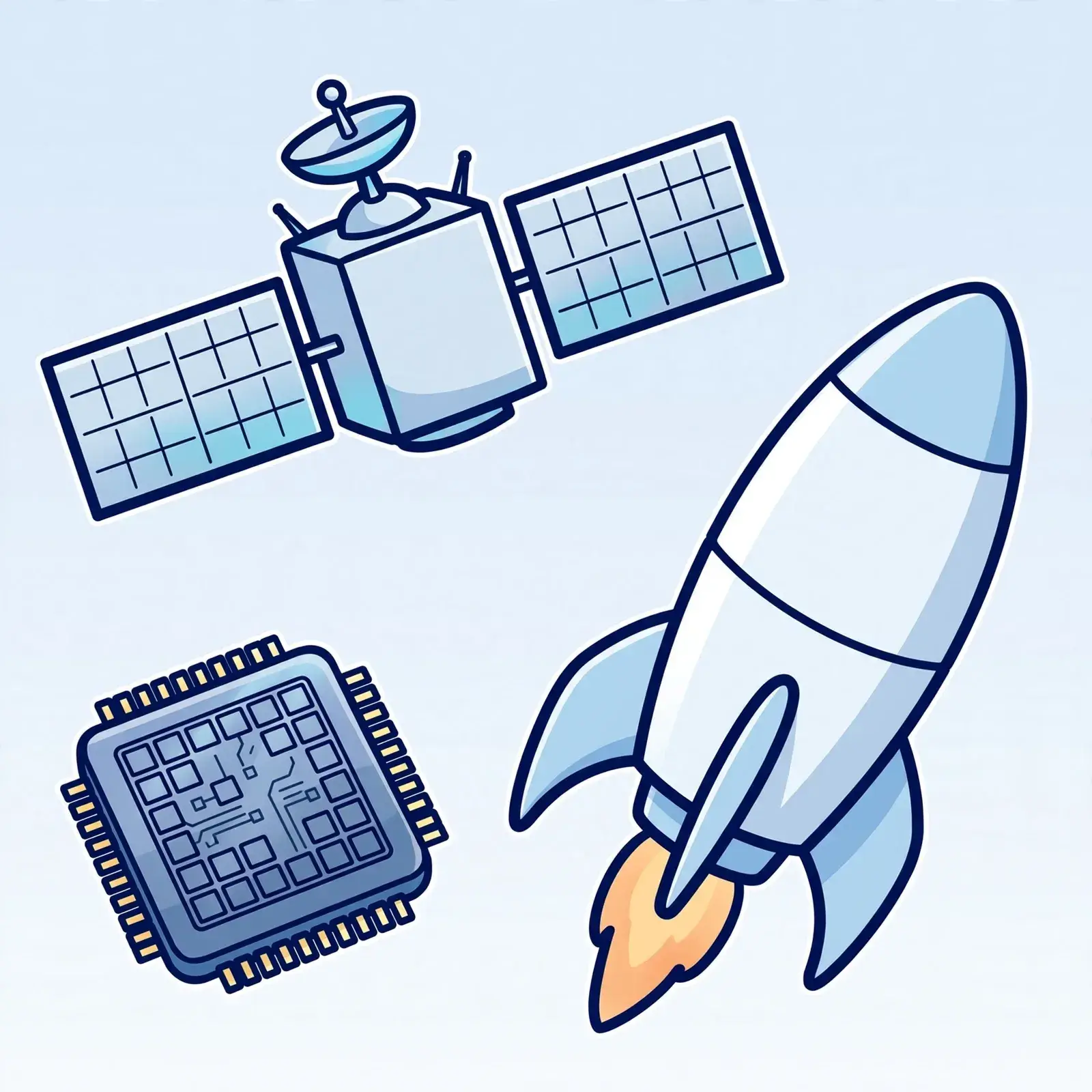
Google has launched a prototype computing satellite carrying one of its Tensor Processing Units, or TPUs, marking the first time the company has sent one of its advanced chips into space. Built by Planet Labs, the satellite is designed to test whether the chip can operate in the demanding conditions of orbit—not to provide a full-scale data center yet.
The experiment must show that the spacecraft can supply roughly one kilowatt of continuous power, keep the chip within a safe temperature range, and run computing tasks without serious failures. A kilowatt is about the power used by several common household appliances running at once, so providing it steadily on a compact satellite is a significant engineering challenge.
“There’s no test that’s completely as good as the real thing,” said Travis Beals, the Google executive leading Project Suncatcher.
What the satellite is checking
A Tensor Processing Unit is a specialized chip designed to speed up artificial intelligence calculations. It competes with graphics processing units, or GPUs (chips widely used to train and run AI systems), and is intended to handle the large number of mathematical operations involved in machine learning.
The prototype will run its TPU in 15-minute bursts after it is commissioned. Short operating sessions will help Google observe how the chip behaves without placing too much strain on the satellite’s power and temperature-control systems.
- Power: Can the satellite provide enough electricity while other spacecraft systems remain operational?
- Heat: Can it move heat away from a chip that is working hard? In space, there is no surrounding air to carry heat away as there is inside a laptop or a conventional server room.
- Reliability: Do the chip and satellite continue to function as expected while exposed to radiation and the other stresses of orbit?
- Computing performance: Can the chip run AI workloads consistently, rather than merely survive in space?
From one satellite to a network of 81
The current spacecraft uses a standard satellite platform. Google and Planet Labs are also working on a more specialized demonstration planned for the following year, with two satellites built more specifically for advanced computing. The pair is expected to test whether separate spacecraft can coordinate their work using a laser communication link.
Laser links send information as beams of light rather than relying only on conventional radio signals. They could help satellites exchange large amounts of data, but coordinating computers spread across spacecraft is more demanding than simply sending a file from one satellite to another.
Why communication speed matters
Google’s longer-term concept, Project Suncatcher, envisions 81 satellites flying in close formation and processing computing tasks in parallel. Parallel processing means splitting a large job into smaller pieces that multiple computers handle at the same time—much like a group of people dividing up a complicated project.
That approach only works well if the computers can share information quickly and reliably. If one part of a job must wait too long for results from another satellite, the network may lose some of the benefit of having many chips working together.
“The bandwidth and the latency between TPUs really, really matters when you’re trying to run a multi-rack workload,” Beals said.
Bandwidth is the amount of data a connection can carry, while latency is the delay before information arrives. Both can shape whether a cluster of computers can behave like one coordinated system. Google says it is designing for workloads that may exist in five years, not just the AI tasks companies run today.
The launch-cost challenge behind the vision
A central question is whether it will become affordable to send enough equipment into orbit. Google’s research examines how launch prices might fall as rockets fly more often and operators gain experience. The analysis is not presented as a full economic feasibility study, but it lays out the scale of launch activity that could be needed to make orbital computing cheaper.
Google’s paper points to a roughly 20% annual “learning curve” in launch costs since SpaceX began flying its Falcon 1 rocket. A learning curve describes how repeated production and operation can reduce costs over time—for example, a factory may become more efficient as workers build the same product again and again.
The paper suggests that launch prices could approach $200 per kilogram by 2035 if a similar cost-reduction trend continues. That price would matter because satellites, computing hardware, power systems, and other equipment all have to be transported from Earth before an orbital data center can begin operating.
Why the estimate reaches about 1,800 flights
Using the amount of cargo launched by Falcon 9 as a reference, Google’s analysis estimates that a comparable downward cost trend could require Starship to carry a total of about 370,000 metric tons into orbit. If each flight carried 200 metric tons, that would mean roughly 1,800 launches over ten years, or about 180 per year.
This is an estimate tied to the paper’s assumptions, not a fixed launch schedule for Google’s satellite project. The actual number would depend on how much cargo Starship can carry per flight, how frequently it flies, and whether the assumed decline in launch costs materializes.
- At the assumed payload: 200 metric tons per flight would make the required total equivalent to about 1,850 full-capacity flights; the paper describes the scale as roughly 1,800.
- At the assumed pace: 180 launches a year would be needed on average for a decade.
- At the target price: The analysis looks toward launch costs near $200 per kilogram by 2035.
Starship has a long way to go
The required pace would be a dramatic change for Starship. At the time of the report, the rocket had not flown more than five times in a single year. Reaching an average of 180 flights annually would require a far higher flight rate, dependable operations, and the ability to transport large payloads repeatedly.
SpaceX has described ambitions for much more frequent Starship flights. Elon Musk has suggested that the vehicle could eventually fly as often as once an hour in 2029. That is a forward-looking claim, however, rather than a demonstrated operating rate, and the gap between a stated target and routine, reliable service remains significant.
Google’s launch-cost projection depends on a scale of Starship operations that has not yet been demonstrated.
The distinction matters because the orbital data center idea is not just a question of whether a chip can function in space. It also depends on whether rockets can deliver large quantities of hardware often and cheaply enough, and whether the satellites can be operated as a coordinated computing network once they arrive.
Radiation may be manageable, but errors still matter
Google’s updated research offers encouraging results on one technical issue: its chips may be able to withstand the radiation environment in orbit. Radiation can disrupt electronic circuits, potentially causing a computer to produce incorrect results or stop working. Spacecraft designers therefore have to consider both how often errors happen and what consequences they would have.
Google repeated tests in a particle accelerator after discovering that the original chip configuration provided more shielding than the version the company expected to use in space. The revised setup experienced slightly more errors in its logic circuitry, but the company remains confident that the chips could handle large inference workloads over a satellite’s planned five-year lifespan.
Inference is the process of using a trained AI model to produce an answer or prediction. For example, when an AI system classifies an image or generates a response to a question, it is performing inference. It differs from training, which is the more intensive process of building a model from large amounts of data.
Beals said the observed error rate was very low for typical inference operations—around one error in a million, by his estimate. But he warned that a rare error could become more consequential in a massive training run involving thousands of chips over several months. The more components a system uses and the longer it runs, the more opportunities there are for small failures to accumulate.
A long-term bet, not an immediate replacement for data centers
Google is not presenting the prototype as a replacement for data centers on Earth. Instead, Project Suncatcher is a long-term effort to test whether future computing infrastructure could be built partly in orbit, where satellites could work together on demanding AI workloads.
The concept faces several connected hurdles: reliable power, managing heat, protecting electronics from radiation, communicating between satellites, and lowering the cost of launch. A successful chip test would address only part of that list. The two-satellite demonstration would provide a further test of cooperation, while a much larger network would require all of these systems to work at scale.
The work is also part of a wider wave of interest in putting AI-related equipment into space. The SpaceX rocket carrying Google’s prototype is launching more than 100 payloads, including projects from Satlyt and Cowboy Space Company. Google’s plan stands out for its emphasis on a long-range infrastructure vision rather than a near-term commercial service.
What to watch next
- The prototype’s first operating results: Whether the TPU can run safely and consistently under real orbital conditions.
- The two-satellite test: Whether laser links can support the fast exchange of data needed for distributed computing.
- Starship’s flight rate and payload capacity: Whether the rocket can move from occasional tests toward the frequent, high-volume operations assumed in Google’s cost analysis.
- Radiation-related errors: Whether low error rates remain acceptable as computing systems grow larger and run for longer periods.
The bottom line
Google has moved its space-computing idea from ground testing to an orbital experiment, but the larger ambition depends on more than a successful chip. Its own analysis describes a future in which launch prices fall substantially—and suggests that achieving the assumed cost trend could require around 1,800 Starship launches in ten years.
That is an enormous operational target for a rocket that has so far flown only a handful of times per year. For now, the satellite is a test of whether the computing hardware can work in space; the launch estimate shows how much more would have to change before orbital data centers could become practical.