Hochul Announces a New Lead for the Investigation
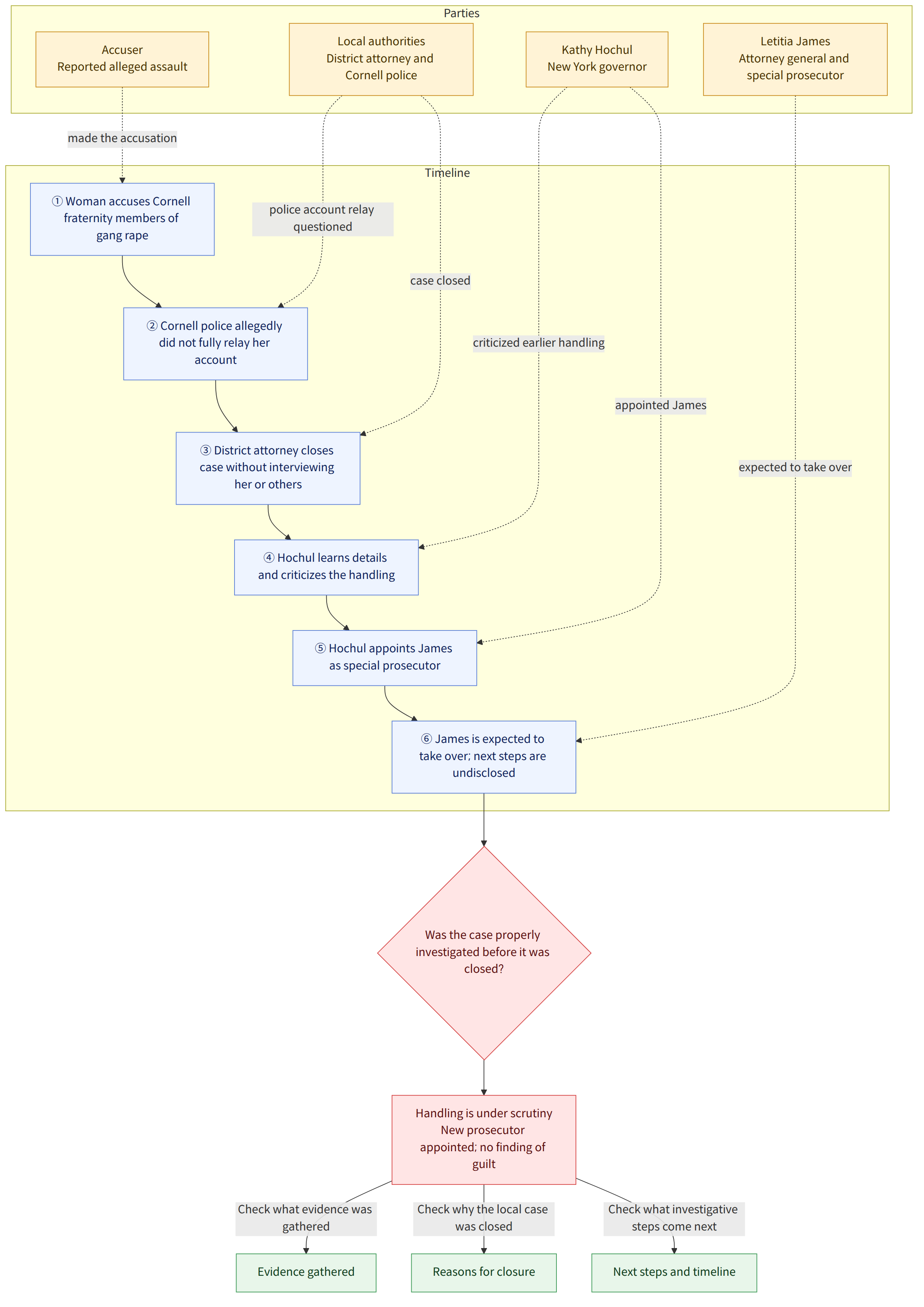
New York Gov. Kathy Hochul said Friday that she had decided to appoint state Attorney General Letitia James as a special prosecutor to take over an investigation into a woman’s allegation that members of a Cornell University fraternity gang-raped her. Hochul said she acted after learning what she called “troubling details” about how authorities had handled the woman’s claims.
A special prosecutor is an official assigned to handle a particular investigation or case instead of the office that would ordinarily oversee it. In this instance, James is expected to take over the investigation from local authorities, although Hochul’s announcement did not provide further details about the inquiry’s timeline or next steps.
Hochul said the woman “was failed by people and institutions with an obligation to protect her,” including campus police and the county prosecutor.
Why the District Attorney’s Handling Is Under Scrutiny
Hochul said the district attorney closed the case without interviewing the woman who made the accusation or anyone else involved in the alleged attack. She also questioned whether prosecutors had requested the full transcript, though the available account does not clarify which transcript she meant.
“In what world does the district attorney not even interview her, or anyone else involved, or even request the full transcript?” Hochul said.
An interview can help investigators understand an account in the person’s own words, ask follow-up questions and identify information that may need to be checked. It is one part of an investigation, not proof by itself that an allegation is true or false. The governor’s criticism centers on the investigative steps she says were not taken before the case was closed.
Questions About Campus Police
Hochul also criticized the Cornell University Police Department, saying it did not fully convey the woman’s account to prosecutors. The information passed between campus police and local prosecutors can shape what investigators know when deciding whether to pursue a case.
The source account ends during Hochul’s remarks about the university police, so it does not provide her complete description of what information was or was not shared. It also does not include a response from Cornell police, the district attorney, or the people accused.
Allegations Remain Allegations
The woman accused members of a Cornell fraternity of gang rape. The available report does not provide details about when the alleged attack took place, how many people were accused, or what evidence investigators reviewed.
The accusation has not been established as fact in the information provided. The decision to assign a special prosecutor is a change in who will handle the investigation; it is not, by itself, a finding that a crime occurred or that any named or unnamed person is guilty.
- What Hochul says: The accuser was not interviewed before the district attorney closed the case, and campus police did not fully relay her account.
- What changes now: Hochul says Attorney General Letitia James will take over as special prosecutor.
- What remains unclear: The evidence gathered, the precise reasons the local case was closed, and the timeline for further investigative steps.
What the New Investigation Could Clarify
James’s office will now have responsibility for reviewing the matter, according to Hochul’s announcement. A fresh review could examine how the original account was documented, what information reached prosecutors, and whether additional interviews or other investigative steps are warranted. The announcement does not confirm which of these steps will be taken.
The case also highlights a broader challenge in reports of sexual assault: investigators must handle allegations carefully, gather relevant information, and avoid treating an accusation as either proven or disproven before reviewing the evidence. For a person reporting an assault, being heard and having the account properly recorded can be a crucial early part of that process.
What to Watch For
The next developments may include statements from James’s office, Cornell police, or the district attorney, as well as information about how the new investigation will proceed. Any conclusions will depend on the evidence and the work of investigators, not solely on the governor’s criticism of the earlier handling.