The 17th Asian Future Forum (아시아미래포럼), hosted by the Hankyoreh Newspaper (한겨레신문사), will be held on October 28, 2026, at the Korea Chamber of Commerce and Industry (대한상공회의소) International Conference Hall under the theme “An Age of Upheaval: The Path to Becoming a Leading Nation.” Professor Kim Yang-hee of Daegu University is scheduled to deliver a keynote address on “An Unstable Global Economic Order and Korea’s Response on Economic Security.” Kim proposed using Korea’s manufacturing capabilities as leverage in cooperation with the United States, while building a policy framework that weighs the benefits and risks of investment in the U.S. and links them to strategic autonomy.
Background and context
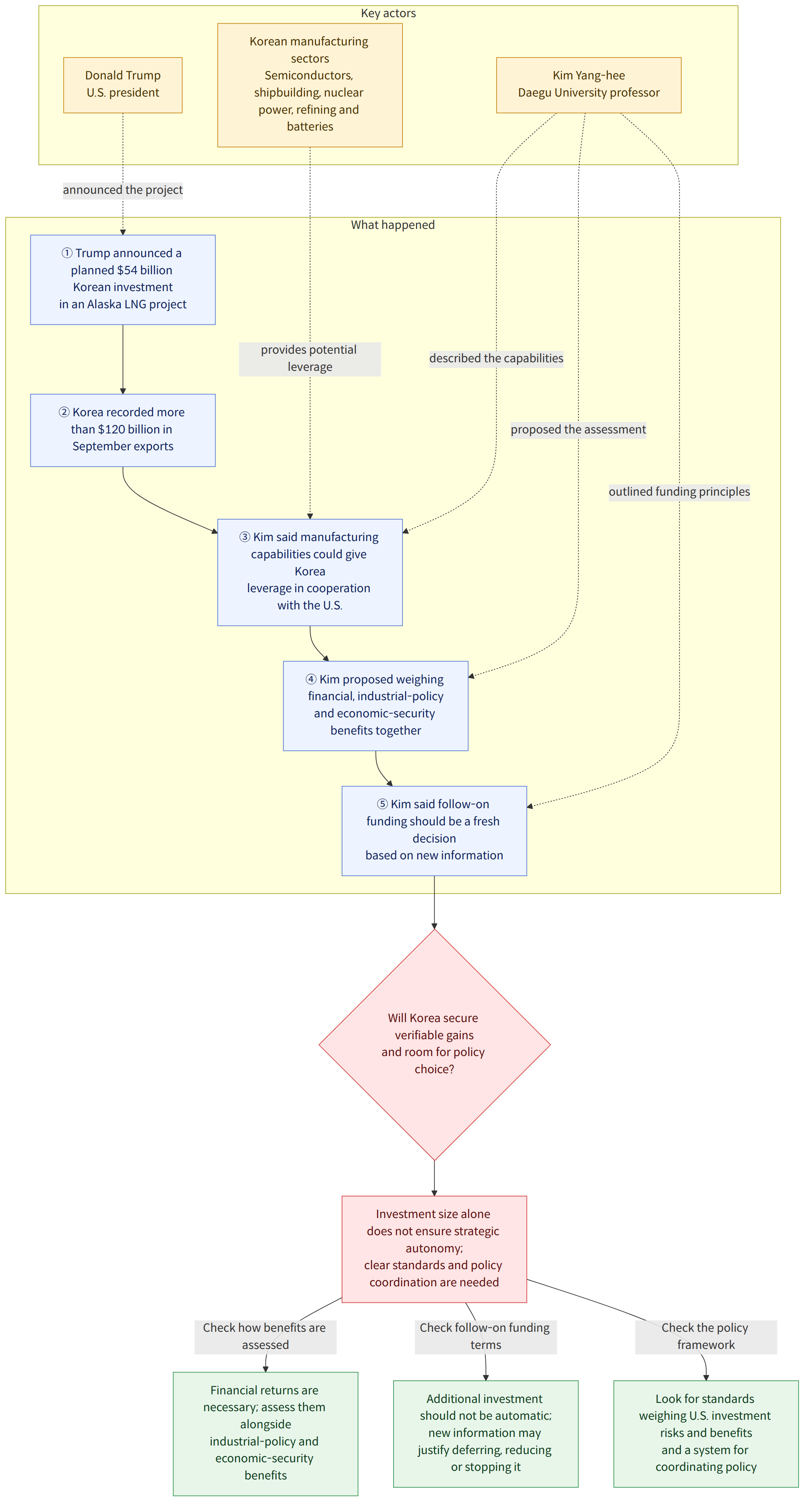
According to the article, U.S. President Donald Trump announced on the 30th of last month that Korea would invest $54 billion in an Alaska liquefied natural gas (LNG, fuel made by cooling natural gas into a liquid) development project. Korea’s exports in September also exceeded $120 billion, a record monthly total. The article forecast that by year’s end, Korea would become the world’s fourth country, after the United States, China and Germany, to reach $1 trillion in annual merchandise exports. This export forecast reflects expectations at the time the article was written; whether it will actually be achieved cannot be determined from the evidence presented here.
Kim said the situation should not be seen simply as Korea having more to give the United States, but as evidence that the capabilities the United States needs from Korea have grown. She explained that Korea’s manufacturing capabilities in semiconductors, shipbuilding, nuclear power generation, refining and batteries could give it leverage within the U.S.-led bloc. But manufacturing capabilities alone do not automatically create bargaining power. Kim argues that a strategy is needed to determine what conditions those capabilities can be exchanged for and how the benefits gained will be verified.
Kim proposed that Korea should aim to become a “strategic nodal country,” performing functions that are difficult to replace within networks of economic, technological and security ties, and turning that position into a source of strategic autonomy. A node is a key point where multiple networks intersect. In other words, the goal is not merely for Korea to play an important role in supply chains or industry, but to turn that role into room for policy choices.
What this news means
The question is not simply whether to invest in the United States. Even when the amount is large, the link between investment and strategic autonomy may remain unclear unless the benefits—such as Korean companies’ participation, stronger industrial capabilities, and access to supply chains, energy or technology—are identified in concrete terms. Conversely, evaluating a project solely on financial returns could overlook its anticipated effects on industrial policy or economic security. Kim said financial benefits (F), industrial-policy benefits (I) and economic-security benefits (ES) should be assessed separately and considered together.
That does not mean financial gains and losses can be set aside. Kim explained that financial benefits should be treated as a necessary condition, while the scope of assessment should be broadened to include industrial-policy and economic-security benefits. If financial benefits are weak but other benefits are emphasized, the risks of an investment could be obscured. For readers, the important questions are not just the total amount announced, but what returns, industrial opportunities and economic-security effects are expected—and whether ways to verify those expectations will also be made public.
The principles for disbursing follow-on funding are also important. Kim stressed that the next transfer should be a new investment decision based on new information, not an automatic extension of an existing commitment. If information about the project’s terms or risks changes, it should be possible to defer, reduce or stop additional investment. This would help prevent money already invested from forcing subsequent decisions. For example, if new information about expected returns or liability terms becomes available before follow-on funding for a project is disbursed, the decision on whether to continue investing should be made by reviewing that information separately from the existing commitment.
This issue is connected not only to the government’s negotiating power but also to who makes decisions, what information they consider and whether the results can later be verified. Kim said there is no overarching strategy to coordinate laws and policies related to supply chains, technology and industry. She proposed appointing a senior presidential secretary for economic security under the chief of staff and establishing an economic-security think tank within the government. These are Kim’s policy proposals; they do not mean that such an office or organization has already been established.
Related laws and support information
The article says Kim referred to the “Three Supply Chain Acts” (공급망 3법) and “Four Technology Acts” (기술 4법), along with industry-specific development laws, as legislation related to economic security. The Three Supply Chain Acts refers to the Special Act on Materials, Parts and Equipment (소재·부품·장비 특별법), the Framework Act on Supply Chains (공급망 기본법) and the Special Act on Resource Security (자원안보 특별법). The Four Technology Acts means the Act on the Promotion of National Strategic Technologies (국가전략기술육성법), the Restriction of Special Taxation Act (조세특례제한법), the Special Act on the National Advanced Strategic Industry (국가첨단전략산업법) and the Industrial Technology Protection Act (산업기술보호법). Kim said that laws had accumulated in response to external shocks, but that there was no overarching strategy to set priorities among laws and policies and coordinate them with one another.
In relation to evaluating investment in the U.S., the article also discusses the “commercial reasonableness” standard in the enforcement decree of a special act. According to the article, this means cash flows sufficient to cover all principal and interest from the total projected income distributed to Korea over the life of a project. Kim argued not that this financial standard should be removed or lowered, but that financial benefits should remain a necessary condition while industrial-policy and economic-security benefits are also measured and assessed.
The verification measures she proposed are to make benefits measurable through indicators and broaden the scope of records made public. She also said that follow-on funding should be deferred or reduced if new information undermines the existing assessment. The article does not establish what indicators the government has actually adopted or whether the specific investment terms and disbursement schedule for the Alaska project have been set.
Confirmed facts and what is not yet known
Confirmed facts
- The 17th Asian Future Forum will be held on October 28, 2026, at the Korea Chamber of Commerce and Industry International Conference Hall.
- Professor Kim Yang-hee is scheduled to deliver a keynote address at the forum on Korea’s response to economic security issues.
- According to the article, President Trump announced that Korea would invest $54 billion in an Alaska LNG development project.
- Kim proposed jointly assessing the financial, industrial-policy and economic-security benefits of investment in the U.S., and making decisions on follow-on funding based on new information.
- Kim proposed establishing a senior secretary for economic security and an economic-security think tank within the government, as well as developing benefit indicators and expanding the release of records.
What is not yet known
- The terms of Korea’s investment in the Alaska LNG project and its specific disbursement schedule have not been provided.
- It is not known what indicators the government will use to assess the three types of benefits from investment in the U.S.
- The evidence provided here does not establish whether the forecast annual merchandise exports of $1 trillion will be achieved.
What readers should check
- When reviewing investment announcements involving the United States, readers should look beyond the total amount and check whether information is available on the scope of Korean companies’ participation, expected returns, and industrial-policy and economic-security benefits.
- They should check whether follow-on funding is an automatic extension of an existing commitment or a separate decision made after reviewing new information and risks.
- Checking whether indicators for verifying investment decisions and rules on the release of records are in place can help gauge whether manufacturing capabilities are actually being translated into bargaining power and strategic autonomy.