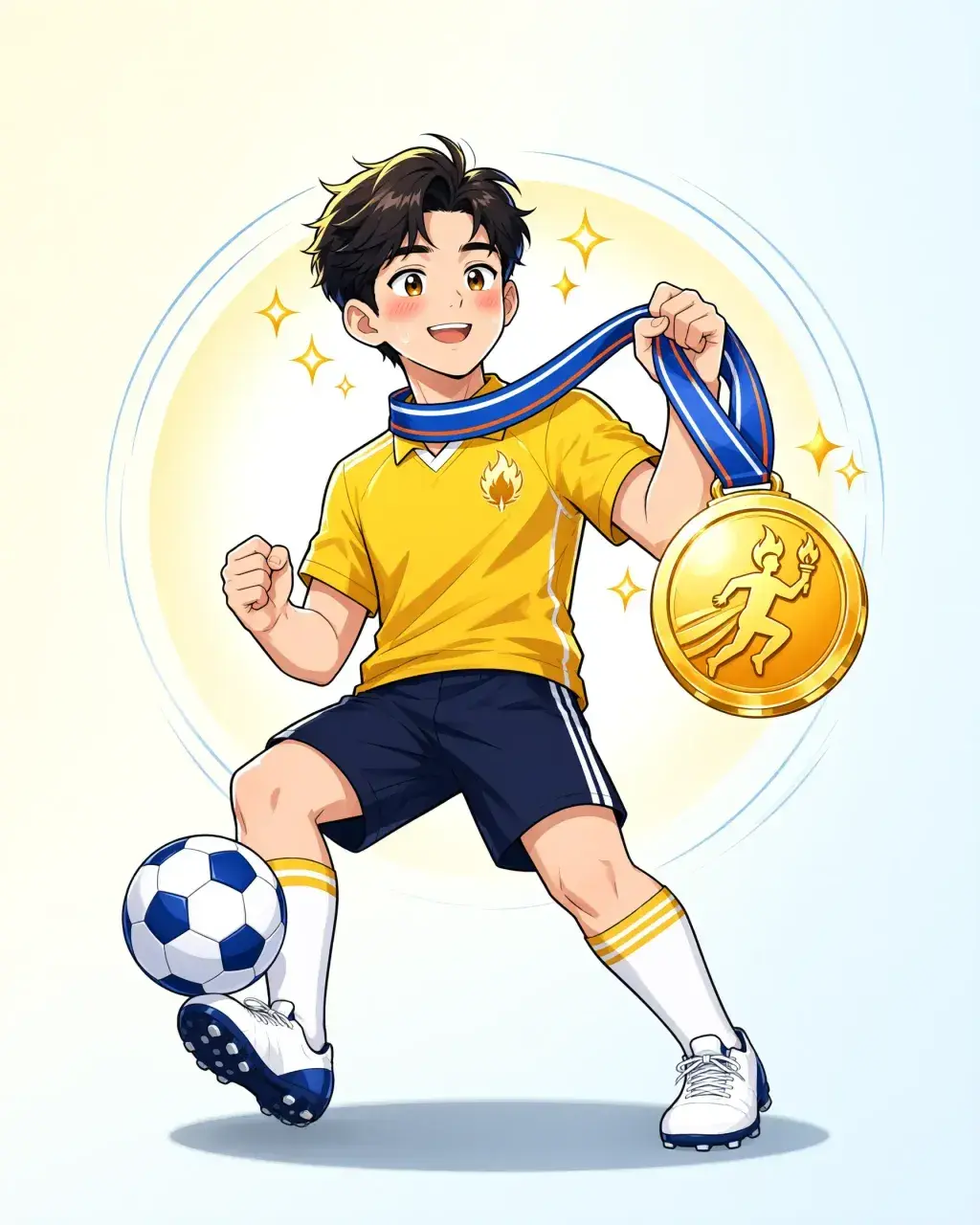
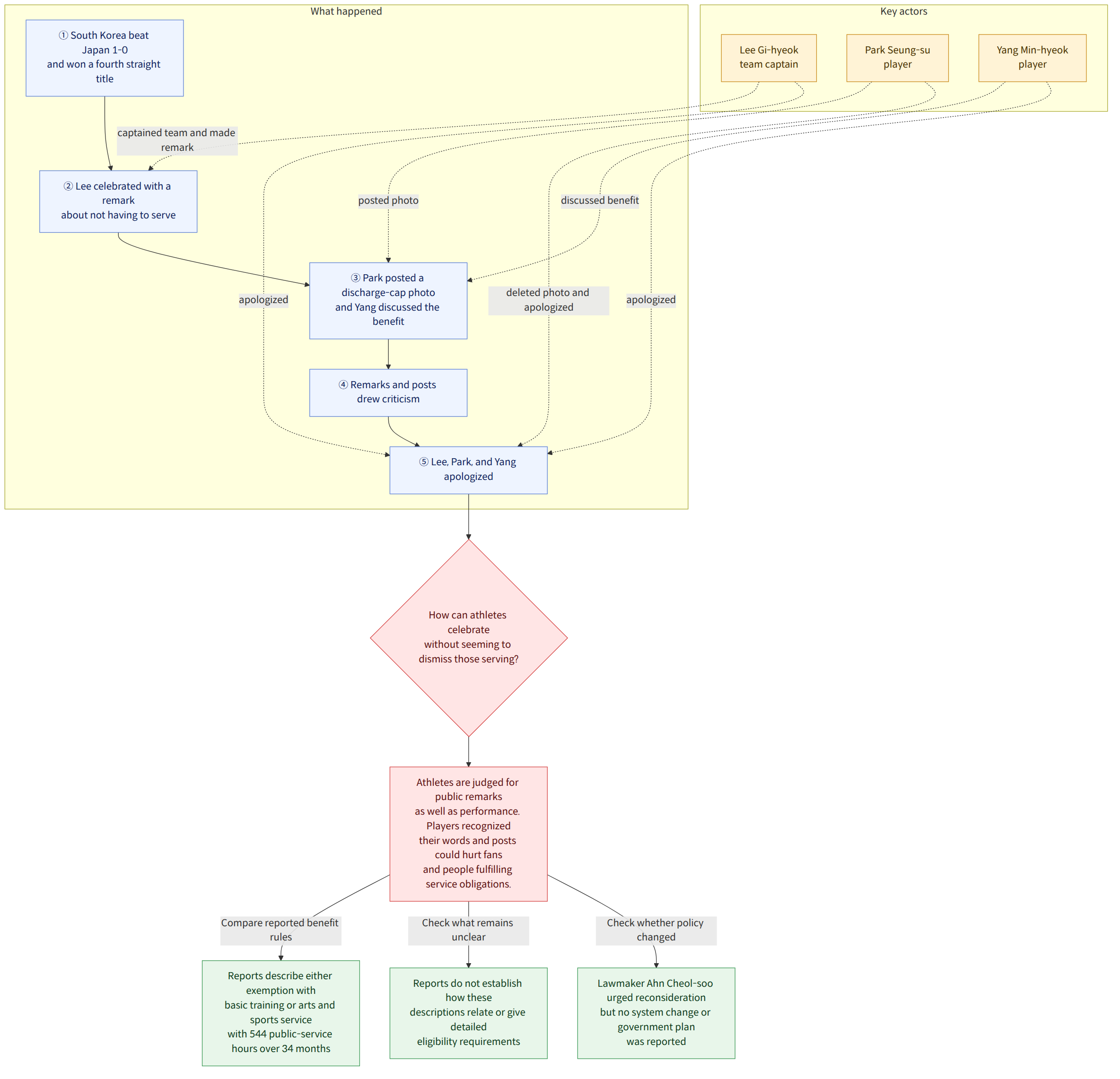
After South Korea’s men’s football team beat Japan 1-0 on Saturday to win the Asian Games title for the fourth consecutive time, captain Lee Gi-hyeok held up his gold medal and said, “I won’t have to serve in the military.” After the remark, which sounded as though he was boasting about the military-service benefit, and social media posts by some players drew criticism, Lee apologized on Sunday. He said that, as captain and a player, he had said and done things after the match that he should not have.
As attention turned to the achievement of winning the title, the controversy shifted to how the players talked about and portrayed the military-service benefit. The incident brought attention not only to debate over the benefit itself, but also to the public responsibility of sports stars toward people fulfilling their military-service obligations and toward fans.
Background and context
The original explains that in South Korea, healthy men generally have to serve in the military for 18 months to two years before turning 28. It also says that Asian Games gold medalists and Olympic medalists receive a military-service exemption, and that those eligible undergo only a few weeks of basic training. The original also notes that the benefit is a sensitive subject and that athletes generally do not discuss it publicly.
Lee is a 26-year-old defender who plays in the domestic K League (K리그). According to domestic reports, immediately after the final he held up his gold medal and said, “I won’t have to serve in the military.” He also reportedly made remarks to the effect that players had often stressed they could soon be enlisted if they failed to win a medal. Even if the words were an expression of the joy of winning, they sparked a backlash because people who feel the weight of military-service obligations could hear them as making light of the benefit or mocking those who serve.
The controversy did not stop with the captain’s remarks. Park Seung-su posted a photo on social media after the match wearing a cap known as a “discharge cap” (전역모), then deleted it and apologized. Yang Min-hyeok also reportedly apologized, saying that his remarks had been misrepresented after he mentioned the military-service benefit as one of the motivations for playing to win.
What this news means
The controversy shows that athletes may be judged by the public not only for their performance on the field, but also for how they talk about that performance. This can be especially important in matters such as military-service benefits, where an individual’s joy intersects with perceptions of social fairness and recognition of the effort made by those who serve. The apologies show that the players recognized that their remarks and posts could hurt fans and people fulfilling their military-service obligations.
For example, even if an athlete achieves a result that comes with a benefit at a major competition, emphasizing the benefit while celebrating could give the impression that the athlete lacks respect for those serving, rather than drawing attention to the achievement itself. This is a hypothetical example and does not mean that everyone interpreted the remarks in the same way.
Ahn Cheol-soo, a lawmaker from the People Power Party (국민의힘), criticized the players’ remarks and actions and argued that the military-service benefit for Asian Games medalists should be reconsidered. This was reported as the position of one politician; it does not mean that the system has changed or that the government has announced plans to revise it. The reported debate reflects public opinion surrounding the benefit, but one controversy alone does not establish that society as a whole shares the same view.
Related systems and support information
Reports differed in their descriptions of how the benefit referred to as a “military-service exemption” is actually carried out. One original report says that Asian Games gold medalists and Olympic medalists receive an exemption and undergo a few weeks of basic training. Domestic reports, by contrast, say that Asian Games gold medalists are assigned as arts and sports personnel (예술·체육요원) instead of serving on active duty, and must complete 544 hours of public service over 34 months.
Therefore, the phrase “I won’t have to serve in the military” should not be taken to mean that all military-service obligations disappear. The reports provided do not establish how the two descriptions relate under the system or what the detailed eligibility requirements are. Readers who need precise information about the benefit should distinguish between the wording used in reports and the actual service obligations.
Points described differently across reports
Reports described the military-service benefit differently. One original report referred to an “exemption” and a few weeks of basic training, while domestic reports said that recipients serve as arts and sports personnel for 34 months, completing 544 hours of public service instead of active-duty service. Rather than merging the two descriptions into a single definitive account, it is accurate to say that the specific scope of the actual obligations cannot be established from the materials provided.
What is confirmed and what remains unknown
What is confirmed
- South Korea beat Japan 1-0 in the Asian Games men’s football final to win the title for the fourth consecutive time.
- After the match, Lee held up his gold medal and made a remark to the effect that he would not have to serve in the military, then apologized.
- Park Seung-su posted a photo wearing a discharge cap, then deleted it and apologized; Yang Min-hyeok also reportedly apologized for related remarks.
- Ahn Cheol-soo criticized the players’ words and actions and argued that the military-service benefit for Asian Games medalists should be reconsidered.
What remains unknown
- The materials provided do not give the full text of Lee’s apology.
- It has not been confirmed whether the Korea Football Association (대한축구협회) or the national team announced any separate action in response to the remarks.
- The detailed requirements and actual scope of the military-service benefit, which reports described differently, cannot be established from these materials alone.
What readers should check
- Distinguish the term “military-service exemption” used in reports from specific obligations, such as service as arts and sports personnel.
- Check whether further details of the players’ apologies or follow-up action by the national team or the association have been announced.
- Distinguish a politician’s call to reconsider the system from an actual announcement that the system is being changed.
References
- Other coverage consulted: hani.co.kr
- Other coverage consulted: chosun.com