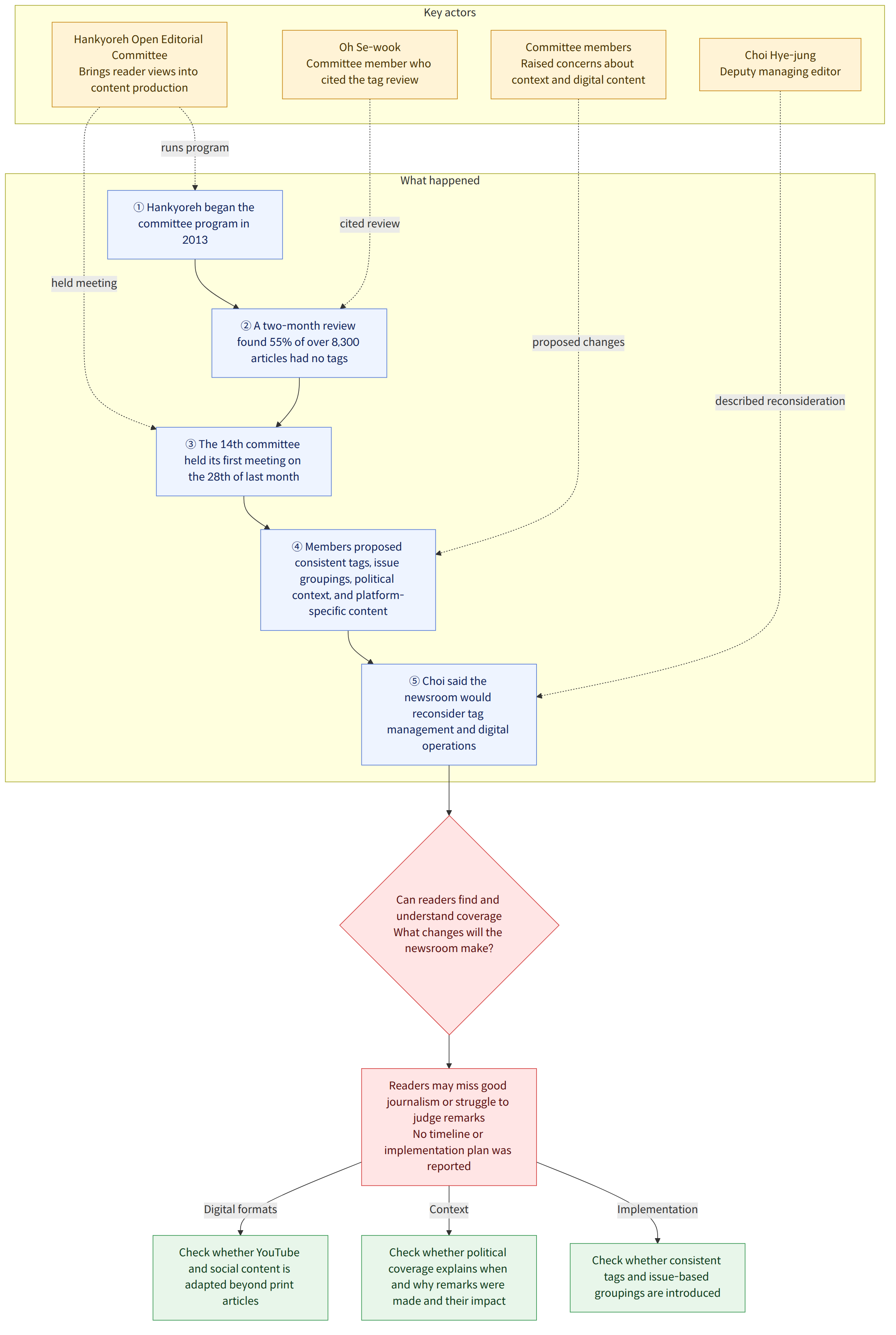
The 14th Hankyoreh Open Editorial Committee (한겨레 열린편집위원회) held its first meeting on the 28th of last month and began its work. At the meeting, members proposed systematically tagging articles and grouping good articles by issue so readers can find them easily. They also said coverage of politicians’ remarks should explain the context in which they were made and their impact, and that content on YouTube and social media should not simply reproduce print articles.
Background and context
The Open Editorial Committee is a program run by Hankyoreh Newspaper Company (한겨레신문사) since 2013 to incorporate a range of readers’ views into content production. Professor Seo Su-min of Sogang University’s Department of Communication and Media Studies has been reappointed as chair and will lead the committee for the next year while also serving as civic editor. The committee has eight members, including its chair.
A prominent concern raised at this meeting was that helping readers find articles and understand their context matters as much as the content of the articles themselves. Committee member Oh Se-wook said that a review of more than 8,300 Hankyoreh articles published over two months found that 55% had no tags. Of 112 articles about the Nepal floods, 53 had no tags, he said, while the rest used two different spellings: “climate crisis” and “climate crisis” (with a space in Korean).
Tags are labels that let readers find related articles grouped by topic. If articles on the same issue are scattered without tags, or the same topic is labeled in different ways, readers may find it difficult to review coverage of that issue all at once. Members said the problem was not a lack of articles, but that good articles already being produced were not easy to find.
The discussion of political coverage focused on the gap between relaying remarks and explaining their context. Oh said there were more than 1,300 political articles in the two-month sample, and about one in four political article headlines followed the format “who did what.” Such headlines may tell readers who said what without explaining how the remarks relate to their lives, he said.
Committee member Ko Eun-ji said coverage of politicians’ remarks should provide sufficient context about when and why they were made. Kwon Seok-cheon stressed the need for the ability to verify context, not just facts. Lee Hee-young said that nearly 99% of content on Hankyoreh’s YouTube channel was political discussion, and noted that audiences may grow tired of coverage that relays statements verbatim in situations of conflict.
What this means
The concerns raised by members show that accurate facts alone do not complete the work of building trust in journalism. Accurately quoting a politician is necessary, but without explaining the background and effects of the remarks, readers may encounter the facts and still find it difficult to judge their meaning. Providing context is therefore not merely a matter of article structure; it is a challenge that can affect readers’ understanding of and trust in coverage.
Accessibility for readers is also part of editing. If related articles are hard to find or investigative coverage does not stand out, readers may miss good content even when it exists. Grouping articles by issue and using consistent tags can help readers follow coverage of a subject, while adapting content for social media and YouTube may create new ways to reach readers beyond the original articles. However, the meeting report does not reveal which approaches the committee will actually choose.
For example, a reader looking for more coverage of the Nepal floods may find it difficult to locate all the related articles at once if some have no tags or the same topic is labeled in two different ways. This is a hypothetical example intended to illustrate the article-classification problem raised by the members.
Members proposed grouping good articles by issue, making them easier to find with tags, and producing content suited to social media and YouTube. Choi Hye-jung, deputy managing editor of the newsroom, said Hankyoreh would reconsider its tag management and digital operations strategy. However, the meeting report gave no timeline or specific implementation plan for when or how improvements would be made.
What is known and what remains unclear
Confirmed facts
- The 14th Open Editorial Committee held its first meeting on the 28th of last month, and Professor Seo Su-min was reappointed as chair to lead the committee for one year.
- The Open Editorial Committee has been operating since 2013 to incorporate readers’ views into content production, and has eight members, including its chair.
- Committee member Oh Se-wook said that 55% of more than 8,300 articles published over two months had no tags.
- Members proposed improving article tags and issue-based groupings, explaining the context behind politicians’ remarks, and adapting digital content.
- Choi Hye-jung, deputy managing editor of the newsroom, said Hankyoreh would reconsider its tag management and digital operations strategy.
What remains unclear
- It has not been confirmed when or how the tag system and issue-based article groupings will be improved.
- It is not known how Hankyoreh will actually change the way it presents content on YouTube and social media.
- The meeting report does not say when the Open Editorial Committee will next review whether improvements have been made.
What readers can look for
- When searching for articles on the same topic, readers can check whether tags and issue-based groupings connect them consistently.
- In articles about politicians’ remarks, readers can check whether the background to the remarks and the perspectives of people affected are explained alongside them.
- Readers can watch for Hankyoreh to provide details about its tag management and digital operations strategy or publish the results of a follow-up review.