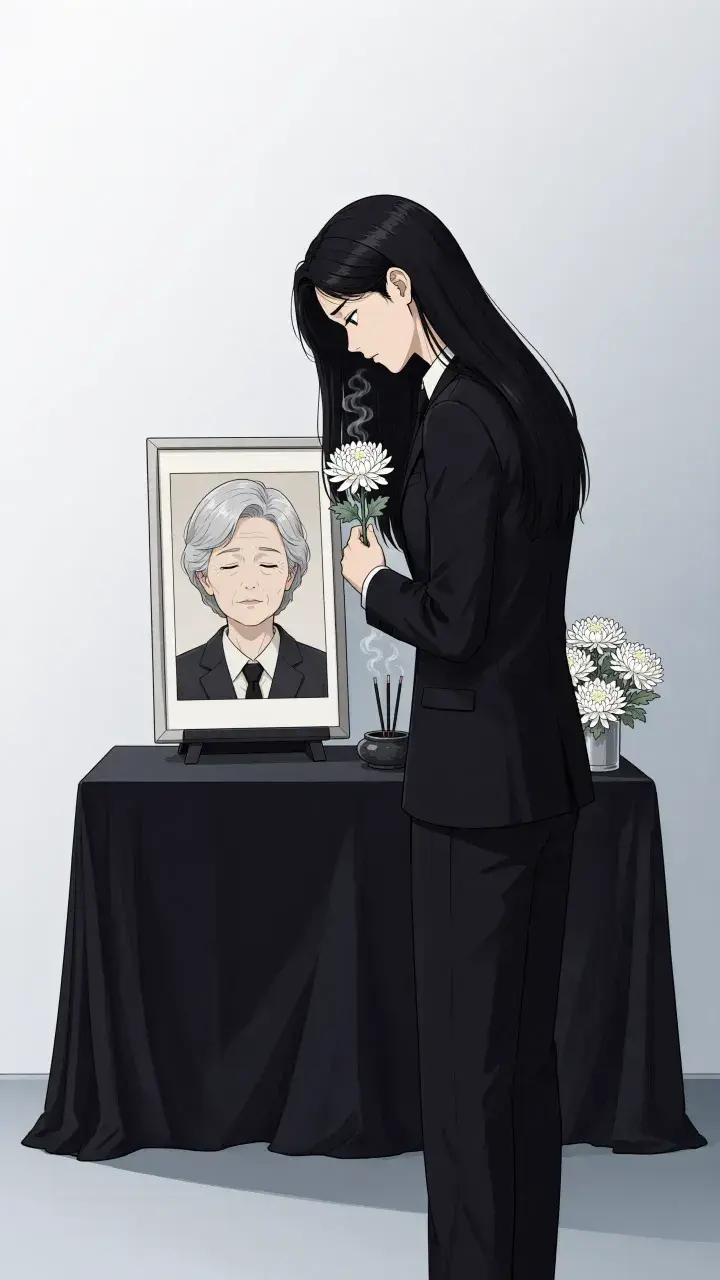
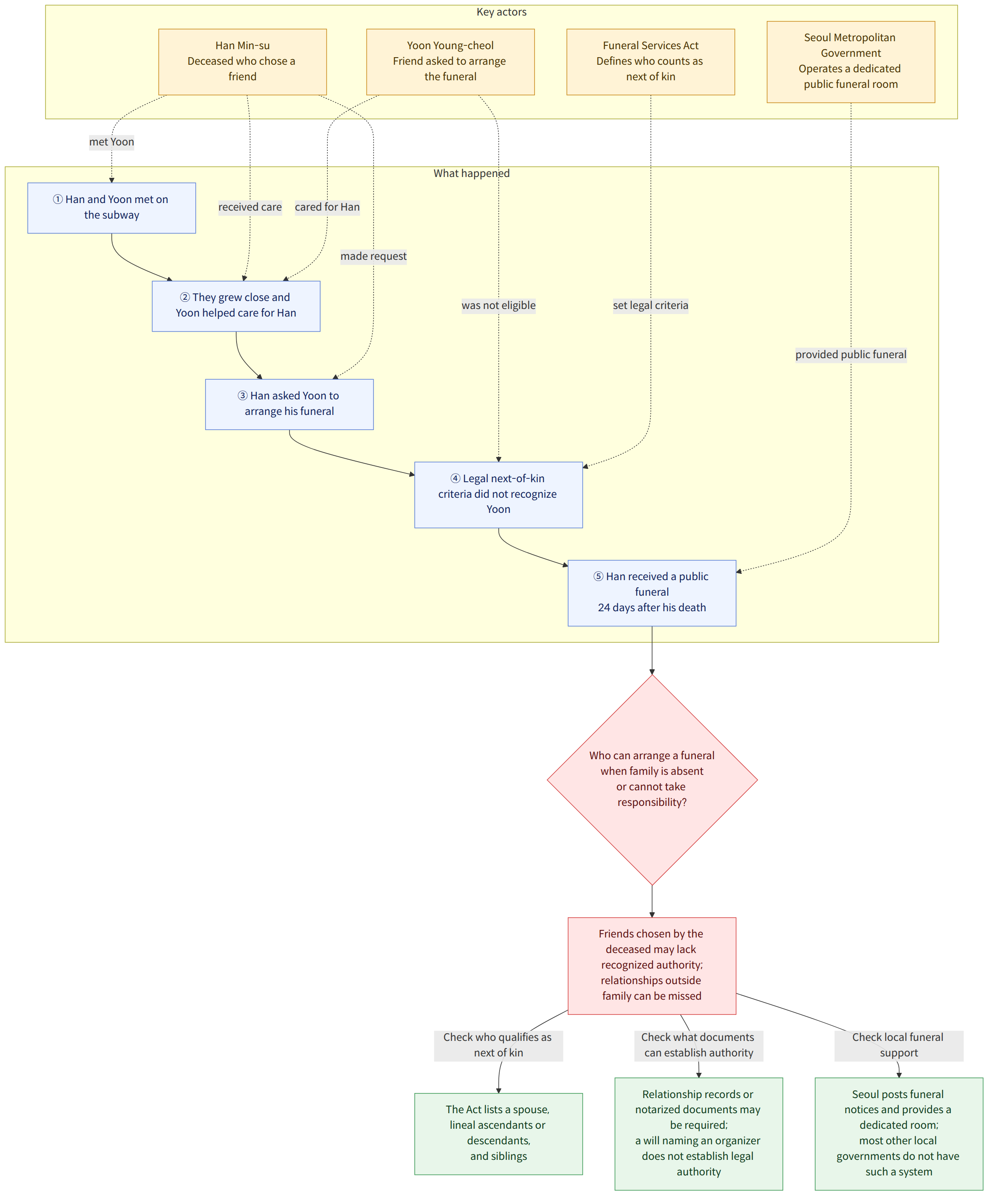
Han Min-su, 72, received a public funeral as a person with no recognized next of kin at the Seoul Metropolitan Crematorium (서울시립승화원) on September 13. Yoon Young-cheol, 78, who had stood by Han during his life, had been asked to arrange the funeral but was not eligible to take charge under the legal criteria for recognizing next of kin. It took 24 days after Han’s death for his funeral to be held. As more people have no family, or have family who do not take responsibility for receiving their remains and arranging a funeral, this case raises the question: “Who can take responsibility for a person’s final arrangements?”
Background and context
Han and Yoon met in a priority seat on the subway nine years ago and grew close. When Han fell on hard times, Yoon gave him a room in his home; when Han was hospitalized, Yoon helped with his admission and visited him. They were close in their everyday lives, but the criteria used to determine next of kin in funeral procedures did not automatically recognize that closeness.
Under the Act on Funeral Services, etc. (장사 등에 관한 법률), next of kin are defined as a spouse, lineal ascendants or descendants, or siblings. Yoon was Han’s longtime friend and a person with whom he shared caregiving, but he did not fall into any of these categories. The administrative classification of having “no next of kin” does not mean that a person had no relationships during their life. The central issue in this case is that relationships outside the family may be difficult to account for in the procedures used to decide who arranges a funeral.
The rise in deaths with no recognized next of kin also makes it difficult to view the issue as merely an unusual personal circumstance. According to data the office of Lee Su-jin, a lawmaker with the Democratic Party of Korea (더불어민주당), obtained from the Ministry of Health and Welfare (보건복지부), the number of deaths with no recognized next of kin rose 99.6%, from 3,603 in 2021 to 7,190 in 2025. Over the same period, the total number of deaths increased by 14.3%. The report projected that, if the current trend continues, the annual number of deaths with no recognized next of kin will exceed 10,000 in 2029. This is a projection based on the trend, not a confirmed outcome.
Among those who died with no recognized next of kin in 2025, 5,385 had next of kin who delegated responsibility for the funeral or declined to take custody of the remains, accounting for 75% of the total. Thus, “no next of kin” does not necessarily mean that the person had no one around them at all. It may be difficult to determine who will arrange the funeral even when the person has family who are unable to take responsibility for it, when family ties have been severed, or when someone outside the family cared for the deceased.
What this news means
The issue of deaths with no recognized next of kin is not limited to funeral procedures after death. If family relationships remain the primary criterion for deciding who arranges a funeral, regardless of whom the person was connected to during life or who cared for them, it may be difficult for the deceased to entrust their final arrangements to someone they chose. Even if there is documentation of the deceased’s wishes, it is unclear how fully those wishes will be reflected in the actual funeral if the document does not establish legally recognized authority.
Those affected are not only people who have no family or whose ties with family have been severed. The system also affects people who rely on close acquaintances for care or maintain relationships outside the family, as well as acquaintances who want to help arrange their funeral. For example, someone who wants to entrust their funeral to a friend who is not a family member cannot assume that the friend will be able to take charge based on a request made during their lifetime alone. According to the report, documentation proving the relationship or a notarized document or will made during the person’s lifetime may be required, and a person designated in a will as the funeral organizer does not have legally established authority.
A public funeral can be an alternative in cases where family members or individuals are unable to arrange a funeral themselves. However, arrangements and opportunities for people to participate in mourning also vary by region. The report said that Seoul operates a dedicated room for funerals for people with no recognized next of kin and posts funeral notices so acquaintances and members of the public can attend, while most other local governments do not have such a system. The ability to hold a funeral and the ability of people who knew the deceased to mourn them are not the same thing.
Related systems and support information
An amendment to the Funeral Services Act in 2023 opened a path for people to designate an acquaintance with whom they had been close as the person responsible for arranging their funeral. However, according to the report, it may be necessary to provide objective documentation showing that the relationship was close over a long period, or for the deceased to leave a notarized document or will during their lifetime. The report did not establish what specific documents are accepted or how the designation process works.
A more significant limitation is that the authority of a funeral organizer designated by the deceased in a will is not legally established. The report said that the designation serves only as a point of reference for administrative agencies. Therefore, it should not be assumed that leaving a will or notarized document will guarantee that the person the deceased wants will be allowed to arrange the funeral.
The report also said that support for and the operation of public funerals vary among local governments. In Seoul, a dedicated funeral room and the posting of funeral notices allow acquaintances and members of the public to attend, but other areas may not have the same system. The time from death to cremation for people with no recognized next of kin also varied by region: 30.5 days in Incheon, 27.8 days in Seoul, and 5.8 days in Gwangju. This shows that funeral and mourning arrangements may differ depending on where a person lives.
What is confirmed and what remains unknown
Confirmed facts
- Han Min-su received a public funeral as a person with no recognized next of kin at the Seoul Metropolitan Crematorium on September 13, 24 days after his death.
- There were 7,190 deaths with no recognized next of kin in 2025, up 99.6% from 3,603 in 2021.
- Among those who died with no recognized next of kin in 2025, 5,385 had next of kin who delegated responsibility for the funeral or declined to take custody of the remains, representing 75% of the total.
- An amendment to the Funeral Services Act in 2023 opened a path for people to designate an acquaintance to arrange their funeral. However, according to the report, proof of the relationship may be required, and the designated person’s authority is not legally established.
- The time from death to cremation and opportunities to participate in public funerals varied by region.
What remains unknown
- What specific documents are accepted when designating an acquaintance to arrange a funeral, and what is the application process?
- To what extent can a deceased person’s will or stated wishes regarding their funeral be reflected in actual procedures?
- If family members and acquaintances disagree over who should arrange the funeral, what criteria do administrative agencies use to decide?
- Will systems or operational standards be established to reduce regional differences in public funerals?
What readers should check
- If you want to ask an acquaintance to arrange your funeral, it is advisable to contact your local government directly to check what documents are required and how to submit a designation. The report does not specify what evidence will be accepted.
- Keep in mind that a will or notarized document made during your lifetime does not establish the designated funeral organizer’s authority. Even if you prepare such a document, you should also check how it will be treated in actual administrative procedures.
- The availability of dedicated rooms for public funerals, participation by acquaintances, and the posting of funeral notices may vary by region. You can ask your local government what funeral support and procedures are available where you live.