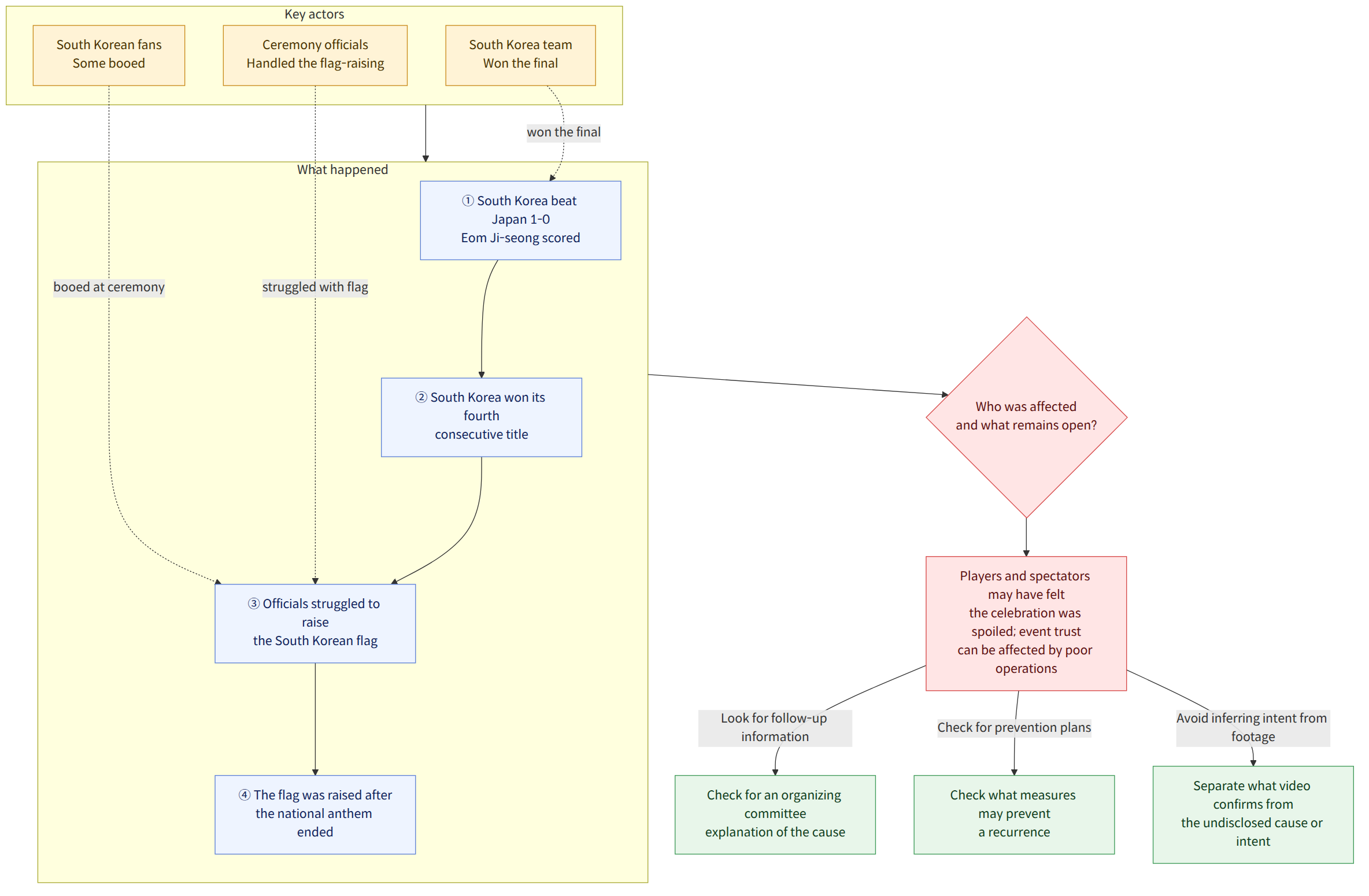
South Korea beat Japan 1-0 to win the Asian Games men’s football title for the fourth consecutive time in the final at Toyota Stadium in Toyota City, Japan. Eom Ji-seong scored the only goal of the final. But at a medal ceremony meant to be a moment of celebration, the South Korean flag was not raised properly; Korean media ultimately reported that it was raised only after the South Korean national anthem (애국가) had ended.
Background and context
Video of the ceremony showed officials struggling to raise the South Korean flag on the flagpole. When it did not rise properly, some South Korean fans booed, and reports said the players also looked toward the flagpole in surprise.
South Korea captain Lee Gi-hyeok said the ceremony should have been a time for celebration and that he was disappointed the flag had not been unfurled properly. He added that not only the players but also the fans who had traveled a long way to cheer them on would have been unhappy. Another player, Lee Young-jun, struck a different note, saying he had achieved his goal by winning gold and indicating that he was not dwelling on the incident.
The incident also came amid existing criticism of the event’s operations. Reports said the Aichi-Nagoya Games had experienced organizational problems, and that North Korea’s national anthem was played instead of South Korea’s at a South Korean men’s hockey game early in the event. However, the existence of these other incidents does not explain the cause of the problem at the football medal ceremony.
What this news means
Raising the flag is part of the medal ceremony, alongside the presentation of medals. Even when the achievement itself is clear at the moment a team clinches the title, if the procedures for honoring the country and its athletes at the ceremony do not go smoothly, players and spectators at the venue may feel that the celebratory experience has been spoiled. The incident shows that, apart from the result of the competition, attention to detail in event operations can also affect trust in an international sporting event.
The impact is not limited to the athletes. For example, a fan attending the ceremony may have felt both the joy of the victory and disappointment that the event did not proceed properly. This describes a possible experience; it does not confirm how all fans felt.
What reports described differently
One report focused on how the flag appeared to get caught on the flagpole and on officials struggling to raise it. Another report specifically said the flag could not be raised because the ropes had become tangled. Both reports agree that the flag was properly raised after the national anthem ended, but neither explained why the ropes became tangled or how the problem occurred.
What is confirmed and what remains unknown
What is confirmed
- South Korea beat Japan 1-0 in the final, with Eom Ji-seong scoring the only goal.
- South Korea won the Asian Games men’s football title for the fourth consecutive time.
- Video of the ceremony showed problems with raising the South Korean flag, and some South Korean fans booed.
- According to Korean media reports, the South Korean flag was properly raised after the national anthem ended.
- Lee Gi-hyeok expressed disappointment about the ceremony.
What remains unknown
- The available evidence does not establish whether the flag-raising mishap was intentional.
- Reports did not say what explanation or follow-up action the event’s organizing committee provided regarding the incident.
What readers should check
- It is worth checking whether the event’s organizing committee has provided further information about the cause of the incident and the procedures for the medal ceremony.
- Follow-up reports may provide details about how the ropes became tangled or what measures will be taken to prevent a recurrence.
- The cause or intent should not be inferred from the ceremony video alone; readers should distinguish between what the footage confirms and what remains undisclosed.
References
- Other coverage consulted: hani.co.kr