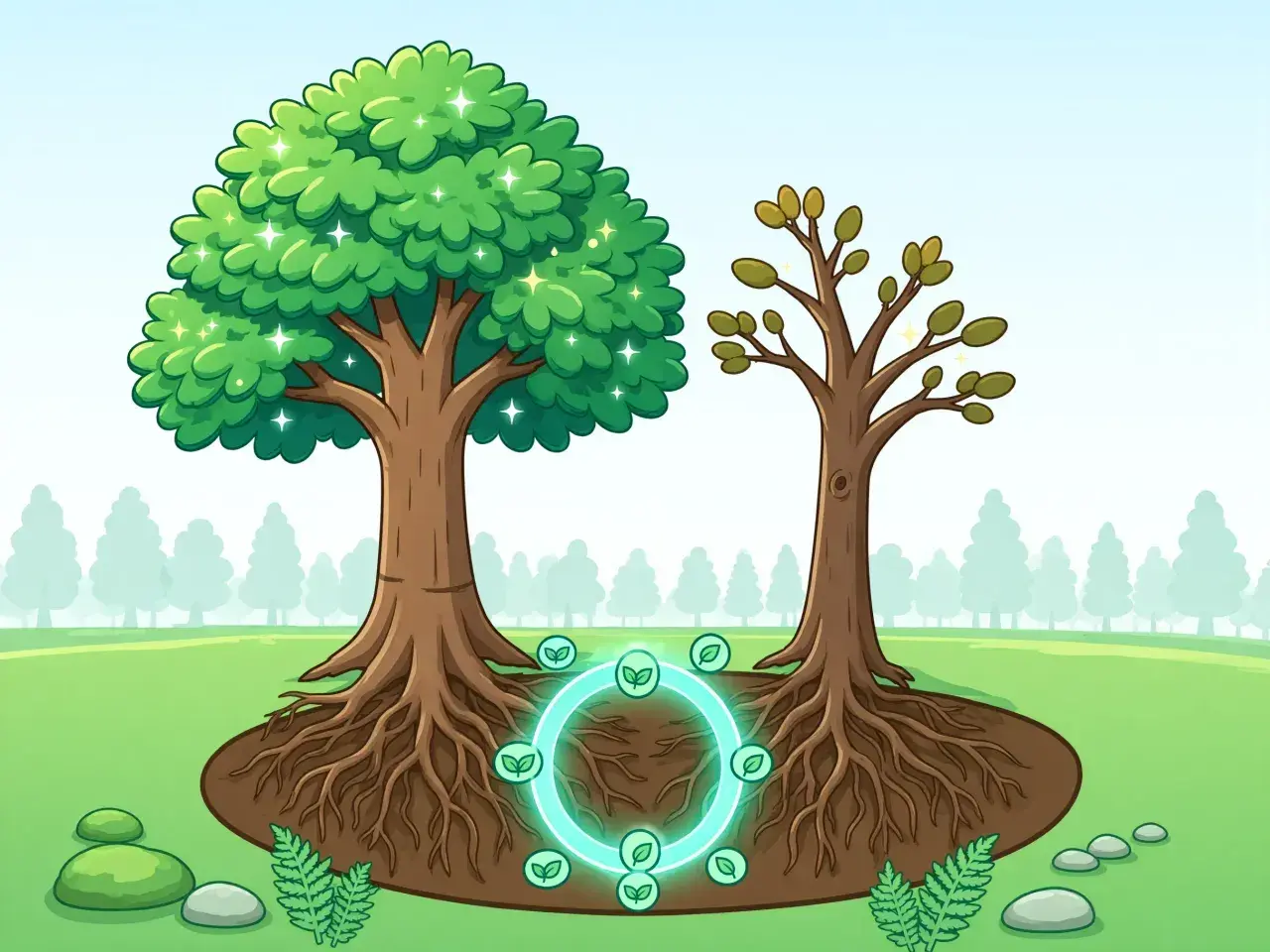
In kauri forests in the north of New Zealand’s North Island, more severe dieback tended to correspond with a greater decline in carbon held in living vegetation. A study that resurveyed forests in the Waitākere Ranges found that healthy forests gained carbon, while forests showing signs of dieback or suffering severe damage lost carbon. The findings show that kauri dieback can affect not only individual trees’ survival but also the carbon-storing capacity of forests that have accumulated carbon over a long period.
Background and context
Kauri are regarded by Māori as a taonga (a treasured heritage) with deep cultural and spiritual significance. Large kauri have accumulated carbon in their trunks, branches, and roots, and mature forests may hold more carbon than young forests. The impact of dieback therefore depends not only on whether trees die, but also on the size and condition of the trees that disappear from the forest.
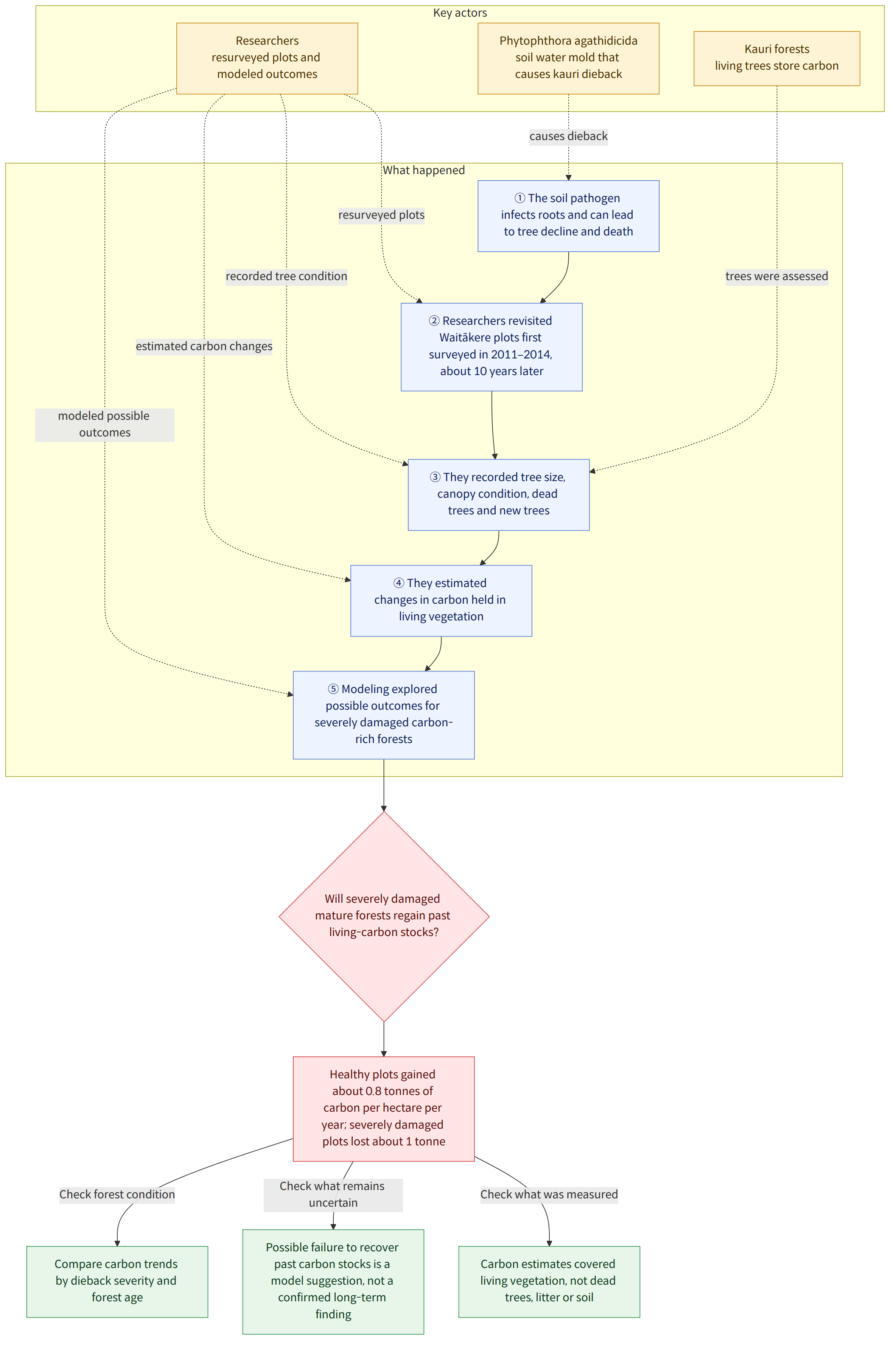
Kauri dieback is caused by Phytophthora agathidicida, a water mold that lives in the soil. It infects roots, interfering with a tree’s ability to absorb water and nutrients. As the disease progresses, leaves and branches may decline, and the tree can eventually die. According to the article, hundreds to thousands of kauri have died in the north of New Zealand’s North Island, with particularly severe damage recorded in Northland and the Waitākere Ranges in Auckland.
The researchers revisited survey plots in the Waitākere Ranges that they had first surveyed in 2011–2014. They examined tree size and the condition of the canopy (the upper part of a tree formed by its branches and leaves), and recorded dead trees and newly established trees. Using tree size and typical wood density for each species, they estimated the biomass (the total mass of living organisms) of living vegetation and calculated how carbon storage had changed over about 10 years.
What this news means
In forests with an initial average carbon stock of 169 tonnes per hectare, healthy survey plots gained about 0.8 tonnes of carbon per hectare per year. Plots showing signs of dieback lost about 0.1 tonnes per year, and plots with severe damage lost about 1 tonne. The difference between healthy forests and severely damaged forests was about 1.8 tonnes per hectare per year. This means that, even across the same area, the direction and scale of changes in carbon accumulated in living vegetation can vary depending on the severity of dieback.
The age and composition of a forest also matter. In the study, mature-forest plots held an average of about 248 tonnes of carbon per hectare in living vegetation, compared with about 88 tonnes in young regenerating forests. The researchers’ modeling found that in forests containing kauri, kauri accounted for an average of about half the carbon in living vegetation, with their share even larger in carbon-rich forests. The death of a large kauri could therefore sharply reduce the carbon stored in living vegetation, which is one reason protecting mature forests matters.
The researchers’ modeling suggests that carbon-rich forests with severe damage could shift from accumulating carbon to losing it. It also indicated the possibility that such forests might not recover their past carbon stocks and could stabilize at lower levels of living biomass and storage capacity. However, this is a possibility suggested by modeling, not a finding confirmed by long-term observations. For example, if dieback becomes severe in a particular mature forest, it is worth examining whether the carbon stored in its living trees declines.
However, this study measured carbon only in living vegetation. It did not directly measure how much carbon remains in dead trees, leaf litter, and soil, or how quickly any of it returns to the atmosphere. Therefore, the decline in carbon in living trees should not be read directly as an increase in carbon in the atmosphere.
What is confirmed and what remains unknown
What is confirmed
- The researchers resurveyed plots in the Waitākere Ranges at an interval of about 10 years and estimated changes in tree condition and carbon in living vegetation.
- More severe dieback tended to mean less carbon gained through tree growth and more carbon lost through tree decline and death.
- In forests with an initial average carbon stock of 169 tonnes per hectare, healthy plots gained about 0.8 tonnes per year, while plots with severe damage lost about 1 tonne.
- Mature-forest plots held an average of about 248 tonnes of carbon per hectare in living vegetation, compared with about 88 tonnes in young regenerating forests.
What remains unknown
- The study did not establish how much of the carbon lost from living vegetation remains in dead trees, leaf litter, and soil, or how much returns to the atmosphere.
- It is not known whether long-term observations will also show that carbon-rich forests with severe damage may fail to recover their past carbon stocks.
- The study did not specify how much management methods such as phosphite treatment affect the progression of dieback or carbon storage.
What readers can check
- When visiting kauri forests, stay on designated tracks and clean your shoes when entering and leaving the forest, following recommendations to prevent the spread of the pathogen.
- Phosphite treatment is being investigated and applied as a way to manage dieback, but this material alone does not allow its effectiveness to be assessed. When evaluating management outcomes, it is important to check whether long-term monitoring tracks changes in forest carbon as well as tree symptoms.
- When you encounter claims about carbon storage, distinguish whether the measurement covers living vegetation alone or also includes dead trees, leaf litter, and soil. The scope measured directly in this study was living vegetation.