
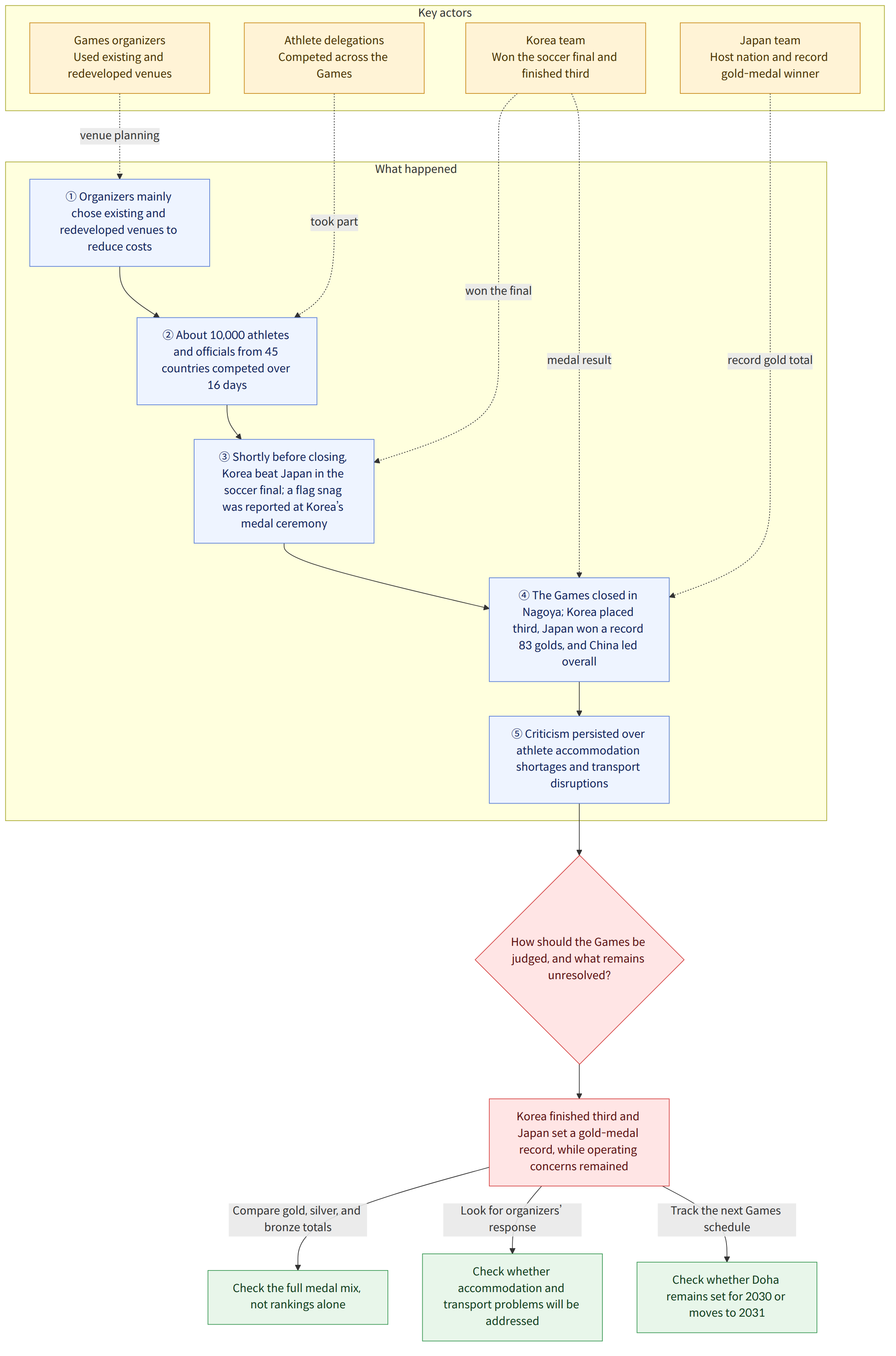
The 20th Asian Games closed on Sunday in Nagoya, central Japan. Over 16 days, about 10,000 athletes and officials from 45 countries competed for 469 gold medals across 43 sports and 71 disciplines. Korea finished third in the medal standings with 39 gold, 43 silver and 68 bronze medals, while host Japan won a record 83 gold medals, the most in Asian Games history. China dominated the Games with 169 gold medals and 341 medals overall.
Background and context
This was the Aichi-Nagoya Asian Games, named after Aichi Prefecture and its capital, Nagoya. It was the third Asian Games held in Japan, with events taking place throughout Aichi Prefecture and in some areas outside the prefecture. The organizers mainly used existing and redeveloped venues to keep costs down.
The slogan for the Games was “Imagine One Asia.” At the closing ceremony, sport climbing gold medalist Seo Chae-hyun entered carrying the South Korean flag, while Qatari equestrian national team member Jassim Al Kuwari appeared on stage carrying the flag of the Olympic Council of Asia (아시아올림픽평의회). The next Games are scheduled to take place in Doha, Qatar, in 2030. However, reports have said that the Olympic Council of Asia (OCA) is considering moving the event to 2031 to raise its profile and competitiveness, so the actual interval may change.
What this means
Korea’s third-place finish reflects its overall medal performance, but in terms of gold medals alone, host Japan’s 83 far surpassed Korea’s 39. Japan set a record, while China stood out in both gold medals and total medals. So, rather than looking only at the rankings, considering the mix of gold, silver and bronze medals alongside each country’s results can help provide a clearer picture of the Games’ outcomes.
But the medal record alone cannot determine how the Games were run. The event faced ongoing criticism over issues including a shortage of athlete accommodations and transportation disruptions. Even though organizers chose to use existing facilities to reduce costs, the dispersal of venues across the prefecture and into some areas outside it means that transportation for participants and accommodation issues can be important criteria in assessing how the Games were managed.
For example, if an athlete has to travel between venues that are far apart, transportation disruptions could make it harder to prepare for competition and get around. This is a hypothetical scenario based on reports that transportation problems were raised during the Games; the available reporting does not establish how they affected any particular athlete in practice.
A separate operational controversy was also reported after the soccer final, held shortly before the Games closed. During the medal ceremony for Korea, which had defeated Japan to win the title, the South Korean flag appeared to get caught on the flagpole. According to an article citing South Korean media reports, the flag was only properly raised after the national anthem had finished. Korea team captain Lee Ki-hyuk was reported to have said he was disappointed that the ceremony had not been conducted properly. The incident shows that, apart from sporting results, event procedures such as medal ceremonies can also matter to participating countries and spectators.
What is confirmed and what remains unknown
Confirmed facts
- The Games closed in Nagoya on Sunday, with about 10,000 athletes and officials from 45 countries taking part over 16 days.
- Competitors contested 469 gold medals across 43 sports and 71 disciplines.
- Korea finished third with 39 gold, 43 silver and 68 bronze medals; China won 169 gold medals and 341 medals overall.
- Japan won 83 gold medals, the most in Asian Games history.
- A shortage of athlete accommodations and transportation disruptions drew criticism of the Games’ management.
What remains unknown
- The available reporting does not give details about which athletes, apart from Seo Chae-hyun and Jassim Al Kuwari, were specifically highlighted at the closing ceremony, or how volunteers were introduced.
- It is confirmed that Seo Chae-hyun was both a gold medalist and a flag-bearer at the closing ceremony, but the specific sporting achievement or additional role that the truncated latter part of the original text may have referred to cannot be confirmed.
- It has not been confirmed whether the next Games will be held in Doha in 2030 or whether the date will be moved to 2031.
- The reporting does not say how organizers will address accommodation and transportation problems, or what changes might be made to the management of future Games.
What readers should check
- When looking at the medal standings, distinguishing between total medals and gold medals can help clarify what Korea’s third-place finish and Japan’s gold medal record each mean.
- Since both 2030 and 2031 have been mentioned as possible dates for the next Asian Games, readers should check for follow-up announcements confirming whether the schedule has been changed.
- Future coverage of the Games can be followed for details on measures addressing transportation between athlete accommodations and venues. This could serve as a way to assess whether the operational issues repeatedly raised during these Games are being addressed.
References
- Other coverage consulted: hani.co.kr
- Other coverage consulted: koreatimes.co.kr