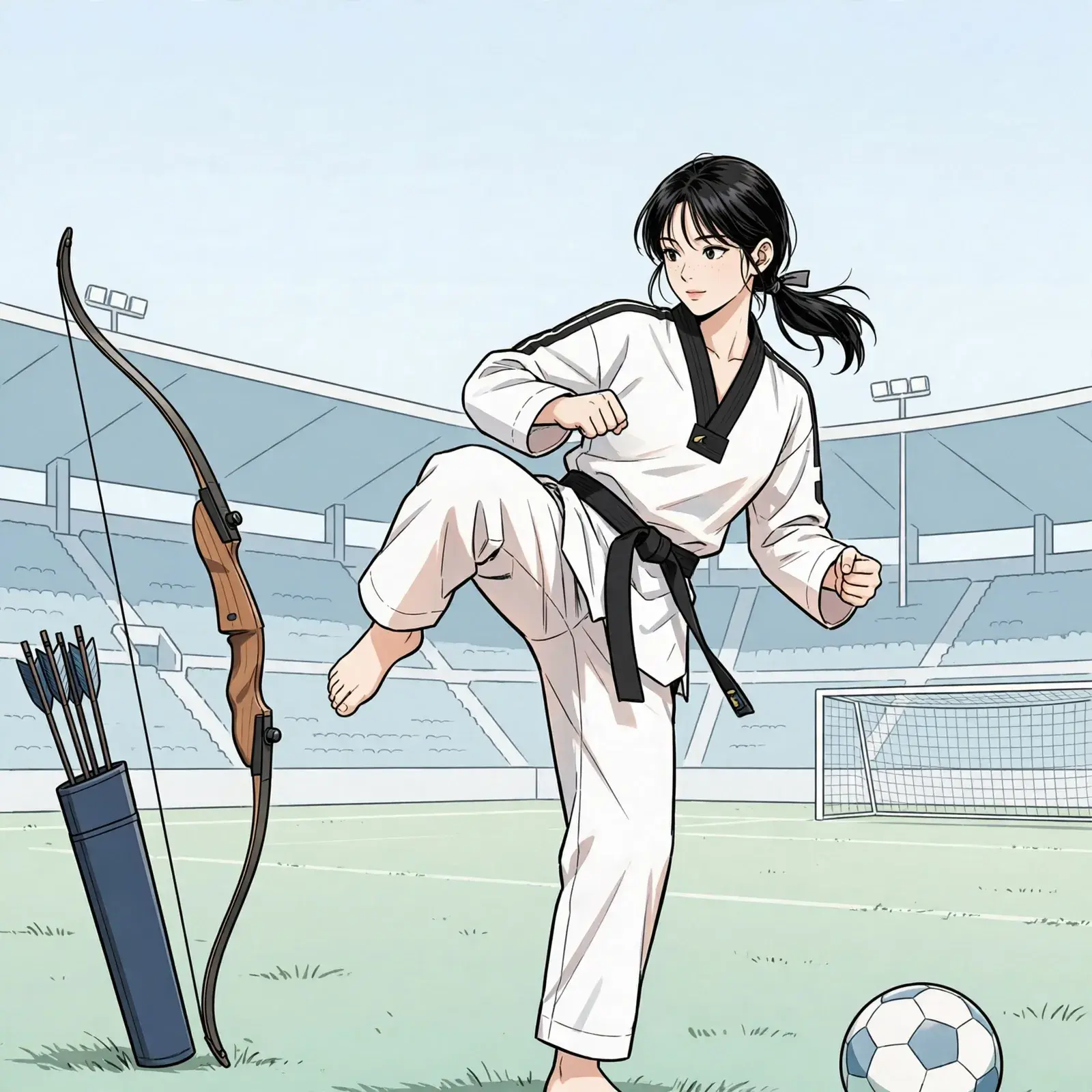
A high-stakes finale against Japan
South Korea’s athletes enter the final stretch of the 2026 Aichi-Nagoya Asian Games on October 3, with a major medal opportunity in several sports and a headline men’s soccer final against Japan. Because only an individual equestrian jumping event is scheduled for the closing day on October 4, Saturday is effectively the last full day for South Korea to add to its medal total.
The soccer final is scheduled for 7:30 p.m. local time at Toyota Stadium in Aichi Prefecture. South Korea’s under-23 team—meaning a squad made up primarily of players aged 23 or younger—is pursuing a record fourth consecutive Asian Games title.
The evening’s Korea-Japan final will cap a packed day of competition, with gold medals also at stake in archery, taekwondo, judo and sport climbing.
South Korea arrives unbeaten
Coach Lee Min-sung’s team has won all four of its matches on the way to the final. Its run included two group-stage victories, a quarterfinal win over Vietnam and a semifinal victory over China on September 30.
Japan took a more difficult route to the championship match. It needed extra time and then a penalty shootout—a tie-breaking contest in which players take turns attempting shots from the penalty spot—to get past Uzbekistan. Japan won the shootout 9-8.
South Korea has recent history on its side: it defeated Japan in the finals of both the 2018 Jakarta-Palembang Games and the 2022 Hangzhou Games, which were held in 2023. Japan has entered an under-21 squad, two years younger than the under-23 age category, as part of its preparations for the 2028 Los Angeles Olympics. That difference in squad age may shape the matchup, but the final will still be decided on the field.
A chance to extend an extraordinary streak
South Korea also won the men’s soccer gold at the 2014 Incheon Games. A victory in Toyota would make the team the first to win the Asian Games men’s soccer tournament four times in a row. The streak raises the stakes beyond a single final: the players are also trying to preserve a record built by three previous generations of Korean teams.
Archery: individual titles after a team silver
The recurve archery competition, in which athletes shoot arrows at a distant target using a traditional-style bow, moves from the quarterfinals through the finals on Saturday. South Korea will have two contenders in the women’s individual event: Kang Chae-young, the reigning world champion, and Oh Ye-jin. The women’s final is scheduled for 10:50 a.m.
The pair will have a chance to turn the disappointment of a silver medal in the women’s team event the previous day into individual gold. In the men’s competition, Lee Woo-seok is South Korea’s only quarterfinalist. His final is scheduled for 2:50 p.m., and a win would add an individual title to the team gold he has already earned, giving him a chance to finish the Games with two gold medals.
- Women’s individual final: 10:50 a.m.; Kang Chae-young and Oh Ye-jin are in contention.
- Men’s individual final: 2:50 p.m.; Lee Woo-seok is seeking a second gold of the Games.
Taekwondo and judo look for more gold
In taekwondo, Kim Yu-jin will compete in the women’s 57-kilogram final at 4:40 p.m. Kim, who won Olympic gold in Paris in 2024, is aiming for her first Asian Games title. She took bronze at the 2022 Hangzhou Games and now has a chance to move to the top of the podium.
Kang Sang-hyun will contest the men’s over-80-kilogram final at 5:25 p.m. Together, the two finalists give South Korea another opportunity to add gold medals through the sport’s fast-paced combination of kicks, footwork and point-scoring attacks.
Judo’s mixed-team event is scheduled to reach its final after 5 p.m. The format brings men and women together to represent one national team, rather than awarding medals to individual competitors alone. South Korea’s lineup includes Kim Min-jong, Huh Mimi, Lee Jun-hwan and Kim Ha-yun. Huh, who has already won gold in the women’s 57-kilogram individual event, could claim a second title at these Games.
Why the mixed-team event matters
A team final tests more than the strength of one standout athlete: competitors take turns in separate matchups, so a country needs contributions across several weight categories. For South Korea, the event offers both a final chance at a judo team gold and an opportunity for Huh to complete a two-gold campaign.
Seo Chae-hyun targets a first climbing gold
Sport climber Seo Chae-hyun will compete in the women’s lead final at 6 p.m. Lead climbing is a discipline in which athletes climb a high wall within a set time, aiming to reach the highest hold possible. Seo is ranked second in the world in the event and advanced to the final after sharing first place in the semifinals.
She has already won bronze in bouldering, a climbing discipline based on completing short, difficult routes on lower walls without ropes. That result follows the combined-event silver she earned at the previous Asian Games, where athletes’ results across more than one climbing discipline contributed to a single overall contest. A lead gold would be her first Asian Games title and her second medal of the current Games.
A final day with little room for delay
The range of events gives South Korea several different paths to end the competition on a high note: a historic soccer streak, individual archery finals, two taekwondo title bouts, a judo team contest and a climbing final. Each event has a different rhythm, from the sustained precision of archery to the head-to-head pressure of a soccer final.
With the closing ceremony approaching and only one medal event listed for October 4, the results on Saturday will carry unusual weight. South Korea’s athletes will be trying not only to add medals, but to give the Games a memorable finish—one that could be defined by a fourth straight soccer championship or by gold across several sports.