
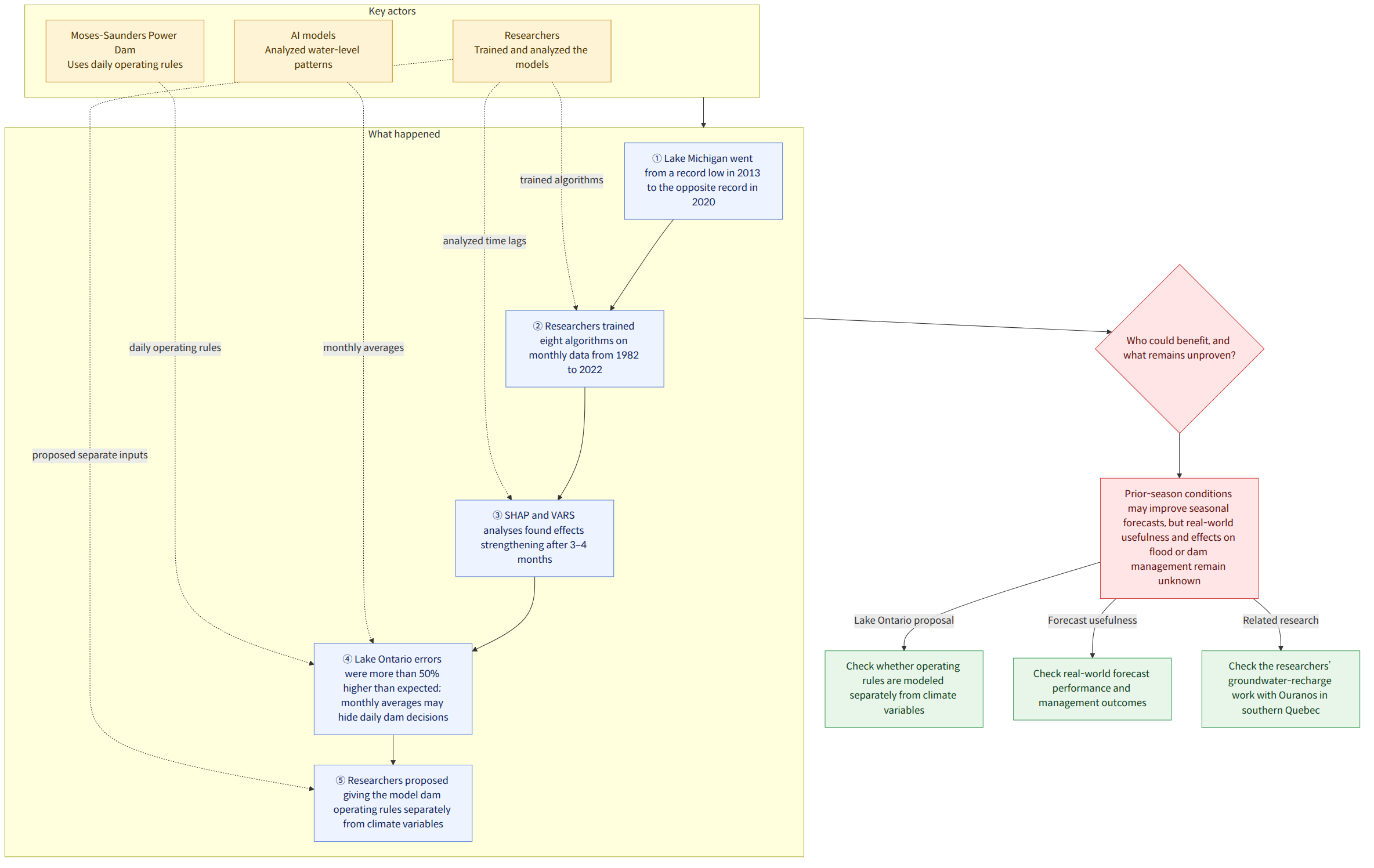
Lake Michigan’s water level hit a record low in January 2013, the lowest since observations began, then broke the opposite record in the summer of 2020, causing flooding, shoreline erosion and the closure of lakeside roads. The difference in water level between the two records was nearly 2 m. Similar reversals occurred several months apart on Lake Superior, Lake Erie and Lake Ontario, the article reports. To predict these wide swings in water levels and explain their causes, researchers used artificial intelligence (AI) models in their analysis.
Background and context
Lake levels are affected not only by rain and snow, evaporation, and inflows and outflows, but also by human decisions. Water levels are also related to harbor depth, shoreline stability, drinking-water intakes and the survival of coastal wetlands. A model’s ability to explain which factors drive changes, rather than merely predict water levels, could therefore be important for managing dams or flood risks.
The researchers trained eight algorithms using monthly water-level data from 1982 to 2022 for Lakes Superior, Michigan, Erie and Ontario. Each algorithm took nine variables as inputs, including temperature and inflows, and also incorporated each variable’s value for the current month and up to six months earlier. This allowed the model, for example, to examine the relationship between June water levels and January snowfall.
The errors for the four best-performing algorithms fell to about 12 cm. Simple models had errors of 14–21 cm. The researchers used both SHAP (a method for breaking down how much each variable contributes to a prediction) to examine the contribution of each variable, and VARS analysis, which looks at how an effect changes over time when a variable is intervened on.
SHAP shows how much each variable contributes to a rise or fall in water levels in a particular month. However, it does not tell researchers how long it takes a signal to move across a watershed (an area where water drains to one place). In the VARS analysis, the researchers examined the effects at one month and six months after intervening on a variable to analyze the time lag.
What this news means
The researchers expected variables’ effects on water levels to weaken the further back in time they went, but instead observed a pattern in which the effects grew stronger after 3–4 months. The researchers’ conclusion is that these lakes respond to conditions from previous seasons more than to the previous day’s weather. The explanation that January snow can affect June water levels shows why seasonal forecasts need to consider conditions from several months earlier.
This finding is notable because it shows that lake levels cannot be explained by short-term weather alone. Models making seasonal forecasts may be able to pick up clues to water-level changes more effectively if they also consider variables such as temperature and inflows from previous months. However, the error figures in this study do not show how useful the forecasts would be in real-world settings or how much outcomes for flood or dam management might change.
Lake Ontario also revealed the model’s limitations. The model’s errors for this lake were more than 50% higher than expected, and the article links this to human decision-making. The Moses-Saunders Power Dam near Cornwall, Ontario, manages water levels according to operating rules that are adjusted daily. But because the model uses monthly averages for each variable, the sequence of decisions that produced a month’s outflow may disappear within the average.
In the case of Lake Ontario, the researchers proposed providing the model with the operating rules used to manage water levels, separately from climate variables. This is a proposal addressing the problem of human decision-making for that lake; it cannot be generalized to mean that all seasonal forecasts need the same conditions.
The researchers said they are also applying this approach, in collaboration with Ouranos, to research on groundwater recharge in southern Quebec. This work uses physics-based models (models that reflect the physical mechanisms of natural phenomena). The direction suggested by this research is that models whose results can be examined for their underlying reasons may help review and discuss management decisions in complex environmental issues such as water levels.
What is confirmed and what remains unknown
What is confirmed
- The researchers trained eight algorithms using monthly water-level data from 1982 to 2022 for the four lakes.
- Each algorithm incorporated nine variables, including temperature and inflows, with values ranging from the current month to up to six months earlier.
- The four best-performing algorithms had errors of about 12 cm, while simple models had errors of 14–21 cm.
- Contrary to their expectation that the effects of variables would weaken further back in time, the researchers observed that the effects grew stronger after 3–4 months.
- Lake Ontario’s water levels are managed according to the daily operating rules of the Moses-Saunders Power Dam, and the researchers proposed providing these rules to the model.
What remains unknown
- What is the full list of the eight algorithms and nine variables used in the study?
- What validation method and forecast period were used to evaluate model accuracy?
- How much would forecast errors decrease if Lake Ontario’s operating rules were included in the model?
What readers should check
- When reviewing water-level forecasts, it is important to look at the forecast period and validation method as well as the accuracy figures. The original article did not provide these details.
- When AI forecasts are used for flood or dam management, readers can check whether the input data consist only of monthly average climate and outflow figures, or whether actual operating rules or decision-making processes are also represented.
- When interpreting seasonal water-level outlooks, readers can check whether the analysis includes conditions from several months earlier, not just the weather in the current month. The researchers concluded that conditions from previous seasons can affect water levels.