
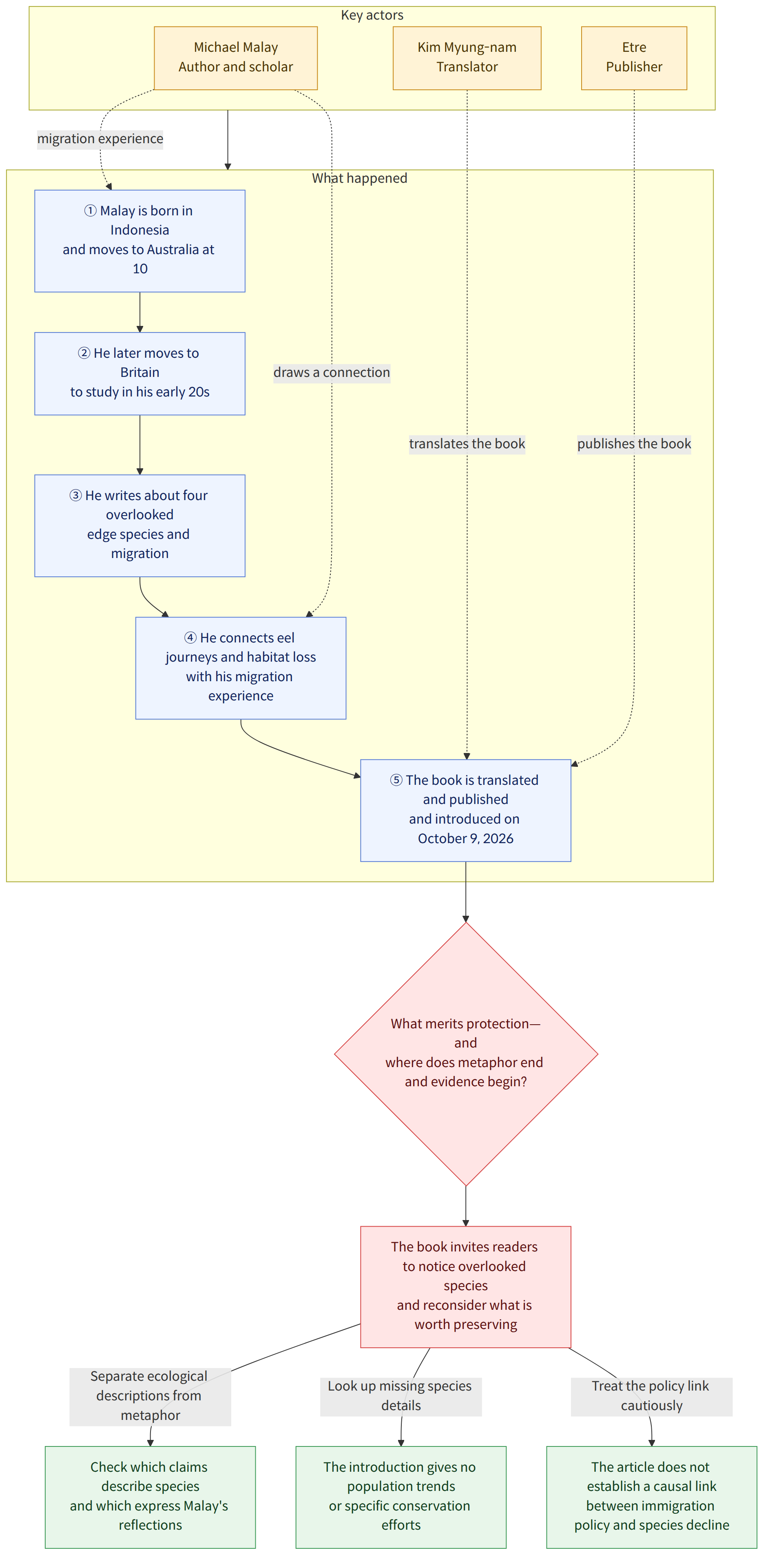
Introduced on October 9, 2026, Michael Malay’s book The Light That Remains is an essay that reflects on nature, migration, belonging, loss and recovery by spending time with eels, moths, freshwater pearl mussels and crickets. Malay, a scholar of English literature and environmental literature, describes them as “edge species”—creatures people know exist but ignore or treat with neglect. It was translated by Kim Myung-nam and published by Etre (에트르); the price is 21,000 won.
Background and context
Malay chose these four species because they are not especially beautiful or “star animals” that attract people’s attention. The book places not only conspicuous, well-loved creatures but also those people know about yet easily overlook at the center of its observations. This perspective prompts readers to reconsider what they deem worth preserving.
The author’s own experience of migration is woven into this question. Malay was born in Indonesia, moved to Australia with his family at the age of 10, and settled in Britain after going there to study in his early 20s. In the book, he places his experience of living in unfamiliar places alongside the lives of animals that are disappearing.
The European eel is one example of this connection. Eels make long-distance journeys across rivers and seas, but their habitats have shrunk as people have dammed rivers and altered their environments, the book says. Malay sees a connection between this declining fate and Britain’s hardline immigration policies. Rather than asserting that animal migration and human migration are the same thing, the book’s perspective invites readers to consider the shared experience of yearning for connection between home and a foreign land.
What this news means
The book’s questions extend to the standards by which people decide what merits attention in nature. It encourages readers to reflect on what they consider beautiful and worth protecting. It is significant because when attention is focused on familiar or eye-catching creatures, species that quietly disappear can become things people know about but do not consider important.
This perspective may also prompt readers to pause before relying on familiar categories. For example, a reader encountering the story of a migrating creature like the eel might consider its life alongside the experiences of migration and belonging that Malay connects to it. However, the book’s introduction alone does not establish a concrete causal relationship between human immigration policies and the decline of species. Malay’s perception of a connection between the two experiences should be distinguished from the verification of ecological facts.
Paying attention to the lives of creatures that receive little notice makes us reconsider the standards by which we decide what is worth preserving.
This perspective also resonates with a passage in which Malay recalls that, during his first summer in England, he could not forget the evening sky, which remained a deep blue long after sunset. The attitude of letting one’s thoughts linger alongside things that are disappearing connects with the song by Yoon Dong-ju: “I must love all things that are dying.” The “light” in the book’s title can be read not merely as a reference to observations of nature, but as an expression that invites reflection on how we face disappearance.
Confirmed facts and what remains unknown
Confirmed facts
- The book is titled The Light That Remains, written by Michael Malay and translated by Kim Myung-nam.
- Malay writes about eels, moths, freshwater pearl mussels and crickets as “edge species.”
- According to the introductory article, European eels make long-distance journeys, but human impacts—such as damming rivers and altering habitats—have reduced the space available to them.
- Malay places his own experience of migration alongside the lives of disappearing animals and questions how the value of conservation is judged.
What remains unknown
- The introductory article does not give specific population trends or extinction-risk levels for the four species discussed in the book.
- The book’s original title and the date it was first published are not confirmed.
- The article does not describe specific ongoing efforts to conserve each species.
What readers should check
- As they read, readers can distinguish the ecological descriptions of the four species from the author’s metaphors about migration and belonging.
- Anyone seeking information about the species’ current status or conservation efforts should first note that the book’s introduction does not include those details and look for relevant sources separately.
- The Light That Remains was translated by Kim Myung-nam and published by Etre (에트르); the listed price is 21,000 won.