
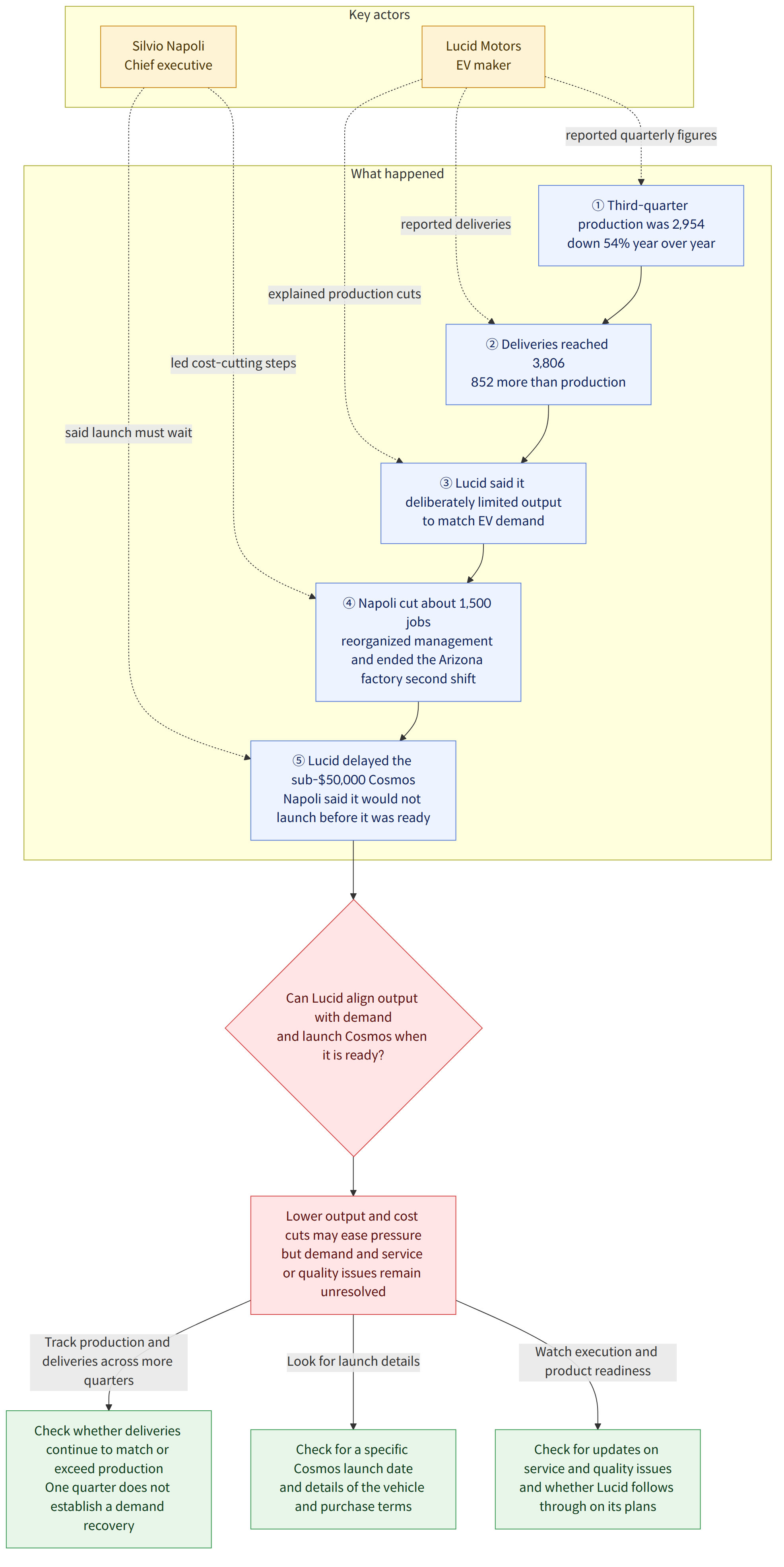
Lucid Motors produced 2,954 electric vehicles in the third quarter. That was 54% fewer than a year earlier, marking the third consecutive quarterly decline in production and the lowest level since the first quarter of 2025. Deliveries, by contrast, totaled 3,806, broadly in line with the second quarter and about 200 fewer than in the third quarter of 2025. The company said it deliberately limited production to align output with electric vehicle demand.
Background and context
A decline in production alone makes it difficult to distinguish weak sales from the effects of production adjustments. Lucid described the cuts as deliberate and intended to match demand, but in five of the past six quarters it produced more vehicles than it delivered. This quarter, by contrast, deliveries exceeded production by 852 vehicles. That difference shows a shift in the pattern of production and deliveries, but the information provided does not establish how much inventory contributed to it.
These figures reflect both the demand challenges facing high-priced electric vehicles and Lucid’s response. The report says the company has struggled to find enough buyers for its first two luxury electric vehicles. Lowering production may help reduce the accumulation of vehicles made in excess of demand, but it could also affect the pace at which production scales up. It is therefore worth watching not just the cuts themselves, but whether the relationship between actual deliveries and production continues.
Lucid has also taken steps to simplify the company. Chief Executive Silvio Napoli laid off about 1,500 employees, reorganized the management team and eliminated the second shift at the company’s Arizona factory. Lucid is targeting $1.4 billion in cost savings through these measures. Cost-cutting may help ease pressure on profitability, but it does not, by itself, mean that vehicle demand or product service and quality issues have been resolved.
Napoli said the company had failed to execute consistently and deliver on its promises, had launched products before they were ready, and had not invested enough in addressing service and quality issues. That assessment makes the delay to the Cosmos more than a simple schedule change. The Cosmos is expected to have a starting price below $50,000, giving it the potential to reach a broader group of buyers, but Napoli said the company would not release it before it was ready. The prospect that a lower-priced model could broaden the market comes alongside the challenge of ensuring the product is fully prepared.
What this means
For Lucid, the priority is not just to increase production again, but to align its production and delivery plans reliably with actual demand. The fact that production exceeded deliveries in most of the past six quarters offers a clue as to why production needed to be adjusted. Even though deliveries were higher than production this quarter, a single quarter is not enough to conclude that demand has recovered.
The competitive landscape provides additional context for comparison. Rival Rivian shipped nearly 20,000 vehicles in the third quarter, the first full quarter in which the R2 was produced. Its shipments in the second quarter totaled 12,194. These figures cannot be assumed to be the same metric as Lucid’s deliveries, but they show why attention is focused on the shipment trajectory of a competitor that has introduced a less expensive new vehicle. It is not yet known exactly when Lucid’s Cosmos will launch or how the market will respond to it.
Lucid’s current performance also falls short of the expectations it set when it went public. The company raised $4 billion in its 2021 public listing and estimated it could ship as many as 90,000 vehicles in 2024. That estimate was an annual shipment forecast, while the figures here represent production and deliveries for one quarter, so they should not be directly compared to calculate performance. Even so, investors and consumers will want to see whether the company’s plans translate into execution, given that its growth expectations at the time are now being discussed alongside production adjustments and cost cuts.
For example, anyone considering buying the Cosmos can check whether Lucid provides more specific information about the launch date and the vehicle rather than assuming that the planned sub-$50,000 price confirms when it will be available or the actual terms of purchase. The company’s explanation that it will not rush the launch indicates that readiness is a priority, but it does not provide a launch schedule.
What is confirmed and what remains unknown
Confirmed
- Lucid produced 2,954 electric vehicles in the third quarter, down 54% from a year earlier.
- Third-quarter deliveries totaled 3,806, broadly in line with the second quarter and about 200 fewer than in the third quarter of 2025.
- The company limited production to match demand and is targeting $1.4 billion in cost savings by adjusting its workforce, management and factory operations.
- The Cosmos launch has been delayed, and its starting price is expected to be below $50,000.
Still unknown
- The report provided does not specify the year for these third-quarter production and delivery figures.
- No specific launch date for the Cosmos has been given.
- Publicly available information does not include production and delivery figures by model.
- The reasons deliveries exceeded production this quarter, and whether that will continue in subsequent quarters, have not been confirmed.
What readers should watch
- In the next earnings report, see whether the gap between production and deliveries persists and how the company explains the relationship between demand and its production adjustments.
- Check for the Cosmos launch date and model details. So far, what is known is that its launch has been delayed and its starting price is expected to be below $50,000.
- Look for follow-up information on the $1.4 billion cost-saving target, the response to service and quality issues, and preparations for product launches.