The United States has reported 3,887 measles cases in 2026. That is the highest annual total since 1991 and about 70% higher than the total for all of 2025. As cases continue to rise, New York declared a state of emergency, and the Pan American Health Organization (범미보건기구, PAHO) is scheduled to review in November whether the United States has lost its measles elimination status, which it has maintained since 2000.
Background and context
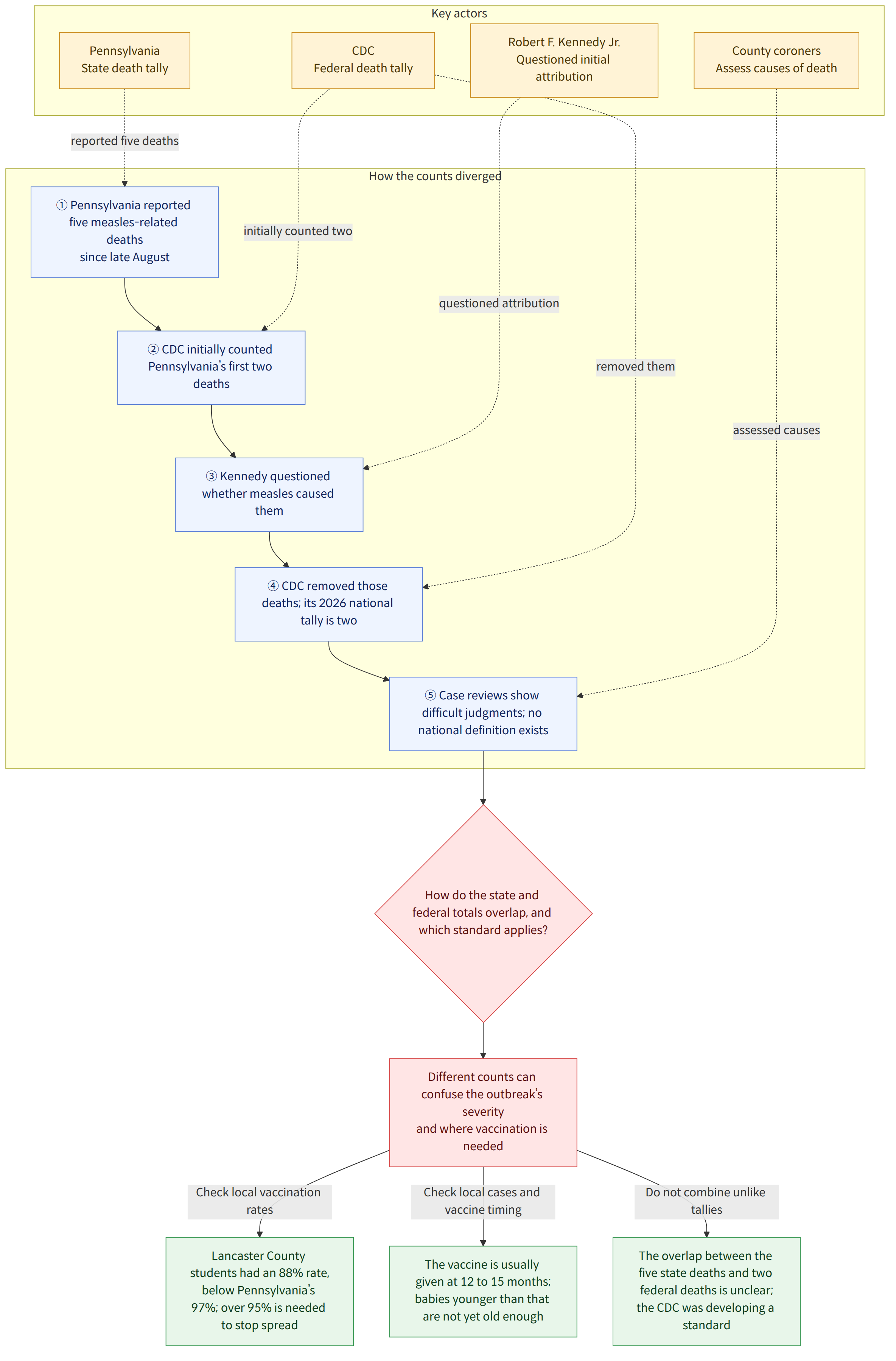
Unlike the case count, the death toll is disputed from the outset because of how it is tallied. Pennsylvania has reported five measles-related deaths since late August, and the state has recorded 1,004 measles cases. By contrast, the Centers for Disease Control and Prevention (미국 질병통제예방센터, CDC) has counted two measles deaths nationwide in 2026, but has not disclosed which states the deaths occurred in.
It is not clear how the two figures overlap. According to the article, no other state has reported measles deaths this year, but it is unclear whether the deaths reported by Pennsylvania are included in the CDC’s count of two. The state’s five cases and the federal government’s two therefore cannot simply be added together, nor can one assume that one tally fully includes the other.
The discrepancy stems from different standards for linking a death to measles. Pennsylvania counts a death as measles-related if the person tested positive for measles, died within 30 days of symptom onset, and had no other clear cause of death, such as a traffic accident. The CDC counts deaths after its National Center for Health Statistics confirms measles as the underlying cause of death. At the time the article was written, there was no nationally agreed-upon definition of a measles death, and the CDC was reportedly developing a standard.
Cases in Pennsylvania show why these determinations can be difficult. The Lancaster County coroner concluded that a newborn who tested positive for measles died of a splenic laceration and that measles did not contribute to the death. The same coroner determined that measles caused the death of another infant who had a rare, generally fatal genetic disorder. The Mifflin County coroner attributed the death of an 18-year-old to acute disseminated encephalomyelitis, a rare and severe neurological complication of measles.
The way deaths are counted has also changed in practice. The CDC initially counted Pennsylvania’s first two deaths, but removed them from its tally after Health and Human Services Secretary Robert F. Kennedy Jr. questioned whether measles had caused them. This shows that the issue is not only a difference in professional standards for determining cause of death, but also how those determinations are treated publicly.
What this means
Death counts can be used to convey the severity of an outbreak. But if the same cases are classified differently under state and federal standards, the public may find it difficult to assess the level of risk from measles. Consistency in counting matters because a higher death toll can be used to underscore the need for vaccination, while a lower one could give the impression that the risk is being exaggerated.
This confusion could affect responses, especially in areas with low vaccination rates. To stop measles from spreading, more than 95% of local residents must be vaccinated. Yet the measles vaccination rate among Lancaster County students in the last school year was 88%, lower than Pennsylvania’s statewide rate of 97%. Because a statewide average can hide differences between local areas, accurate and consistent data can be important for communicating prevention information and directing staff and vaccines where they are needed.
For example, families living in areas with low vaccination rates may need to check both the rate in their area and the latest measles situation, rather than relying only on the statewide average. The vaccine is usually given at 12 to 15 months of age, so information about community vaccination rates and outbreaks may be more important for babies younger than that, who are not yet old enough for the shot. This does not determine the risk to any particular baby or family; it means that information gaps in areas with low vaccination rates may have a greater impact on vulnerable people.
The figures currently available do not show how the CDC’s national count of two deaths overlaps with Pennsylvania’s report of five. It is important not to treat numbers based on different standards as if they were one definitive death toll.
What is known and what remains unclear
What is known
- The United States reported 3,887 measles cases in 2026, the highest annual total since 1991 and about 70% more than the total for all of 2025.
- Pennsylvania reported five measles-related deaths and 1,004 cases in the state. The CDC counted two deaths nationwide.
- Pennsylvania and the CDC use different standards for determining measles deaths, and there was no common national standard at the time the article was written.
- The measles vaccination rate among Lancaster County students in the last school year was 88%, compared with 97% statewide in Pennsylvania. More than 95% of local residents must be vaccinated to stop measles from spreading.
What remains unclear
- Are any of the deaths reported by Pennsylvania included in the CDC’s count of two measles deaths in 2026?
- When will the CDC finalize a common national standard for determining measles deaths?
- How will PAHO assess the United States’ measles elimination status in its November review?
What readers can check
- When looking at the measles outbreak, readers can check case and death counts nationwide as well as cases and vaccination rates in their own area. Local and statewide averages may differ.
- When comparing death statistics, readers should look not only at the numbers but also at the standards used to determine what counts as a “measles-related death” and which entity compiled the figures. The state and federal figures reported to date were not calculated using the same standards.
- To check whether a child has been vaccinated or when a dose is due, readers can review the child’s vaccination records. The measles vaccine is usually given at 12 to 15 months of age.