
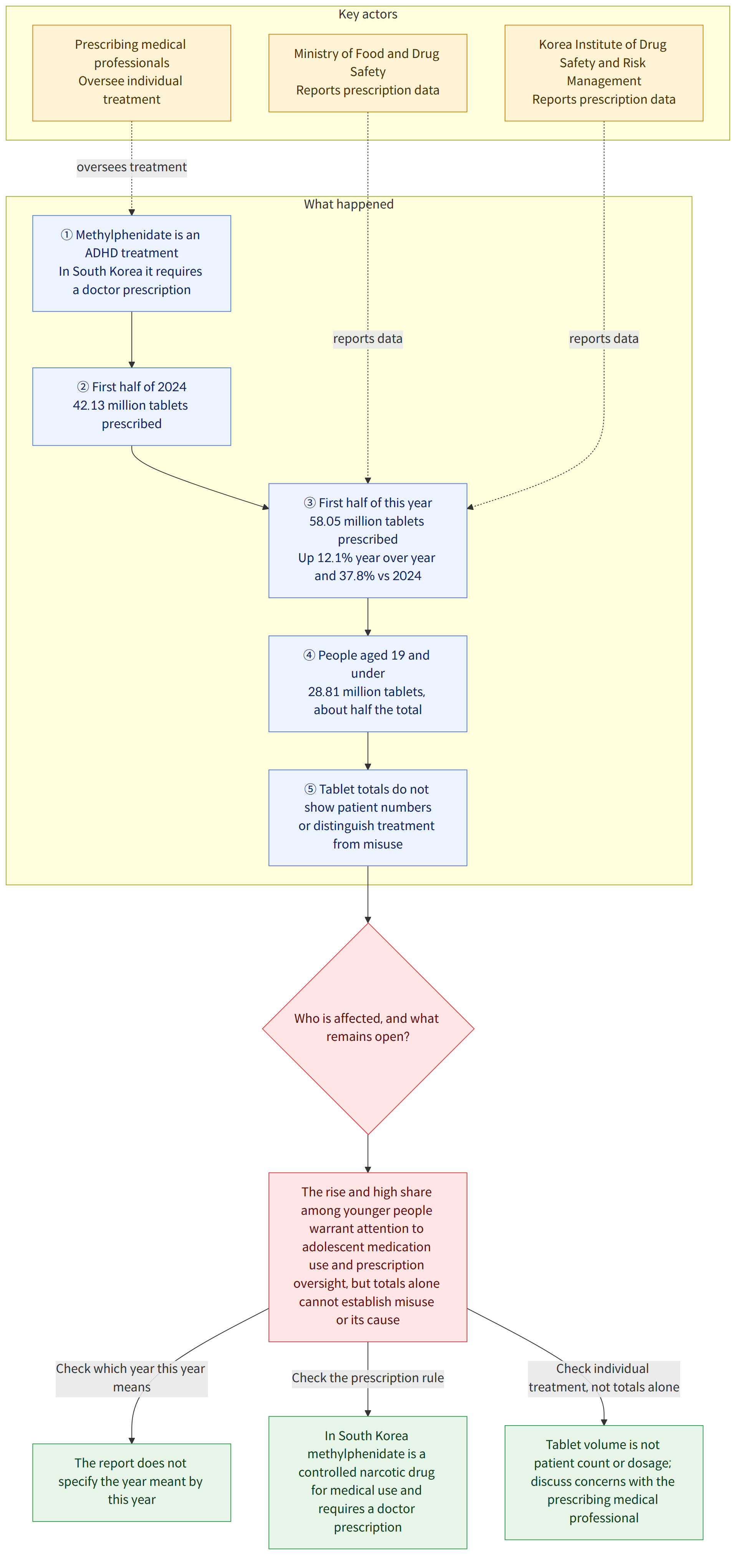
According to data from the Ministry of Food and Drug Safety (식품의약품안전처) and the Korea Institute of Drug Safety and Risk Management (한국의약품안전관리원), methylphenidate prescriptions totaled 58.05 million tablets in the first half of this year. That was up 12.1% from the same period a year earlier and 37.8% higher than the 42.13 million tablets prescribed in the first half of 2024.
Methylphenidate is a treatment for attention-deficit/hyperactivity disorder (ADHD). According to the article, it is also widely known among Korean students as a “study drug.” In South Korea, however, the medication is a controlled narcotic drug for medical use and can be obtained only with a doctor’s prescription.
Background and context
These figures show the number of tablets prescribed. They are not the same as figures that directly show the number of patients or changes in the number of people receiving prescriptions, so the increase in prescription volume alone cannot be interpreted as meaning that the number of people with ADHD rose by the same proportion.
By age, prescriptions for people aged 19 and under totaled 28.81 million tablets in the first half of this year, about half of all prescriptions. Of the prescriptions for this age group, 20.9 million tablets were for males and 7.91 million for females. These figures show the distribution of prescription volume by age group, but do not explain individual dosages or the reasons for the prescriptions.
What this news means
The rise in prescription volume and the high share accounted for by people aged 19 and under are reasons to pay attention to the use of ADHD medication among adolescents and to prescription oversight. However, prescription volume itself does not distinguish between use for treatment and misuse. The data alone make it difficult to determine whether the increase in prescriptions is related to changes in the number of patients, the duration of prescriptions, or dosages.
For example, if a family is concerned about the increase in prescriptions for a child aged 19 or under, these statistics alone cannot establish whether that child’s prescription is appropriate or constitutes misuse. Concerns about actual medication use or a prescription should be discussed with a medical professional familiar with the individual’s treatment.
What is confirmed and what remains unknown
Confirmed facts
- Methylphenidate prescriptions totaled 58.05 million tablets in the first half of this year.
- Prescription volume was up 12.1% from the same period a year earlier and 37.8% from the first half of 2024.
- Prescriptions for people aged 19 and under totaled 28.81 million tablets, about half of the total.
- Of the prescriptions for people aged 19 and under, 20.9 million tablets were for males and 7.91 million for females.
- In South Korea, methylphenidate is a controlled narcotic drug for medical use that requires a doctor’s prescription.
What remains unknown
- What caused the increase in prescriptions in the first half of this year?
- What proportion of all prescriptions involved use for purposes other than ADHD treatment or misuse?
- Which exact year does the article mean by “this year”?
What readers should check
- Check which year “this year” refers to. The report does not specify the year.
- Because prescription volume is measured in tablets, take care not to confuse it with the number of patients or individual dosages.
- If you or a family member has concerns about medication use or a prescription, it is more appropriate to discuss the individual’s treatment with the prescribing medical professional than to make a judgment based only on nationwide prescription totals.