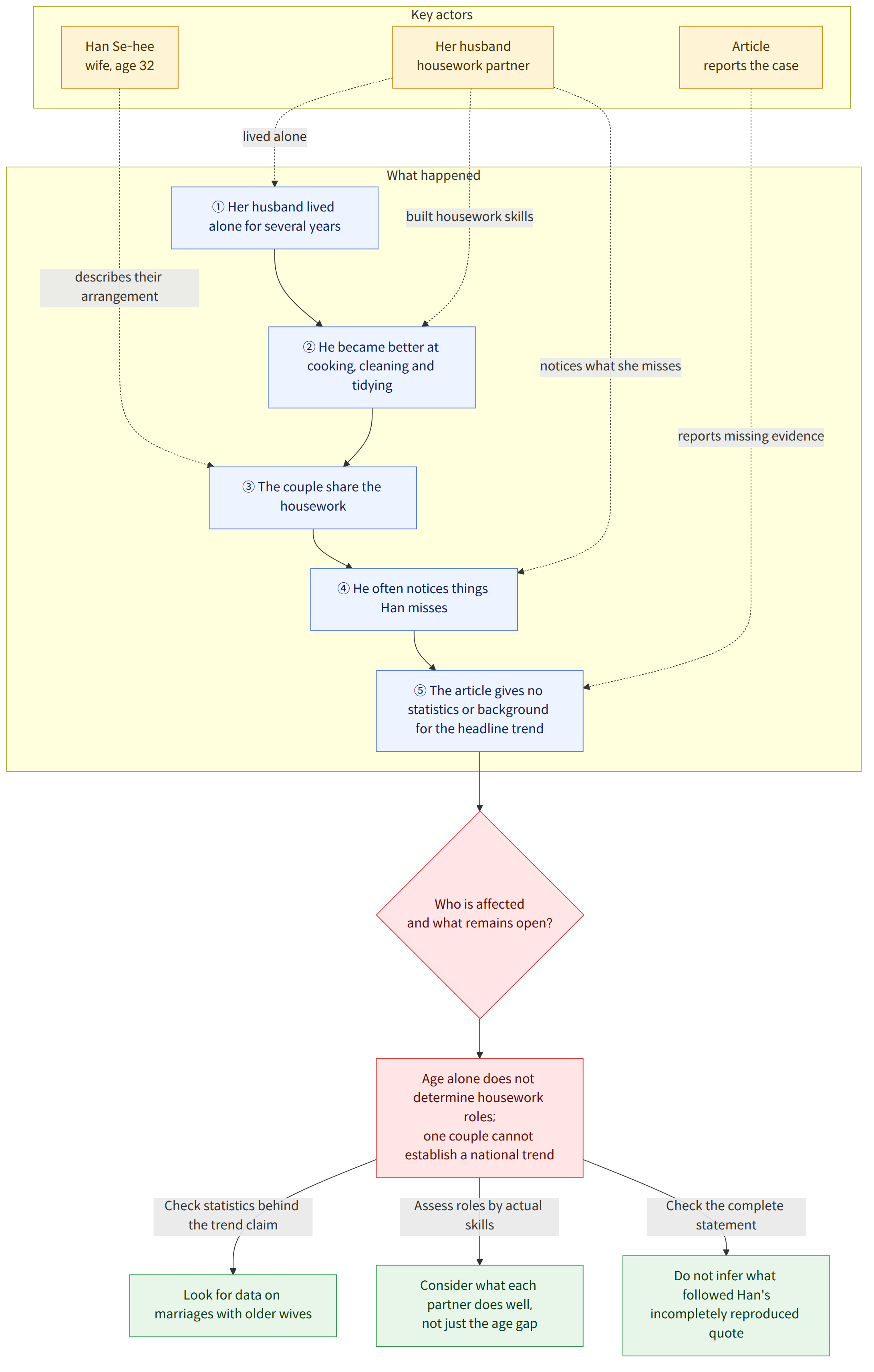
Han Se-hee, 32, is four years older than her husband. She said he is better than she is at cooking, cleaning and tidying up. The two share the housework, but Han said her husband often notices things she misses. Their experience shows that the age gap between a wife and her husband does not necessarily translate into differences in household roles or experience.
Background and context
The article’s headline says that “noona” wives are becoming more common in South Korea and that the age gap between married couples is changing. But the article content provided includes no statistics showing how much more common wives older than their husbands have become, nor any information explaining the background to the change.
What the article does establish is how Han and her husband manage their household. Han explained that her husband became more adept at housework than she is after living alone for several years. This one example cannot establish a trend among all South Korean couples or a change in the age gap between married spouses.
What this news means
The couple divides the housework, and Han says her husband is more attentive to some things than she is. This suggests that it is difficult to assume, based on age alone, who has more experience or what role each person will take on.
Han said people often say that men remain like children even as they get older, so their wives have to look after them.
For example, for a couple that expects the older partner to be better at housework, this case suggests they could consider what each person actually does well and what each tends to miss, rather than assigning roles based on age alone. This is an interpretation drawn from one case; it does not mean the same approach applies to every couple.
What is confirmed and what remains unknown
Confirmed facts
- Han Se-hee is 32 and is four years older than her husband.
- Han said she does not act at home as though she is more experienced than her husband.
- Han said her husband became better than she is at cooking, cleaning and tidying up after living alone for several years.
- The two share the housework, and her husband often notices things Han misses.
- Han said people often say that men remain like children even as they get older, so their wives have to look after them.
What remains unknown
- No information is provided on how much more common marriages between older wives and younger husbands have become in South Korea, or what statistics show this.
- The article does not explain the background or causes behind the headline’s claim that the age gap between married couples is changing.
- Han’s quote is not reproduced in full, so it is unclear what followed her remarks about this stereotype.
What readers should check
- When assessing the claim that “wives older than their husbands are becoming more common,” readers should check whether statistics are provided to support it, rather than relying on the headline alone.
- When considering how a couple divides household tasks, readers can look at what each person actually does and does well rather than assuming roles based only on the age gap.
- If an article cuts off a quote midway, it is best not to speculate about what came next until the full statement and its context can be checked.