
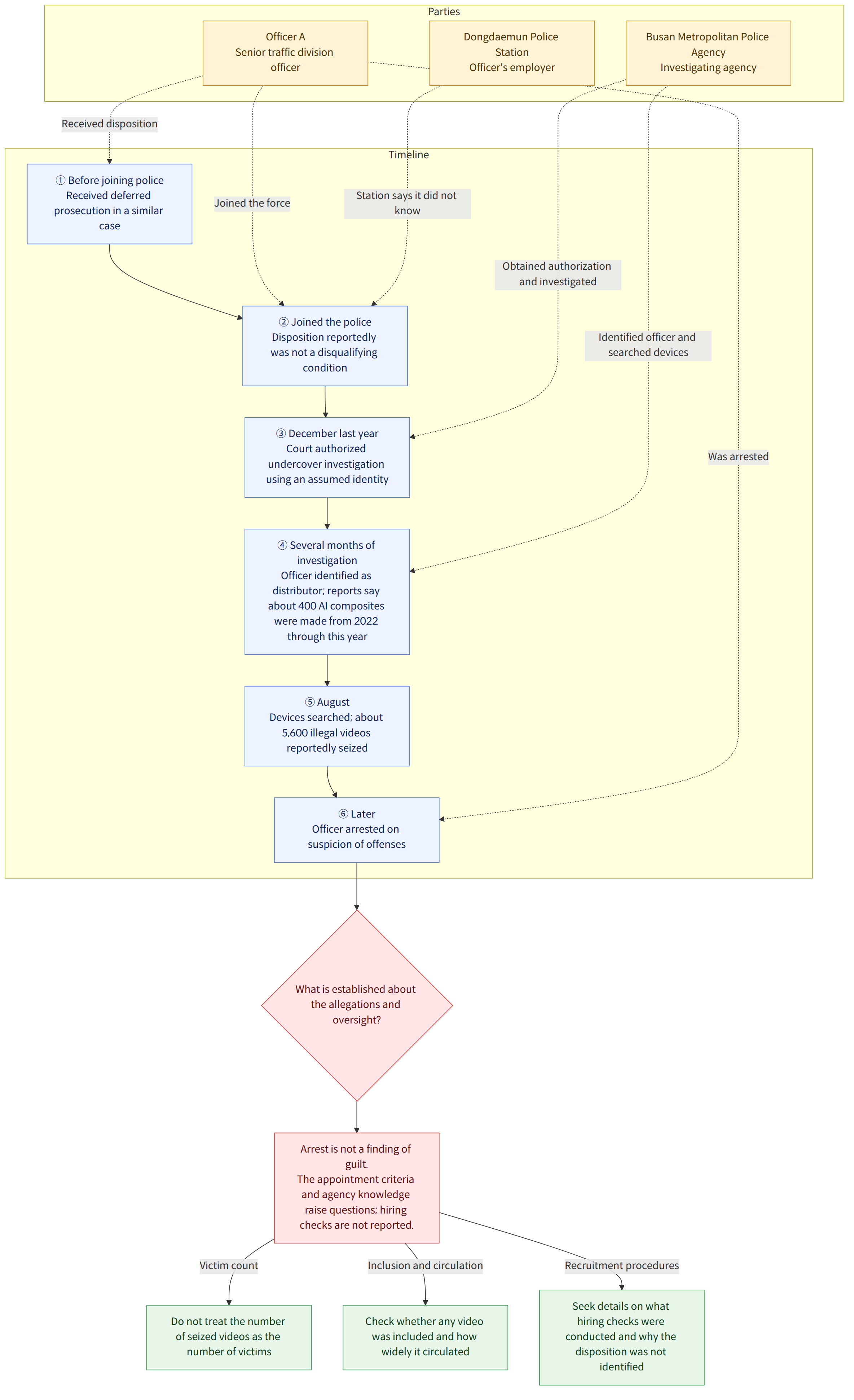
Officer A, a senior police officer in the traffic division at Seoul’s Dongdaemun Police Station (서울 동대문경찰서), was arrested last month on suspicion of possessing sexually exploitative material and fake videos, and producing and distributing fake videos, among other charges. Police searched Officer A’s mobile phone, computer and other devices, seizing illegal videos. According to reports, the total was about 5,600. The case has brought to light not only allegations that Officer A produced and distributed videos using AI to composite acquaintances’ bodies, but also the police’s statement that they did not know Officer A had received a deferred prosecution before joining the force in a similar case.
Background and context
The investigation was conducted by the Busan Metropolitan Police Agency (부산경찰청) into a Telegram chat room where fake videos were being distributed. After obtaining court authorization in December last year to conduct an undercover investigation using an assumed identity, police investigated for several months and identified Officer A as a distributor of the videos. In August, they searched Officer A’s mobile phone, computer and other devices. Officer A was later arrested.
The reported videos comprised about 2,600 fake videos, about 1,600 items of sexually exploitative material involving children and teenagers, and about 1,300 illegally filmed videos. These figures indicate the reported quantities of each type of video in Officer A’s possession; they have not been confirmed as the number of victims or the actual scope of distribution. The number of victims should not be inferred from the large volume alone.
The information reported from the police investigation goes beyond possession. Investigators found that Officer A had made about 400 fake videos using AI applications to composite acquaintances’ bodies, from 2022 through this year. The investigation also found evidence that Officer A had secretly filmed women’s bodies. However, the reports do not establish how many of all the videos Officer A made personally or how far each one was circulated.
The case also raises questions about the police organization’s responsibility for recruitment and oversight. Officer A reportedly received a deferred prosecution before joining the police in a similar case, but according to the reports, this disposition is not a disqualifying condition for appointment under the Police Officers Act (경찰공무원법). An official at Dongdaemun Police Station said the station did not know that Officer A had received a deferred prosecution before joining the force. What is currently clear, then, is that there was a gap between the appointment criteria and what the agency actually knew; the reports do not explain what checks were conducted during the hiring process.
What this news means
For people who have been harmed or may appear in the videos, it may be important to establish whether and how widely the videos were circulated. But the reports do not state how many victims there are, who received the videos, or what support has been provided to victims. It is especially important not to treat the number of videos seized as the number of victims.
Beyond investigating the individual criminal allegations, the police organization may also need to examine what information could have been checked at the time of appointment and what procedures were actually followed. The fact that a deferred prosecution was not a disqualifying condition is not enough to determine whether the appointment process was appropriate or inappropriate. Since an official said the agency did not know about the disposition, further information is needed about why it was not identified and how the relevant procedures operated.
For example, if someone is concerned that a video using a composite of their face or an acquaintance’s face may have been distributed, the number of videos seized alone cannot establish whether that person’s video was included or circulated. Whether it was included and the extent of its circulation are questions that would need to be resolved during the investigation.
Related procedures and support information
Arrest is a procedure for physically detaining a suspect during the investigation stage, and arrest does not mean that guilt has been established. According to an internal legal guide, a suspect who has been arrested may request a review of the legality of detention (구속적부심사) during the investigation stage. The suspect, as well as their lawyer, legal representative, spouse, lineal relatives, siblings, family members, cohabitants or employer, may make the request, and the court decides whether the person should be released.
After charges are filed, the procedure changes and the defendant may apply for bail (보석). Family members and others may also apply, but the court decides whether to grant bail and what conditions to impose after considering the specific circumstances. Even if bail is granted, conditions such as a pledge to appear in court or restrictions on residence may apply. If the conditions are violated or the defendant fails to appear in court without a valid reason, bail may be revoked or the bond forfeited. The reports provided do not say whether Officer A has been charged or applied for a review of the legality of detention or for bail.
Differences among reports
Reports agree that Officer A was arrested last month, but one specifies the arrest date as September 16. Others say only “last month.”
Reports also differ in their descriptions of when the videos were made and distributed. One reported that Officer A made about 400 fake videos from 2022 through this year. Another gave a narrower period, from March 2022 through July this year, and said that dozens were distributed in a Telegram chat room. Because reports differ in how they describe the period and scale of distribution, it is difficult to treat unconfirmed details as settled.
What is confirmed and what remains unknown
Confirmed facts
- In December last year, the Busan Metropolitan Police Agency received court authorization to conduct an undercover investigation into a Telegram chat room where fake videos were being distributed.
- After investigating for several months, police identified Officer A as a distributor and searched Officer A’s mobile phone, computer and other devices in August.
- Officer A was arrested on suspicion of possessing sexually exploitative material and fake videos, and producing and distributing fake videos, among other charges.
- The videos reportedly in Officer A’s possession totaled about 5,600: about 2,600 fake videos, about 1,600 items of sexually exploitative material involving children and teenagers, and about 1,300 illegally filmed videos.
- Officer A was placed on standby immediately after being notified that an investigation had begun and was relieved of their position after the arrest. A police official said the agency did not know about the deferred prosecution before Officer A’s appointment.
What remains unknown
- How did the investigation and trial of Officer A proceed afterward?
- How many victims appear in the videos seized, and how widely were the videos distributed?
- What support for victims or measures to stop the videos’ distribution were provided?
- Why could the deferred prosecution not be identified at the time of appointment, and what procedures were actually used to check for it?
What readers can check
- The family members or legal representatives of a suspect arrested in a similar case can ask a lawyer whether they may request a review of the legality of detention during the investigation stage. A bail application is a separate procedure available after charges are filed, so they should first establish the current stage of the case.
- If bail is granted, the conditions set by the court and the dates for court appearances should be checked. Violating the conditions or failing to appear without a valid reason may result in bail being revoked and the bond being forfeited.
- Whether someone was victimized in this case, and how widely the videos were distributed, cannot be determined from the reported number of videos seized. It is worth watching for further information about the investigation and support measures for victims.
References
- How Should You Respond to Arrest, Detention, Release, and Bail?
- Other coverage consulted: koreatimes.co.kr
- Other coverage consulted: koreatimes.co.kr