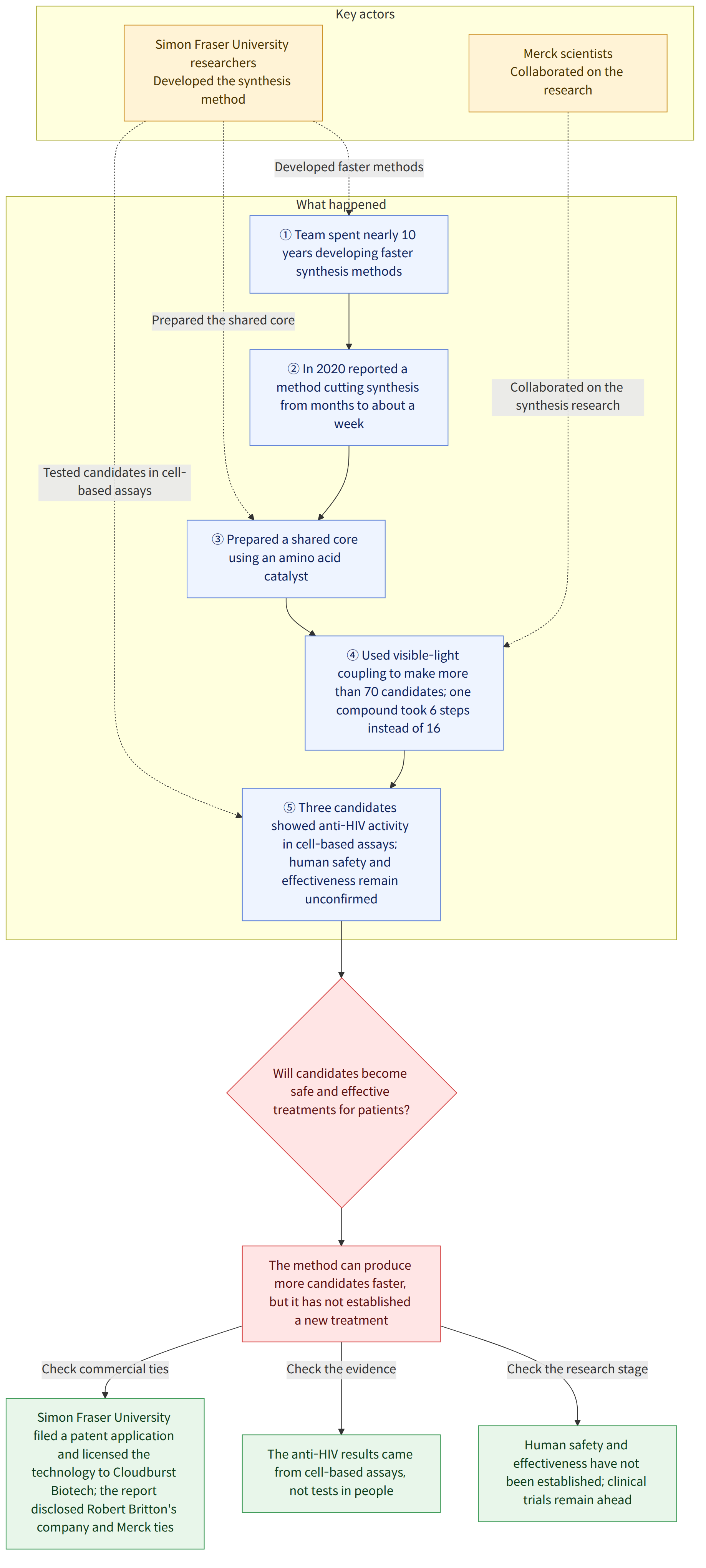
Researchers at Simon Fraser University (사이먼프레이저대학교), working with Merck scientists, have presented a synthesis method for making nucleoside analogues (compounds designed to mimic the building blocks of genetic material and interfere with viral replication) more quickly and in greater variety. Using the method, the researchers made more than 70 candidate compounds, three of which showed promising activity against HIV in cell-based assays. These are early laboratory results, however, and a long process remains before clinical trials.
Background and context
Remdesivir was one of the drugs doctors used early in the COVID-19 pandemic. The original report explains that it is a nucleoside analogue and that drugs in the same class are also used to treat HIV, hepatitis and some cancers. These compounds work by interfering with the process by which viruses replicate their genetic material.
The challenge is that making these molecules is difficult. Conventional methods typically involve a lengthy series of reactions to produce a single molecule, and researchers have to start the synthesis process over to test a different candidate. The research team has spent nearly 10 years developing ways to speed up this process. In 2020, it reported a method that bypassed most of the traditional synthesis steps, reducing the time needed to make a molecule from months to about one week.
Rather than making each candidate from scratch, the approach in this study starts by preparing a core component that can be used across multiple molecules. The researchers used an amino acid catalyst (a substance that helps a chemical reaction take place) to make a core molecule containing a chemical linker, then joined it to various molecular fragments in a single reaction driven by visible light. Because this final coupling step can be done quickly, different candidates can be made in parallel, the researchers say.
The compounds made using this method included variants in which the oxygen in the sugar ring was replaced with sulfur or nitrogen. The researchers also made forms designed to enter cells more easily. They also reported synthesizing in six steps a compound that had previously required 16.
What this news means
The new synthesis method does not mean that an effective new treatment has been identified. The researchers say the platform can produce, in weeks rather than months or years, a pool of candidates 10 to 100 times larger than was practically possible before. Producing candidates more quickly and in greater variety could give researchers more options to compare and test, potentially improving the ability to respond to new viruses. But expanding the number of candidates and developing a drug that can actually be used are separate steps.
For example, if a researcher is looking for a molecular form that could act against a particular virus, this method could be used to attach different molecular fragments to a shared core and produce multiple candidates for comparison in experiments. This is a hypothesis about how the method could increase the speed and breadth of candidate discovery; it does not mean that any of the candidates would be safe or effective in people.
The original report says that the three anti-HIV candidates performed in cell-based assays at a level similar to some already approved HIV treatments in their ability to block the virus. However, their safety or effectiveness in people has not been established. This is why patients waiting for treatment should understand the results as a possibility at an early research stage, rather than as a new treatment option available now.
It is also worth considering disclosures of potential conflicts of interest alongside the research findings. Simon Fraser University filed a patent application for the synthesis of nucleoside analogues, and the technology was licensed to Cloudburst Biotech. The original report discloses that Robert Britton is a co-founder, shareholder and board member of the company, and was a paid consultant to Merck in 2024. This is separate from the evidence used to assess the efficacy of the research findings, but it is information readers need to understand the research’s commercial connections.
What is established and what remains unknown
What is established
- The researchers synthesized candidate compounds using an amino acid catalyst and a single reaction driven by visible light.
- The method produced a library of more than 70 nucleoside analogues.
- A compound that previously required 16 steps was synthesized in 6.
- Three compounds showed promising anti-HIV activity in cell-based assays, at a level similar to some approved HIV treatments, according to the original report.
- A long process remains before clinical trials.
What remains unknown
- What are the specific names and structures of the three compounds that showed anti-HIV activity?
- Can the safety and effectiveness of these compounds also be confirmed in tests involving people?
- If clinical trials proceed, what will their timing and process be?
What readers should check
- When encountering research results, first distinguish whether they come from cell experiments or clinical trials involving people.
- Checking whether the specific names and structures of the candidate compounds and the results of follow-up tests have been released can help readers assess whether the early activity leads to further development.
- When interpreting the research, readers can also consider the disclosed potential conflicts of interest, including patent applications, technology licensing, and researchers’ company or consulting relationships.