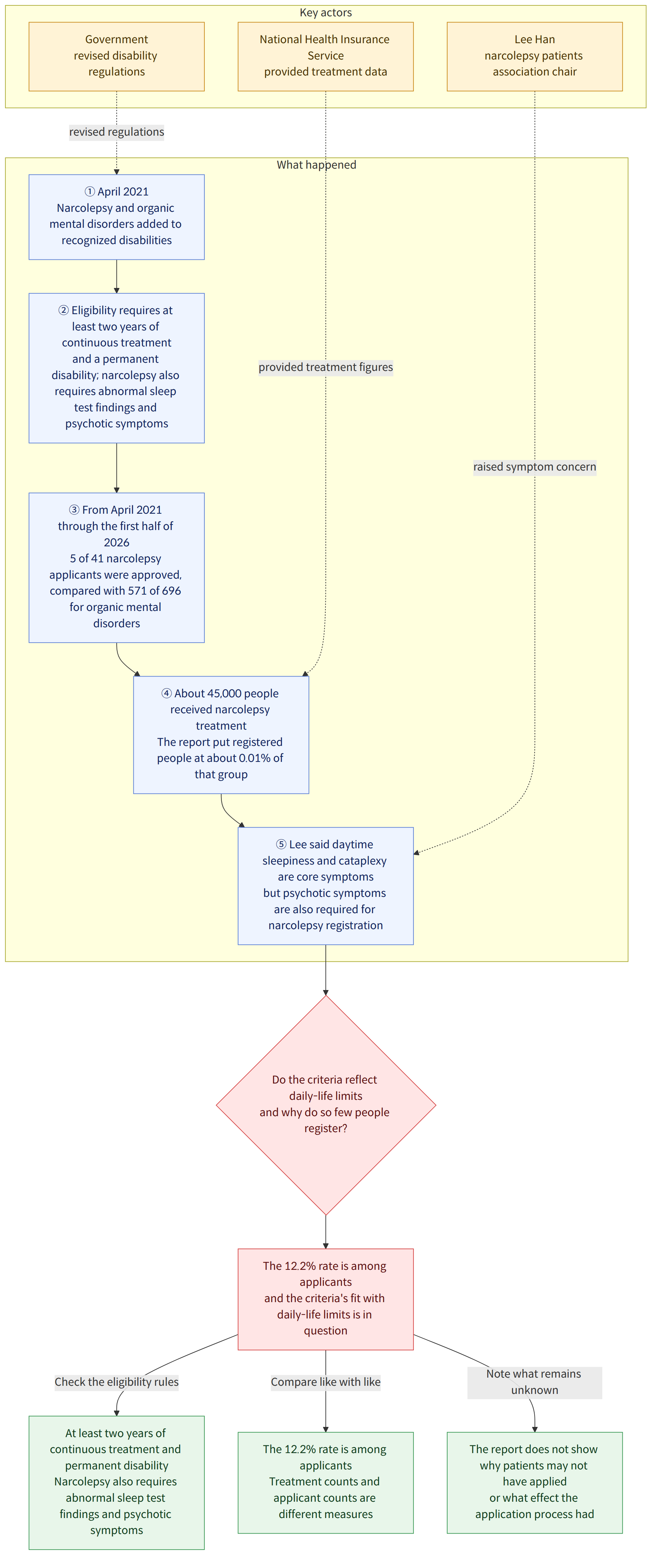
Narcolepsy and organic mental disorders were newly added to the list of recognized disabilities in 2021, but the number of people actually registered as disabled differs greatly from the number receiving treatment. From April 2021 through the first half of 2026, five of the 41 people who applied for a disability assessment for narcolepsy were approved for registration, a rate of 12.2%. For organic mental disorders, 571 of 696 applicants, or 82.0%, were registered. With such markedly different outcomes for the two conditions, a key question is whether the criteria for narcolepsy adequately reflect patients’ actual symptoms and limitations in daily life.
Background and context
In April 2021, the government revised the subordinate regulations of the Disability Welfare Act (장애인복지법) to add organic mental disorders and narcolepsy to the list of recognized disabilities. Organic mental disorders are conditions in which damage to the brain’s nerves causes delusions, hallucinations, or personality changes, while narcolepsy causes excessive daytime sleepiness. According to the report, this was the first expansion of the list of recognized disabilities in 18 years, since 2003.
Being included among the conditions eligible for recognition does not mean that everyone receiving treatment for one of them is eligible to register as disabled. The current criteria, as described in the report, allow a person with either condition to receive a disability diagnosis if the condition has not improved despite at least two years of continuous treatment and the disability is considered permanent. In addition, people with narcolepsy must have abnormal findings on tests such as polysomnography (a test that measures bodily signals during sleep), as well as psychotic symptoms.
These criteria are important for understanding the difference between the number of people receiving treatment and the number registered. According to data from the National Health Insurance Service (국민건강보험공단), about 92,000 people received treatment for organic mental disorders during the period. This figure includes the same patients more than once across different years. The number of people receiving treatment for narcolepsy was reported as 45,000, compared with five registered people. The report put the number registered at about 0.01% of those receiving treatment, but the treatment figures and the number of applicants for disability assessments are different measures. This percentage should not be read as an individual patient’s likelihood of being registered as disabled.
What this news means
The 12.2% approval rate for narcolepsy refers to the outcome among people who had reached the application stage. The registration rate relative to the number receiving treatment, by contrast, compares a broader group of people receiving care with the number registered. Distinguishing between the two helps avoid confusing the effects of whether someone applied with those of the assessment criteria when interpreting the low number of registrations. The report alone, however, does not show why patients may not have applied or what effect the application process may have had.
The gap between narcolepsy’s main symptoms and the assessment requirements is also at issue. Lee Han, chair of the Korean Narcolepsy Patients Association (한국기면병환우협회), said that daytime sleepiness and cataplexy (a sudden loss of muscle strength) are core symptoms for patients, but that the current criteria also require psychotic symptoms, making it difficult for most people to qualify. The issue raised is not only whether a condition has been included among those recognized as disabilities, but also how the difficulties it causes in daily life are reflected in the assessment criteria.
The groups receiving treatment for organic mental disorders and those registered as disabled also differed in composition. Among those receiving treatment, 53.5% were aged 70 or older and 53.0% were women. Among registered people, 17 (3.0%) were aged 70 or older, while 76.7% were men. These differences alone cannot establish why registration rates may be lower among older people or women. They do, however, show that it is difficult to assume the group of registered people has the same profile as the overall group receiving treatment.
For example, even if someone being treated for narcolepsy experiences limitations in daily life because of daytime sleepiness, the registration outcome may depend on how the criteria described in the report are assessed in that person’s case: the duration of treatment, whether the disability is considered permanent, test findings, and the requirement for psychotic symptoms. This is a hypothetical example and does not predict the assessment outcome for any individual applicant. Assembly member Seo Mi-hwa said the disability registration system itself should be overhauled so that services addressing limitations in people’s actual lives are made available to them.
Related systems and support information
The system change confirmed by the report is the addition of the two conditions to the list of recognized disabilities through the April 2021 revision of the subordinate regulations of the Disability Welfare Act. The criteria presented alongside that change require that, for both conditions, the disability be considered permanent with no improvement despite at least two years of treatment; for narcolepsy, psychotic symptoms are an additional requirement. Therefore, the fact that a condition is on the list of recognized conditions does not guarantee registration.
The report does not explain what documents are required to apply, the steps in the assessment process, or how to appeal or request a reassessment if registration is denied. It also does not establish whether the government plans to revise the assessment criteria. Therefore, this article alone cannot determine eligibility or the steps to take after a denial. Anyone considering using the system should separately check the official criteria and guidance currently in effect.
What is confirmed and what remains unknown
Confirmed facts
- From April 2021 through the first half of 2026, 571 of the 696 people who applied for an assessment for organic mental disorders (82.0%) were registered.
- During the same period, five of the 41 people who applied for an assessment for narcolepsy (12.2%) were approved for registration.
- For both conditions, the criteria include that the disability be considered permanent, with no improvement despite at least two years of treatment.
- The report said that narcolepsy applicants must have psychotic symptoms in addition to abnormal test findings.
What remains unknown
- Does the government actually plan to change the assessment criteria?
- What are the specific procedures and outcomes for applicants whose registration is denied and who appeal or request a reassessment?
- Have application procedures or a lack of relevant information, beyond the assessment criteria, also contributed to the low number of registrations?
What readers should check
- If you are considering applying for registration, check the latest official guidance on the assessment criteria and procedures that apply to your condition. This report does not specify the required documents or requirements at each stage of the assessment.
- For narcolepsy, note that the report mentions the requirements of at least two years of treatment and a permanent disability, as well as test findings and psychotic symptoms. Do not use the article alone to judge your chances of approval.
- The report does not cover the appeal or reassessment process if registration is denied. If you are in that situation, check the applicable official procedures and deadlines separately.