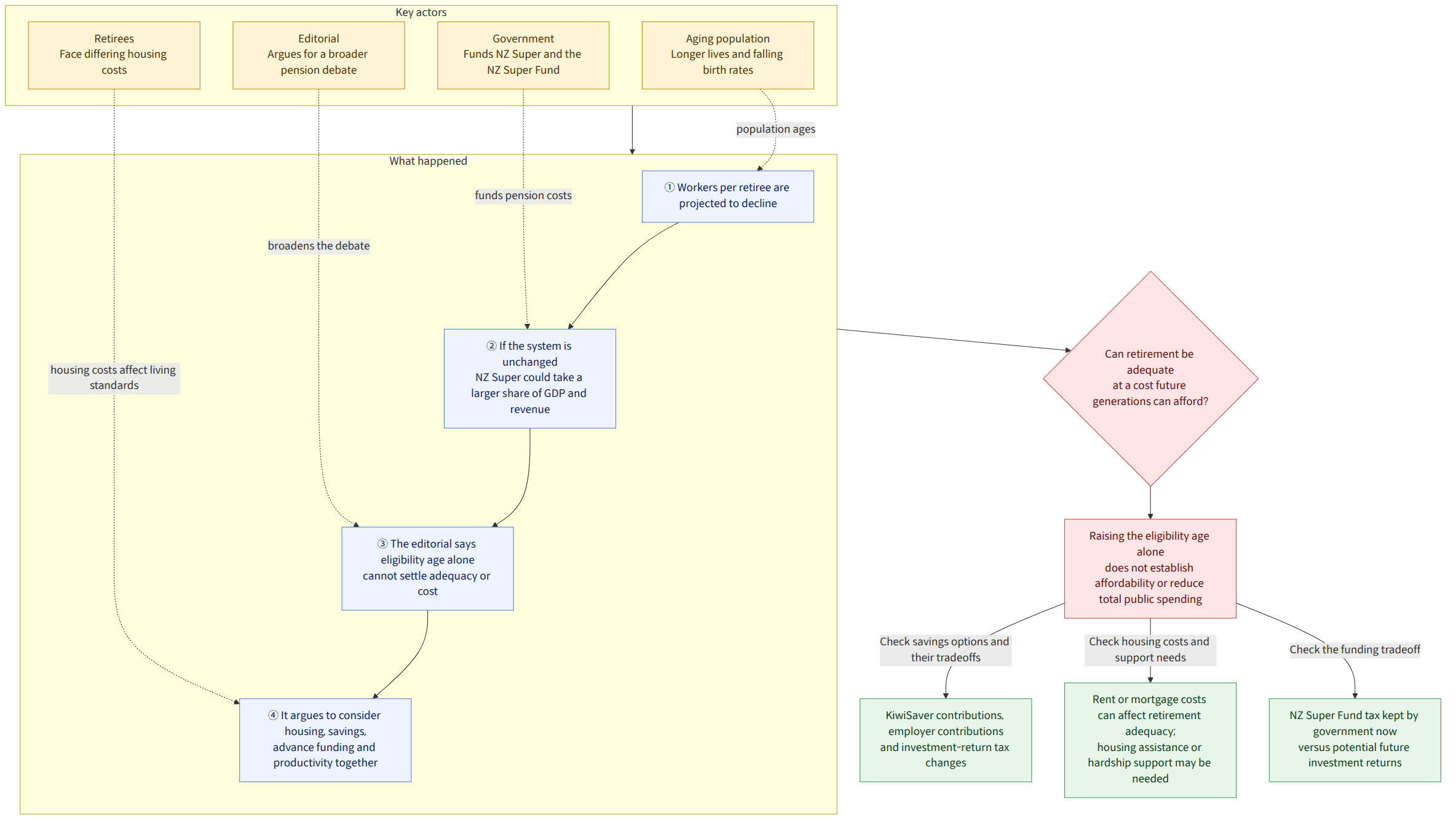
As New Zealand’s population ages, retirees are expected to live longer, birth rates are falling, and the number of workers relative to retirees is projected to decline. If the current system is unchanged, New Zealand Superannuation (뉴질랜드의 공적 노후연금; NZ Super) could also account for a larger share of gross domestic product (GDP) and government revenue. An editorial argues that the debate should not be confined to whether the eligibility age for the pension should rise. Instead, it should ask how to provide an adequate and dignified retirement at a cost future generations can afford.
Background and context
It is important to ask whether NZ Super is fiscally sustainable, but adjusting the eligibility age alone cannot determine whether people can afford to live well in retirement. The editorial describes retirement adequacy as personal resources plus government support, minus the costs of retirement. From this perspective, it is necessary to consider not only the amount of the public pension but also personal savings and expenses such as housing costs.
Housing circumstances affect this calculation. In the past, most New Zealanders owned a home by age 65, and many retired with their mortgages paid off. That matters because a person’s living expenses can differ depending on whether they have rent or mortgage payments to make, even if they receive the same pension.
However, rising house prices can delay the purchase of a home or extend the time it takes to pay off a mortgage, and some people may be unable to buy a home at all. The editorial says that, as a result, a significant number of future retirees may face substantial housing costs. In this context, housing policy is also a policy area that affects the cost of retirement.
What this means
If the debate focuses only on raising the eligibility age, it may overlook the circumstances of retirees who struggle to afford housing. The editorial points out that even if NZ Super is reduced, other forms of government spending—such as housing assistance or hardship support—may be needed for retirees facing higher housing costs. This is why a change in one category of pension spending cannot be assumed to lead directly to a reduction in overall public spending.
Options for increasing personal savings include raising contributions to KiwiSaver (뉴질랜드의 퇴직 저축 제도), changing employer contributions, and adjusting taxes on investment returns. More savings could give retirees the option of relying less on government support, but there are costs. Higher employee contributions could put pressure on household budgets, while higher employer contributions could increase business costs and affect wages. Expanding tax incentives could shift the burden to other taxes, and people with low or unstable incomes may still fail to accumulate enough retirement assets even if they save more.
For example, if someone approaching retirement does not own a home and must continue paying rent, the person’s retirement living standard cannot be fully assessed from the amount of NZ Super alone. Even when personal savings and government support are considered together, the resources needed will vary depending on housing costs. This is a hypothetical example; it does not describe the actual pension or housing costs of any particular person.
The New Zealand Superannuation Fund (미래 연금 비용을 지원하기 위해 자산을 쌓는 기금; NZ Super Fund) invests money from current taxpayers so that future governments can use the accumulated assets to meet the rising cost of NZ Super. According to the editorial, the fund paid about NZ$1.2 billion in tax on investment returns in 2026, while scheduled government contributions were considerably smaller. The editorial calculates that if the tax were instead kept invested and earned a 7.2% annual return, it could grow to about NZ$9.66 billion in 30 years. However, it must also be considered that not collecting the tax would reduce the resources available for the government to use now.
Productivity growth is also presented as an option, but the editorial says it would be difficult to solve the fiscal problem through productivity alone. New Zealand’s productivity growth averaged 0.7% a year over the past 20 years, and NZ Super is linked to wages. Higher productivity could increase the economy’s capacity, but the pension payments could also rise in line with wages, limiting how much productivity growth alone could reduce the fiscal burden.
What is established and what remains unknown
What is established
- An aging population and falling birth rates are expected to reduce the number of workers relative to retirees; if the current system is maintained, NZ Super could make up a larger share of GDP and government revenue.
- Home purchases and mortgage repayments may take longer than in the past, raising the possibility that future retirees will face higher housing costs.
- Higher KiwiSaver contributions could increase savings, but may affect household budgets, business costs, wages, or other taxes.
- The NZ Super Fund invests money now to prepare for future pension costs, and the editorial presents figures comparing tax receipts with contributions, as well as a long-term investment assumption.
- The editorial proposes considering housing costs, savings, advance funding through the fund, productivity, employment, and economic growth together.
What remains unknown
- The editorial does not specify what changes, if any, the author supports to the NZ Super eligibility age or the way benefits are calculated.
- It is not established how changes to taxes paid by the NZ Super Fund or to government contributions would actually affect the burden on future generations.
- The projected fund value in 30 years is based on an assumed annual return of 7.2%; the actual result cannot be determined from this information alone.
What readers can check
- When reviewing retirement policy proposals, readers can check whether they address housing costs and personal savings as well as the eligibility age.
- If changes to KiwiSaver contributions or tax treatment are proposed, it is worth checking who would bear the costs: households, employers, or other taxpayers.
- Proposals concerning the NZ Super Fund can be assessed by comparing their effects on current government finances with their effects on future fund accumulation.