
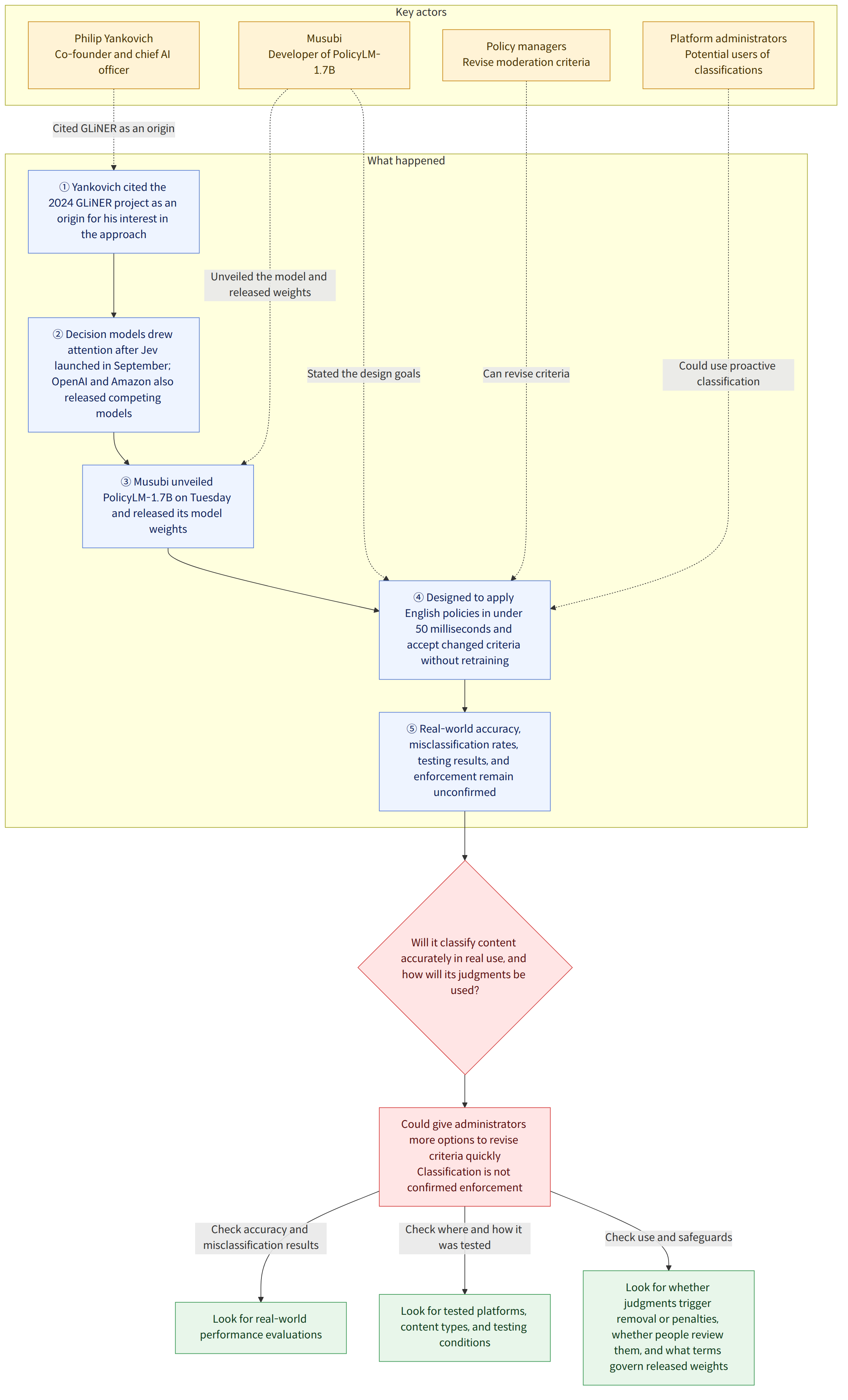
On Tuesday, Musubi unveiled PolicyLM-1.7B, a lightweight model for real-time content moderation, and released its model weights. The company’s stated goal is to apply content policies written in English to messages and produce a result in under 50 milliseconds. The key feature is that the model is designed to let users change the criteria without retraining it every time a policy changes.
Background and context
Musubi said PolicyLM-1.7B was designed to deliver costs and speeds comparable to those of AI classifiers used for content moderation on most social platforms. At the same time, the company said its goal is to use the flexibility of the latest large language models (LLMs) to apply complex policies without additional specialized training. This describes the model’s design objectives; it does not mean that the same performance has been confirmed on actual platforms.
According to the company, policy managers can revise policies as needed without retraining the model each time the criteria change. The approach aims to separate “changing the criteria for making a decision” from “retraining the model” in content moderation. As content volumes grow and policies are adjusted, this could make it possible to try operational changes more quickly than in a system where retraining is required to apply new criteria.
The decision model to which this model belongs is designed to produce results from a set of predefined choices, rather than generate text like a conventional large language model. The original report says decision models typically output the probability of an outcome, while distinguishing PolicyLM-1.7B as producing a binary judgment on whether content belongs to a particular category. According to the report, limiting the available output choices can make the model faster and cheaper to run than a large language model while retaining the flexibility of the transformer architecture.
Decision models drew attention after TypeSafe AI released Jev in September, and OpenAI and Amazon also released competing models, the original report said. Musubi co-founder and chief AI officer Philip Yankovich said he became interested in this approach before Jev was released. He cited the 2024 project GLiNER, which used several of the same techniques, as its origin.
What this means
Content moderation involves not only setting policies but also classifying messages posted to a platform according to those criteria. If PolicyLM-1.7B’s design works as intended, its ability to apply new criteria without waiting for the model to be retrained could give administrators of platforms handling large volumes of content more operational options. Yankovich said the model gives administrators a way to proactively classify content.
However, “classification” and “enforcement” are not the same thing. The model’s output, as described in the original report, is a judgment about whether content belongs to a particular category. The report does not say whether that judgment leads to posts being removed or users being penalized, or whether people review the results. Rather than conclude that the model directly automates specific content actions, it is important to distinguish that it was introduced as a tool for classifying content according to moderation criteria.
For example, if a platform wanted to change the wording of an existing policy to apply new criteria, Musubi says it could modify and apply the policy itself without retraining the model. This suggests the possibility of simplifying the process by which operators revise and apply criteria. But the information released does not establish how accurately the model applies revised criteria or how misclassified content would be corrected.
What is confirmed and what remains unknown
Confirmed facts
- Musubi unveiled PolicyLM-1.7B on Tuesday and released its model weights.
- The model is designed to apply English-language content policies to messages in under 50 milliseconds.
- Musubi says policy managers can revise policies without retraining the model when the criteria change.
- PolicyLM-1.7B is described as producing a binary judgment on whether content belongs to a particular category.
What remains unknown
- What are its real-world moderation accuracy and misclassification rate?
- On which platforms or types of content was it tested, and what were the results?
- What terms of use or restrictions apply to the released model weights?
What readers should watch for
- If news of real-world adoption or performance evaluations emerges, it will be important to examine not only accuracy but also the rate of content misclassification and the testing environment.
- Anyone planning to use the open weights directly should check the applicable terms and restrictions. The original report does not provide those details.
- If a platform adopts the model, it is worth watching to see whether it discloses the procedures through which the model’s classifications lead to actual content actions, as well as how those decisions can be reviewed and revised.