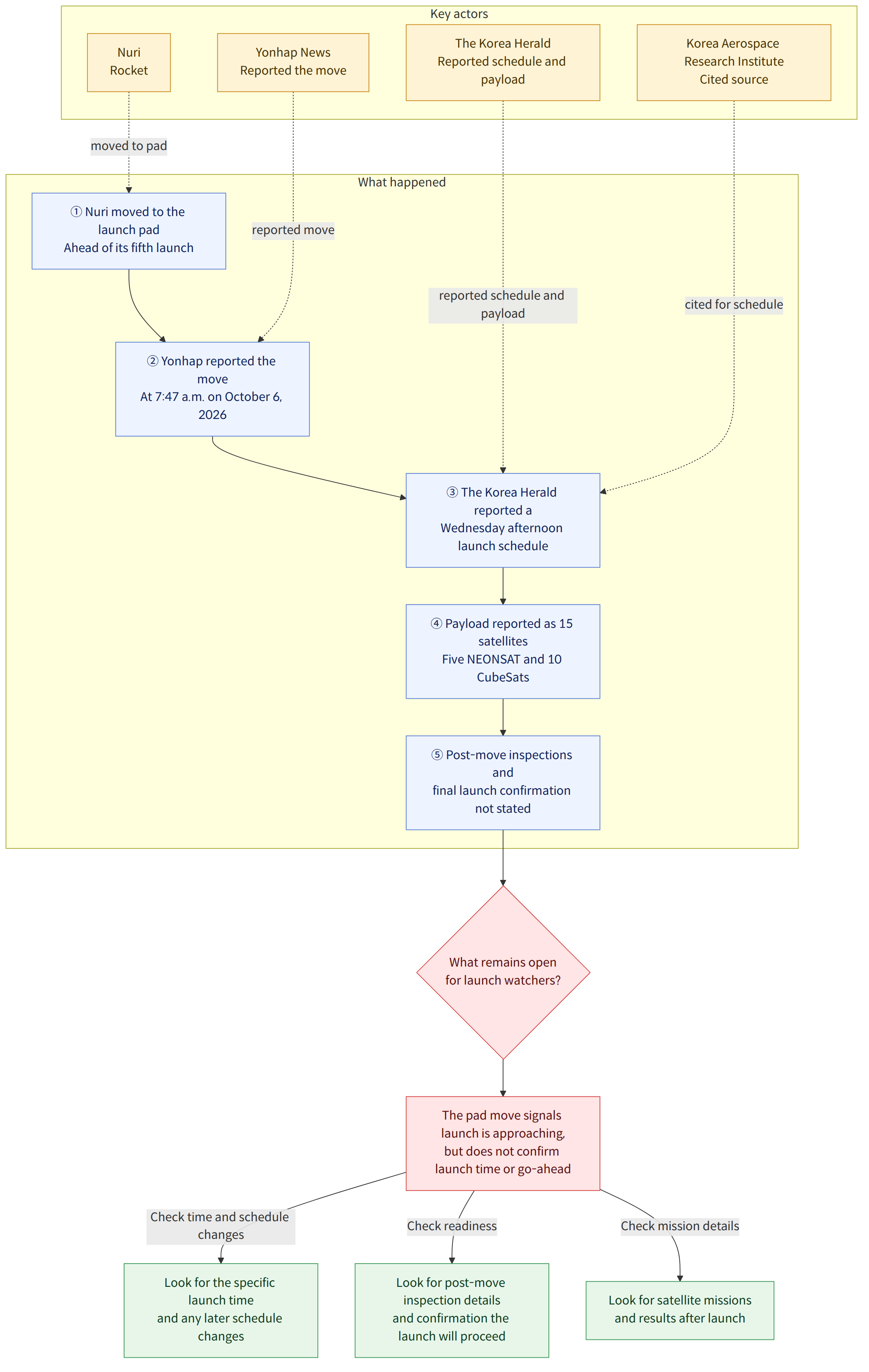
Nuri (누리호) was moved to the launch pad ahead of its fifth launch. Yonhap News (연합뉴스) reported this in a headline at 7:47 a.m. on October 6, 2026, but its article did not include the scheduled launch time, payload or procedures following the move to the launch pad. A separate report published the same day provided additional information about the launch schedule and payload.
Background and context
Moving to the launch pad is an indication that the rocket has entered a preparatory stage ahead of launch. However, the move alone does not mean that all preparations are complete or that the launch is confirmed. The reports provided do not establish what inspections will take place after the move.
The Korea Herald reported, citing the Korea Aerospace Research Institute (한국항공우주연구원), that Nuri was scheduled to launch from the Naro Space Center on Wednesday afternoon. According to the report, the rocket will carry 15 satellites: five NEONSAT (New Space Earth Observation Satellite Constellation; 신우주 지구관측 위성군) satellites and 10 CubeSats.
What this news means
For readers following the launch, the move to the launch pad is a sign that the scheduled date is approaching, but it does not confirm the actual launch time or whether the launch will go ahead as planned. The payload details show that the mission involves not only launching the rocket itself but also sending several satellites into orbit. The information provided does not say what missions the satellites will perform or what results they will achieve after launch.
For example, anyone hoping to watch the launch in person or via a broadcast should check for a specific launch time and any schedule changes announced later, rather than setting a time based only on the report that the rocket has moved to the launch pad. The scheduled launch time may differ from the actual launch time.
What is confirmed and what remains unknown
Confirmed facts
- Nuri was moved to the launch pad ahead of its fifth launch.
- The Yonhap News article was published at 7:47 a.m. on October 6, 2026, and its author was Kim Eun-jung.
- The Korea Herald reported, citing the Korea Aerospace Research Institute (한국항공우주연구원), that the launch was scheduled for Wednesday afternoon.
- According to The Korea Herald, the payload consists of 15 satellites: five NEONSAT (New Space Earth Observation Satellite Constellation; 신우주 지구관측 위성군) satellites and 10 CubeSats.
What remains unknown
- The specific scheduled launch time and whether the launch will ultimately go ahead
- The inspection and preparation procedures to be carried out after the move to the launch pad
- The specific missions of each satellite and the results after launch
References
- Other coverage consulted: m.koreaherald.com