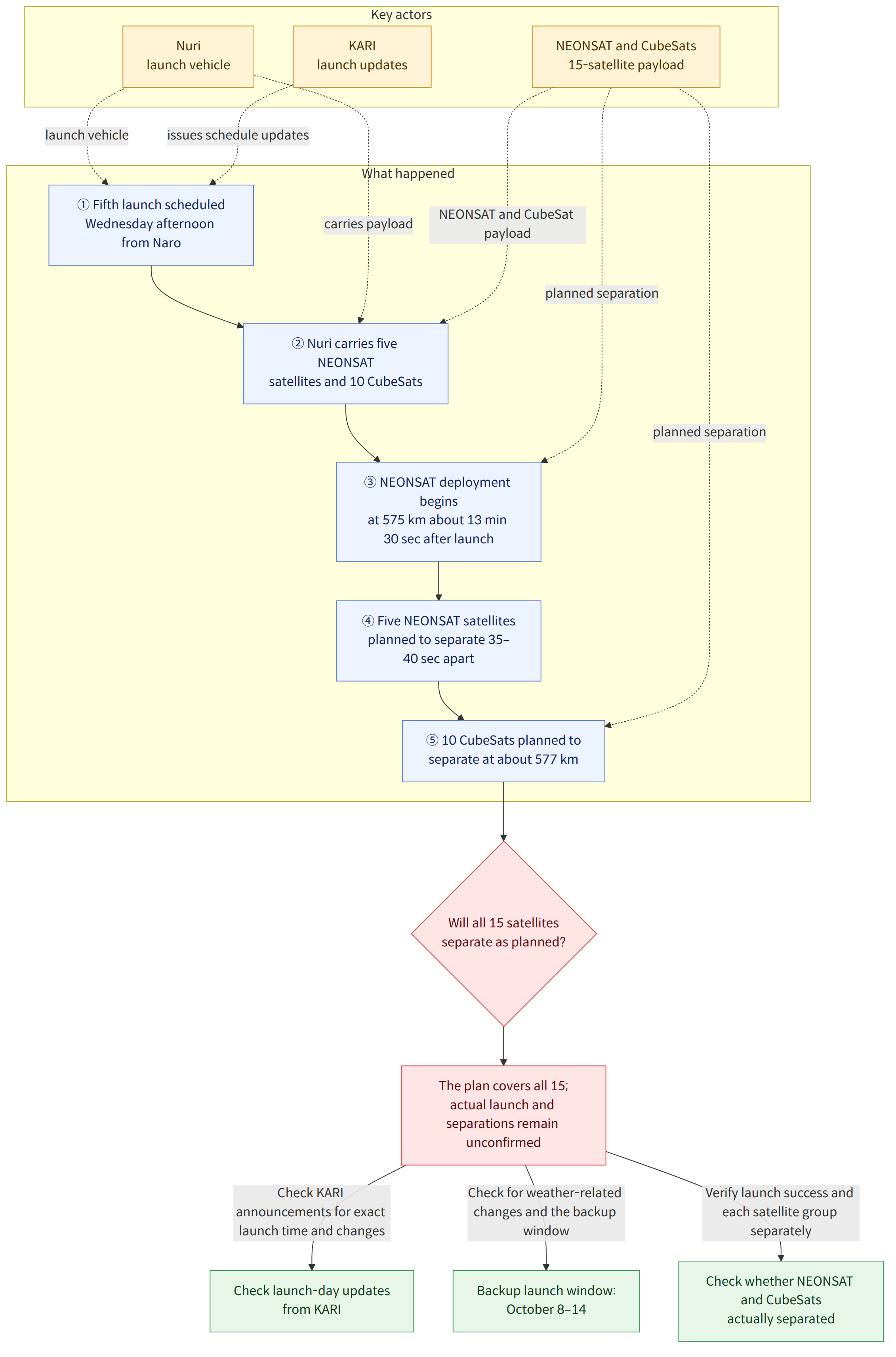
Nuri’s (누리호) fifth launch is scheduled for Wednesday afternoon from the Naro Space Center (나로우주센터) in Goheung, South Jeolla Province (전라남도). The payload (satellites and other items carried and launched by a rocket) consists of five NEONSAT satellites (네온샛), part of a New Space Earth-observation satellite constellation, and 10 CubeSats. The launch plan includes South Korea’s first sequential deployment of five constellation satellites at set intervals.
Background and context
The focus of this launch is not only the number of satellites but also the order and method in which they are placed in orbit. A satellite constellation is a group of satellites operated together. Under this plan, the five NEONSAT satellites will be separated one after another, with 35–40 seconds between each. If the launch proceeds as reported, it will be the first case in South Korea of five constellation satellites being separated sequentially at set intervals.
The separations are not all scheduled to happen at once immediately after launch; instead, they are planned to take place at different altitudes and times. Deployment of the NEONSAT satellites is set to begin at an altitude of 575 kilometers about 13 minutes and 30 seconds after launch. The 10 CubeSats are then scheduled to separate at about 577 kilometers. So, in addition to whether the launch vehicle follows its planned flight path, it will be important to see whether the different groups of satellites separate at the planned times, altitudes and in the planned order.
The backup launch window is set for October 8 to 14. It is also worth keeping in mind that the flight sequence may change depending on conditions such as the weather on launch day. The launch schedule and separation plan are tentative; the report does not provide an exact launch time or the actual launch and separation results.
What this news means
The plan to separate the five NEONSAT satellites at intervals involves an operational process different from putting a single satellite into orbit. However, the fact that the plan has been announced does not mean the launch or separations have succeeded. To assess the actual outcome, it will be necessary to confirm whether each satellite separated after launch.
For readers, this means the launch involves more than the moment the rocket lifts off: it also includes the process of separating all 15 satellites at the designated altitudes and in the planned order.
The key is to distinguish between “15 satellites were carried” and the outcome “all 15 separated as planned.” What is currently confirmed is the planned launch and separation schedule.
What is confirmed and what is not yet known
Confirmed facts
- Nuri’s fifth launch is scheduled for Wednesday afternoon from the Naro Space Center in Goheung.
- The payload consists of 15 satellites in total: five NEONSAT satellites and 10 CubeSats.
- Deployment of the NEONSAT satellites is scheduled to begin at an altitude of 575 kilometers about 13 minutes and 30 seconds after launch, while the CubeSats are scheduled to separate at about 577 kilometers.
- The backup launch window is October 8 to 14, and the flight sequence may change depending on conditions such as the weather.
What is not yet known
- The report does not provide the exact scheduled launch time.
- It is not yet possible to confirm whether the launch and satellite separations took place as planned.
What readers should check
- On launch day, check announcements from the Korea Aerospace Research Institute (한국항공우주연구원) for the exact launch time and any schedule changes.
- Given the possibility that conditions such as the weather could change the flight sequence, check for updates again before and after launch.
- After launch, check separately not only whether the launch succeeded but also whether the NEONSAT and CubeSat satellites separated.
References
- Other coverage consulted: en.yna.co.kr