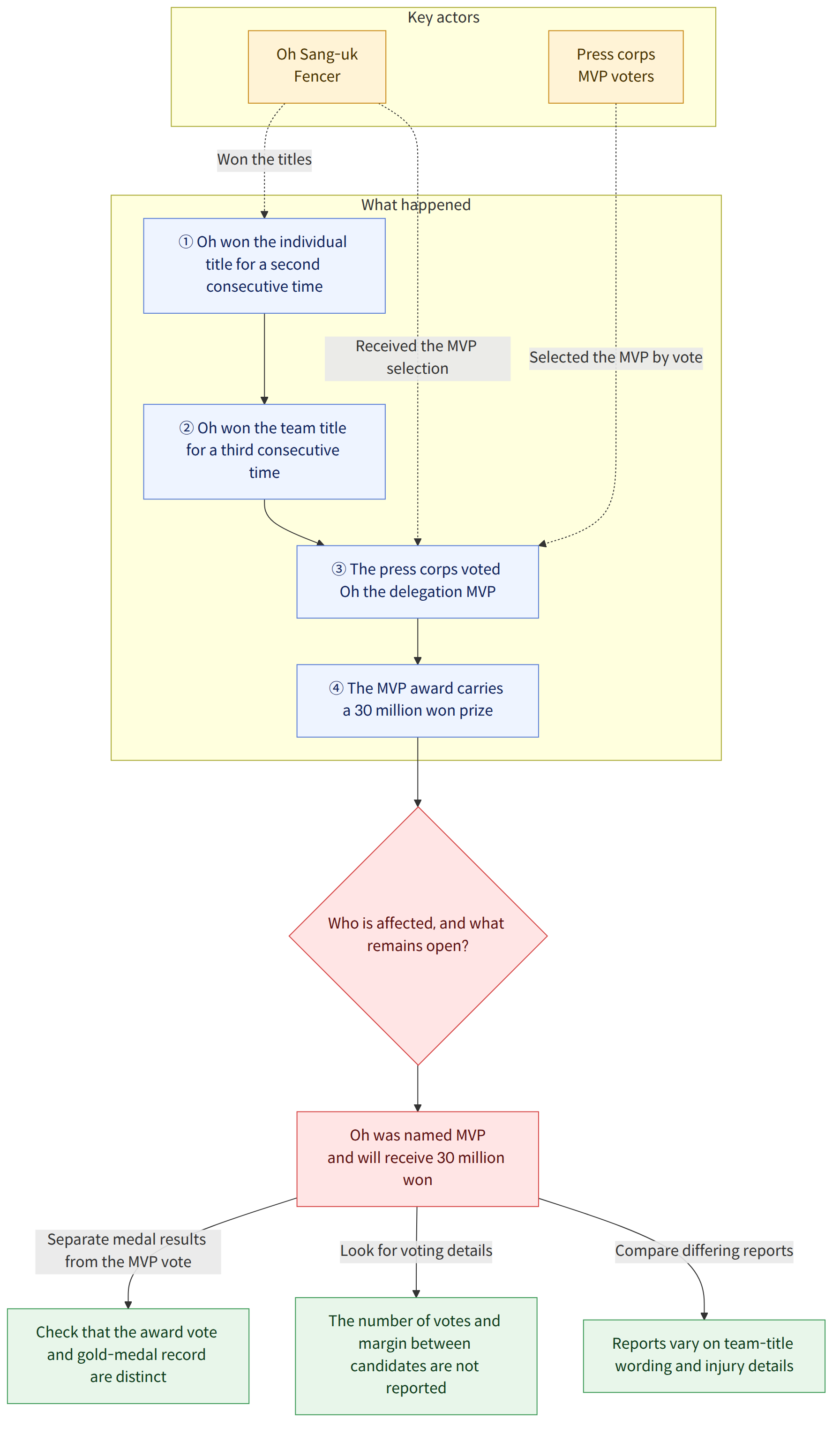
Fencer Oh Sang-uk was named the South Korean delegation’s Most Valuable Player (MVP) at the 2026 Aichi-Nagoya Asian Games. Selected in a vote by the press corps, Oh will receive a 30 million won prize. He won the individual title for a second consecutive time and the team title for a third consecutive time, earning two golds at a second consecutive Asian Games.
The award recognizes Oh’s individual achievement and also comes amid the South Korean delegation’s successes in several sports at the Games. Techball and canoeing produced gold medals and individual awards, while the coach of the men’s 3x3 basketball team received the Leadership Award.
Background and context
Oh first competed at the Asian Games at the 2018 Jakarta-Palembang Games. At this edition, he defended his individual title and won the team event, earning two golds at a second consecutive Games. However, the available information confirms only that the MVP was chosen by a vote of the press corps; there is no basis for concluding that any particular record was the direct reason for his selection.
Reports also described a pivotal sequence in which Oh scored repeatedly to lead a comeback. Korean-language coverage said he scored four consecutive points when his team was trailing 41-44. English-language coverage said that in the final bout of the final against Japan, South Korea fell behind 40-39, then the gap widened to 41-44, before Oh scored four points in a row. These moments illustrate his performance in competition, but do not reveal what criteria influenced the MVP vote.
Oh was reported to have been struggling with a herniated disc—a condition in which a disc between the vertebrae protrudes and can press on a nerve—since last November. His injury and his results at the Games were mentioned together, but the specific effect of the injury on his performance or the voting outcome has not been established.
What this news means
The MVP selection is notable as the result of a press corps vote assessing standout performances at the Games. Oh’s record of winning two golds at consecutive Games is a concrete measure of his success, while the MVP is a separate award decided by a vote. The two facts can be reported together, but the medal record should not be interpreted as having directly caused the award.
The South Korean delegation’s awards were not limited to fencing. Lee Jun-seok won the inaugural gold medal in the men’s singles event in techball, a new sport at these Games, and received the Fighting Spirit Award. Canoeists Cho Gwang-hee and Kim Hyo-bin won gold in both the K-4 500m and K-2 500m, earning two golds apiece, and received the Most Improved Athlete Award. Bae Gil-tae, coach of the men’s 3x3 basketball team, was named the recipient of the Leadership Award.
For example, readers comparing athletes’ achievements after seeing the awards news should distinguish the MVP vote from the medal records in each sport. Medal totals and consecutive-title records are achievements confirmed by competition results, but the available information does not include the number of votes cast or the margin between candidates.
Differences in how reports described the events
Reports used different wording for Oh’s consecutive team titles. Korean-language coverage said Oh had won the team title for a third consecutive time, while English-language coverage said he helped South Korea win the men’s sabre team event for a fourth consecutive time. These may refer to different records—the athlete’s personal run of consecutive wins and the South Korean team’s run—so it is difficult to conclude that they directly contradict each other on the same figure.
Reports also differed in the scope of their injury descriptions. Korean-language coverage said Oh had been struggling with a herniated disc since last November, while English-language coverage mentioned lower-back and ankle injuries. The reports did not provide identical diagnoses or timelines, so the full course of his injuries cannot be established from this information alone.
What is confirmed and what remains unknown
Confirmed facts
- Oh Sang-uk was selected as the South Korean delegation’s MVP at the 2026 Aichi-Nagoya Asian Games in a vote by the press corps and will receive a 30 million won prize.
- He won the individual title for a second consecutive time and the team title for a third consecutive time, earning two golds at a second consecutive Games.
- Lee Jun-seok was the inaugural gold medalist in the new sport of techball men’s singles and received the Fighting Spirit Award.
- Cho Gwang-hee and Kim Hyo-bin won gold in the K-4 500m and K-2 500m and received the Most Improved Athlete Award. Reports said the gold medals in the two events were, respectively, South Korea’s first ever and its first in 36 years.
What remains unknown
- How many votes did Oh receive, and by what margin did he beat the other candidates?
- What detailed criteria did the press corps use to evaluate the candidates?
- What course of events and diagnoses were referred to in the differing descriptions of his injuries?
What readers should check
- The MVP selection process and prize, and the medal records, are different pieces of information and should be checked separately.
- When reviewing the canoeing results, readers can distinguish the K-4 500m gold as South Korea’s first ever from the K-2 500m gold as the first in 36 years.
- The Fighting Spirit Award and the Most Improved Athlete Award each carry a 10 million won prize. The reports provided do not confirm the prize amount for the Leadership Award.
References
- Other coverage consulted: koreatimes.co.kr
- Other coverage consulted: en.yna.co.kr