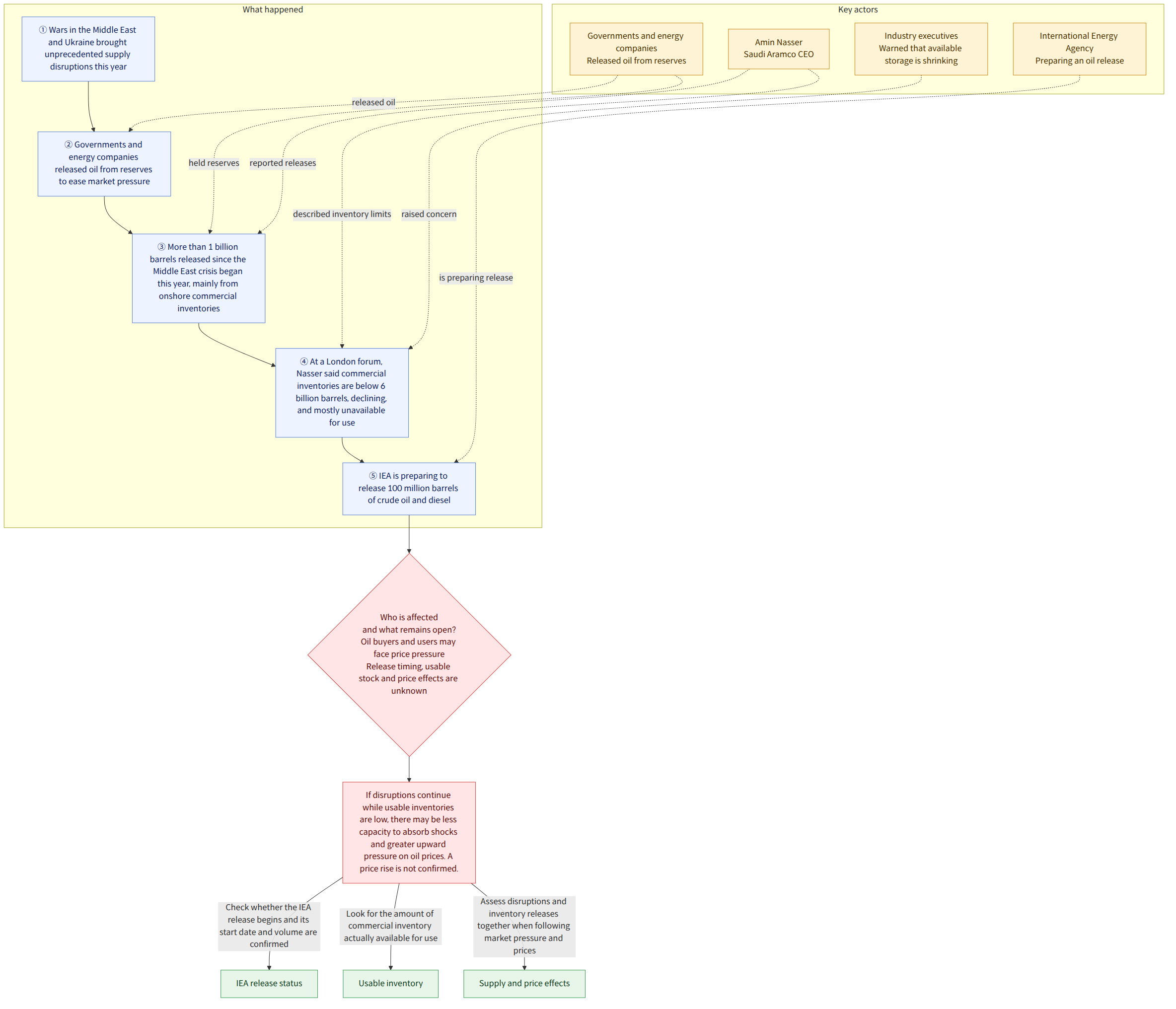
At an energy forum held in London this week, industry executives said the amount of oil storage available to the global market is shrinking. Saudi Aramco CEO Amin Nasser said commercial inventories are below 6 billion barrels, and most of them are not actually available for use. He said inventories are declining, weakening the market’s buffer capacity and putting upward pressure on oil prices.
As unprecedented supply disruptions have continued this year because of the wars in the Middle East and Ukraine, governments and energy companies have released oil from reserves to ease pressure on the market. According to Nasser, more than 1 billion barrels of oil have been released since the Middle East crisis began this year, mainly from onshore commercial inventories. He said the release of these inventories was the last major measure available.
Background and context
Commercial inventories are oil stocks held by companies. But having inventories is not the same as being able to put that oil on the market. Nasser said most of the remaining commercial inventories are not actually available for use, but the article does not give a reason or specify the exact volume that is available.
In this situation, inventories may become less able to serve as a buffer against supply disruptions. The key point of Nasser’s remarks is that if there is little room to release additional inventories when supply falls, the market may be more vulnerable to shocks and upward pressure on prices could increase. This does not mean prices will necessarily rise; it means there may be less capacity to stabilize the market if supply disruptions continue.
What this means
Changes in supply disruptions and inventory levels could become important for companies and consumers that buy or use oil. If supply disruptions continue while inventories are low, the market will have less room to absorb shocks, which could increase upward pressure on oil prices. However, the article does not provide information about actual price changes or the scale of any impact on consumer costs.
For example, if further supply disruptions occur, there may be limited scope to release more inventories to cushion the impact. This describes a possible scenario; the article does not confirm that further disruptions or price changes have occurred.
The International Energy Agency (국제에너지기구; IEA) is preparing to release 100 million barrels of crude oil and diesel to ease pressure on the market. Releasing reserves adds supply to the market, but the article alone does not establish when the release will begin or how much will actually be released. Therefore, news that a release is being prepared does not mean that supply to the market has already increased.
What is confirmed and what remains unknown
Confirmed facts
- At a London forum, industry executives said the amount of oil storage available to the global market is shrinking.
- Nasser said commercial inventories are below 6 billion barrels and most are not actually available for use.
- According to Nasser, more than 1 billion barrels of oil have been released since the Middle East crisis began this year, mainly from onshore commercial inventories.
- The IEA is preparing to release 100 million barrels of crude oil and diesel.
What remains unknown
- When will the IEA’s release begin, and how much will actually be released?
- Exactly how much of the commercial inventory—less than 6 billion barrels—is actually available for use?
- How much will supply disruptions and declining inventories affect oil prices going forward?
What readers should watch
- Readers can watch to see whether the IEA’s planned crude oil and diesel release moves from the preparation stage to an actual release, and whether its start date and volume are confirmed.
- It will also be important to look for further information not only on total commercial inventories but also on the volume actually available for use.
- Supply disruptions and whether inventory releases are easing market pressure should be considered together. A decline in inventories alone is not enough to determine how oil prices will actually move.