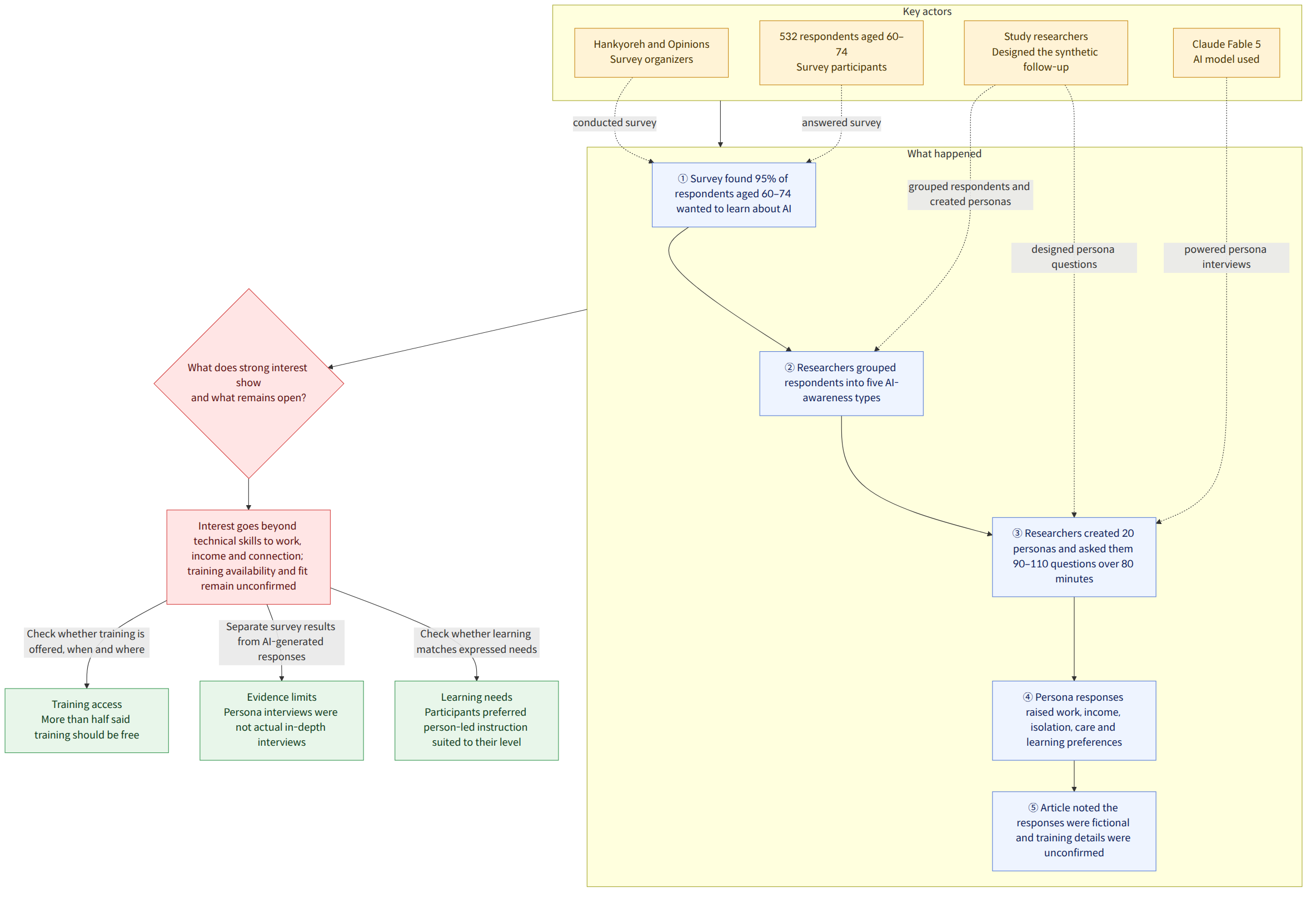
A survey conducted last August by the Hankyoreh (한겨레) and polling firm Opinions (오피니언즈) of 532 men and women nationwide aged 60 to 74 found that 95% said they wanted to learn about AI. A total of 40.5% said they felt hopeful about the AI era, while 10.8% said they were worried. Follow-up interviews showed that people’s motivation to learn went beyond fun and curiosity: it also reflected a desire to protect their jobs and income, anxiety about falling behind, and a wish to connect with others.
Background and context
This follow-up study did not involve bringing the original respondents back for interviews. A synthetic survey (합성조사) is a research method in which AI interviews fictional individuals, or personas, created to reflect the characteristics and experiences of a particular group, based on survey results. The 532 respondents were divided into five types according to their awareness of and exposure to AI: proactive, skeptical, waiting, potential, and reserved. Researchers then created a total of 20 personas, one for each type.
Researchers asked the personas 90 to 110 questions over 80 minutes of conversation. The model used was Claude Fable 5. In the second source text, the study designer explained that the researchers had AI connect the answers to questions written by people, and instructed it not to change the answers selected in the survey and to flag anything not covered by the survey.
The researchers also explained why they chose this approach. The study designer said that when researchers contact previous respondents again and ask them to take part in an interview, the response rate is around 3%; even then, participation may skew toward people with time to spare or an interest in the topic. The approach was an attempt to compensate for the possibility that the voices of people whose views are important to policy—such as those with little interest in the topic or those busy making a living—might be left out.
What this news means
The 95% figure shows the interest in learning among the survey’s respondents aged 60 to 74. But saying “I want to learn” does not necessarily mean someone is ready to take part in training or pay for it. The second source text reports that more than half of respondents said training should be free. Given the potential gap between strong interest and access to training, interest alone does not mean that demand for education has been met.
The persona interviews revealed several different motivations for learning. One virtual respondent talked about the fun of it and wanting to get ahead of others; another said, in effect, that they needed to understand AI in order to keep working. One persona said they would pay to learn if it could help them work, while other responses expressed uncertainty about whether they would actually be able to find work after learning. The value of training, then, is not limited to acquiring technical skills; it is also tied to whether learning can lead to job or income opportunities.
The interviews also brought issues of relationships and isolation to light. “Potential 61,” a persona who lived alone, said they wanted to learn not only for work but also to feel less isolated and have a reason to leave home. This is an example of why learning AI may be difficult to view solely as acquiring individual digital skills. It is important to keep in mind, however, that this was not something an actual respondent said in an interview; it was a response from a fictional persona created based on the survey results.
Views on care-related AI also varied. The personas showed interest in and willingness to use functions such as checking in on someone, detecting emergencies, or providing companionship, but generally said they would use them “when they need them later.” This is noteworthy because interest in care-related AI does not necessarily mean people want to replace human care with machines right away. The article also noted concerns that people may put off using such devices until they feel a need for them, or that using them could be associated with the perception that they “look old.”
As for how they wanted to learn, participants expressed a preference for learning directly from a person, at a level suited to them. If this preference were put into practice in actual training, step-by-step instruction that beginners can follow, an environment where they can ask questions, and formats that working people can attend could be important. This is an interpretation based on the needs expressed in the interviews, not an indication that tailored training has already been arranged.
For example, someone who wants to learn about AI but finds it difficult even to use a smartphone might prefer a class that starts with the basics, moves slowly, and allows them to ask questions, rather than one that teaches many functions all at once. The learning preferences expressed by the personas in the article suggest the need to take these differences into account.
What is confirmed and what is still unknown
What is confirmed
- The survey was conducted last August among 532 men and women nationwide aged 60 to 74.
- In the survey, 95% said they wanted to learn about AI, 40.5% felt hopeful about the AI era, and 10.8% said they were worried.
- The follow-up interviews lasted 80 minutes and involved 20 fictional personas selected from five types; 90 to 110 questions were used.
- The personas’ responses reflected a desire to prepare for changes in jobs and income, have fun, avoid falling behind, and connect socially.
- The personas featured in the article preferred learning directly from a person, at a level suited to them.
What is still unknown
- The extent to which responses from AI-generated personas match the results of conducting in-depth interviews directly with older adults has not been presented.
- It has not been confirmed when or where tailored AI training reflecting the interview results will actually be offered.
- This survey alone cannot show how much interest in learning will translate into actual enrollment or job and income opportunities.
What readers should check
- If you are considering taking part in training, check whether the class is suited to your current level of digital skills and whether it allows you to ask questions and practice repeatedly.
- If you want to learn for work or income, look closely at the specific practical skills covered by the class and what outcomes you can expect after the training.
- If you are looking into care-related AI, consider not only your interest in its functions but also when you might feel a need for it and whether using it would feel burdensome.
References
- Other coverage consulted: hani.co.kr