
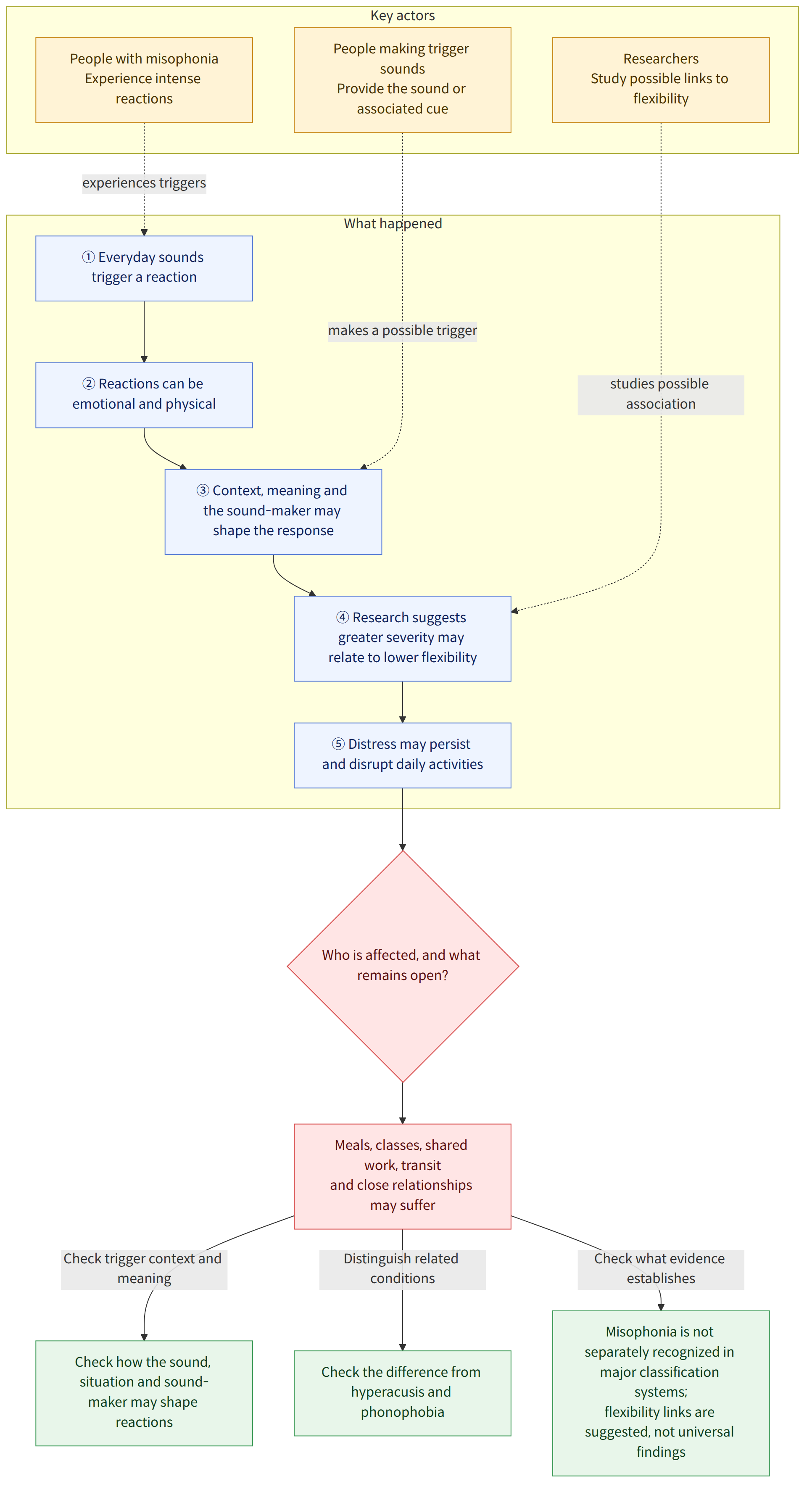
Ordinary sounds such as chewing, sniffing, breathing, swallowing, tapping fingers, and clicking a pen can trigger an immediate and intense reaction in some people. This is called misophonia. The key is not simply that a sound is irritating or seems loud. Because it involves a reduced tolerance for certain sounds or things associated with them, it needs to be considered separately from everyday annoyance.
Background and context
Reactions to misophonia can include emotions such as anger and disgust, anxiety and panic, as well as physical responses such as muscle tension and an increased heart rate. A person may feel an urge to leave the situation or stop the sound, and, rarely, verbal or physical aggression may occur. The reaction is automatic and intense, and may seem excessive to the person experiencing it, given the situation.
What shapes the reaction is generally not just the sound’s volume. The type of sound, its personal meaning, the situation in which it occurs, and who is making it can all have an effect. In other words, the same chewing sound may be easy to tolerate or difficult to bear depending on who is making it and in what circumstances.
For this reason, the effects of misophonia may extend beyond the moment a sound is heard. It can become difficult to eat with family, attend classes, work in a shared office, use public transportation, or maintain close relationships. Some people also react strongly to visual cues associated with sounds, such as watching someone chew or seeing repetitive movements. The article calls this misokinesia.
Misophonia is described as frequently associated with obsessive-compulsive disorder (OCD), post-traumatic stress disorder (PTSD), depression, and anxiety disorders. However, it is not currently recognized as a separate disorder in major international medical classification systems, an issue that remains under scientific discussion. The article also distinguishes misophonia from hyperacusis, in which people are unusually sensitive to sound volume, sometimes to the point of pain, and phonophobia, in which fear of specific sounds is central.
What this means
If misophonia is viewed only as sound sensitivity or oversensitivity, it may be easy to overlook the difficulties it can actually cause. That is because the reactions affect not only emotions and the body, but can also make it harder to shift attention elsewhere and reinterpret a situation. The research discussed here suggests that more severe misophonia may be associated with lower cognitive flexibility (the ability to change one’s thinking in response to changing circumstances) and lower emotional flexibility (the ability to shift attention or regulate responses while responding to emotional information).
If this association exists, it may be harder to redirect attention after a trigger sound is heard, see the situation differently, or return to a calm state. The article links this difficulty to cases in which tension or distress continues after the sound has stopped, or a person keeps thinking about the incident for a long time. This is a possibility suggested by the research, however, and it cannot be assumed that the same process occurs for everyone.
How a person interprets the behavior of the one making the sound may also be connected to the reaction. Judgments about whether the behavior was unnecessary or avoidable, intentional, or rude may have an effect. For example, if someone is distressed by another person’s chewing during a family meal, their thoughts about the person making the sound and the situation may be part of the reaction, in addition to the sound itself. This does not mean that the person’s distress should be taken lightly or that the person making the sound should automatically be held responsible. It means that the reaction is difficult to explain by sound volume alone.
What is known and what remains unknown
What is known
- Everyday sounds such as chewing, sniffing, breathing, and swallowing can trigger strong and immediate reactions in people with misophonia.
- Reactions can include emotions such as anger, disgust, and anxiety; physical responses such as muscle tension and an increased heart rate; and an urge to leave the situation or stop the sound.
- Reactions may depend more on the type and meaning of a sound, the situation, and who is making it than on the sound’s volume.
- Research suggests that more severe misophonia may be associated with lower cognitive and emotional flexibility.
- Misophonia is not currently recognized as a separate disorder in major international medical classification systems.
What remains unknown
- This article does not say how common misophonia is in the general population.
- It also does not provide specific diagnostic criteria or treatments whose effectiveness has been confirmed.
- The role of the ability to understand other people’s thoughts or intentions, and of empathy, in misophonia remains a topic for future research.
What readers should check
- If you react to particular sounds, you can consider not only the type of sound but also the circumstances, who made it, your emotional and physical reactions at the time, and whether they continued afterward.
- A strong reaction to sound alone is not enough to conclude that you have misophonia. The article distinguishes misophonia from hyperacusis and phonophobia, and does not provide specific diagnostic criteria.
- If the reaction makes family life, classes, work, or travel difficult, you can describe the situations and reactions to a medical professional and ask about assessment options. This article alone cannot determine a diagnosis or the effectiveness of treatment.