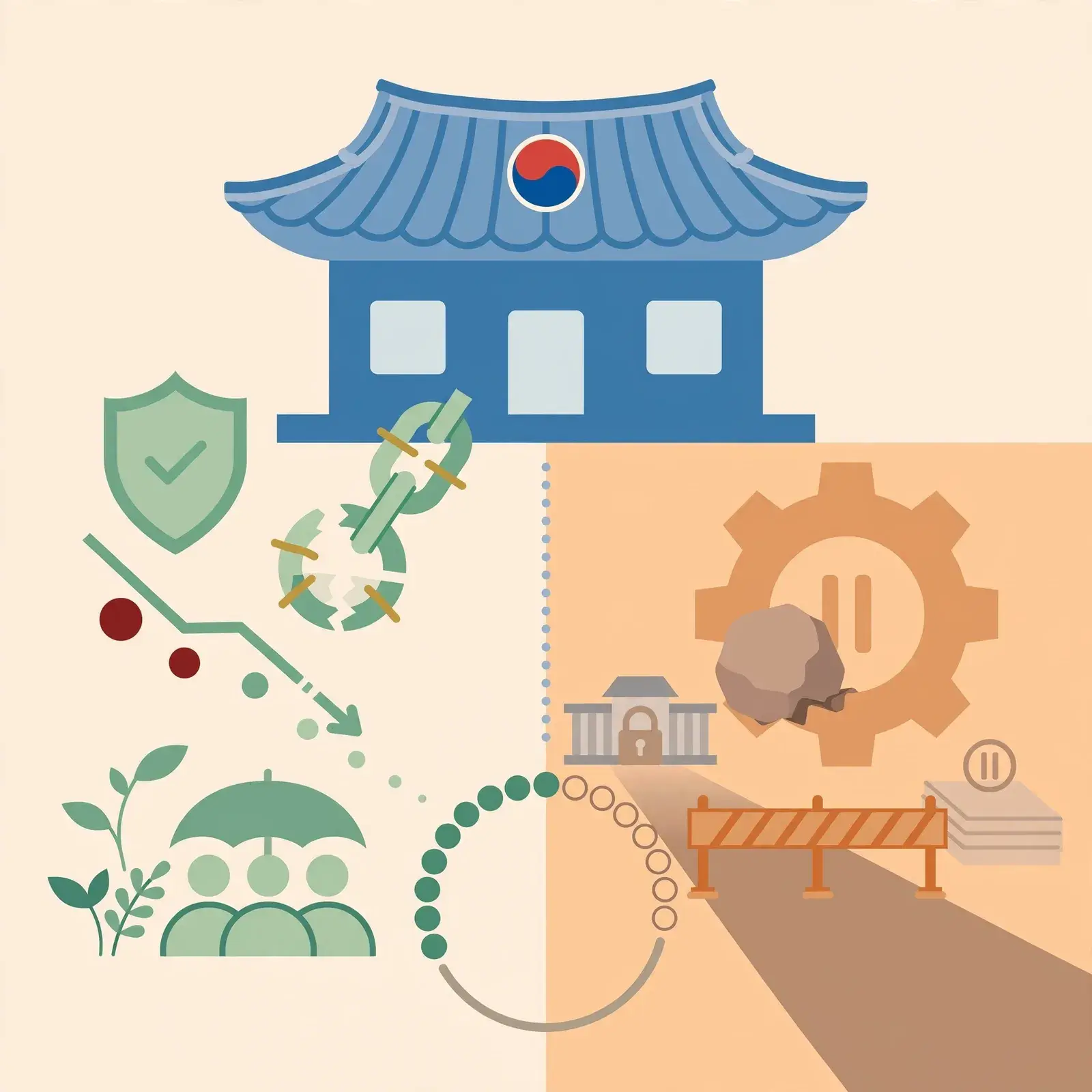
A first-year record with two very different sides
South Korea’s Ministry of Gender Equality and Family marked one year since its reorganization and expansion on October 1, 2026. The ministry says it has worked to rebuild the government’s system for pursuing gender-equality policies and has improved cooperation among agencies responding to gender-based violence (violence directed at people because of their gender, including sexual and partner violence).
The anniversary has brought a mixed assessment. Some coordination mechanisms are taking shape, but major equality policies have made little progress, prompting questions about whether the ministry can lead work that depends on other parts of government.
The central tension: The ministry reports progress in coordinating responses to gender-based violence, while broader gender-equality measures remain delayed or lack a clear path to implementation.
What the ministry says it has achieved
At a government briefing in Seoul, Gender Equality and Family Minister Won Min-kyung said the ministry had begun repairing a policy system that had weakened in previous years. It has also held an in-person meeting of the Gender Equality Committee, an interagency body intended to help coordinate equality priorities across government.
The ministry’s work has involved cooperation with agencies including the Ministry of Justice, police, and the broadcasting and communications regulator. Such coordination matters because preventing violence and supporting survivors can involve several institutions: police may investigate, justice officials may shape laws, and regulators may address harmful material distributed through media or online services.
- Cross-agency cooperation: The ministry says it has helped build a framework for agencies to work together on gender-based violence.
- Policy coordination: The Gender Equality Committee has provided a forum for discussing equality measures across government.
- A stated priority for year two: Won said the ministry would work to take a more active lead in setting policy priorities.
These steps can create a foundation, but they do not by themselves guarantee that proposed policies will become law or be carried out consistently. That depends in part on whether the ministry can influence departments with their own responsibilities, budgets, and decision-making structures.
Key equality proposals are still waiting
One major policy still in limbo is an employment equality disclosure system. The ministry took over some responsibilities from the Ministry of Employment and Labor and said it would introduce a system requiring relevant information about workplace equality to be disclosed. A government-and-ruling-party bill was submitted to the National Assembly in April, but it remains pending in a standing committee (a parliamentary committee that reviews legislation before it can proceed).
The proposal is intended to make workplace disparities more visible. In practical terms, public information about employment conditions can help show whether women and men have equal access to jobs, advancement, and leadership roles. But until lawmakers review and advance the bill, the system cannot move from proposal to implementation.
Legislation addressing dating violence also faces a gap. Advocates have called for a law specifically addressing violence within dating relationships, but the current approach is expected to be narrower, focusing on changes to the Stalking Punishment Act. Critics say that leaves unresolved the broader question of how to respond to dating violence that may not fit existing legal categories.
- The employment disclosure bill has been introduced but has not cleared committee review.
- The planned response to dating violence is expected to rely on amendments to stalking law rather than a broader, dedicated measure.
- Advocacy groups say further action is needed to protect people who experience abuse in intimate relationships.
The question of authority: can the ministry lead other departments?
Experts say the stalled agenda reflects a structural problem: the ministry may not have enough authority to coordinate policies that fall under other departments. Shin Kyung-ah, an emeritus professor of sociology at Hallym University, said the government should examine whether the ministry has been given sufficient responsibility and power to oversee and align other agencies’ gender-equality work.
That issue affects everyday policy. A ministry can propose an employment measure, for example, but implementation may depend on labor officials, legislators, and other government bodies. Without clear authority and agreement on who is responsible, a policy can remain an announcement or a draft bill rather than changing workplace practices.
Choi Sun-hye, secretary-general of the Korea Women’s Hotline, said the ministry has made efforts to listen to people working in the field, but has not shown comparable results in resolving differences with other departments and advancing policy according to its own priorities. The challenge, in other words, is not only to identify problems but also to bring the institutions with the power to address them into a workable plan.
Why authority matters: A policy “control tower” is an agency able to coordinate different departments, assign responsibilities, and keep a shared plan moving. If it can only recommend action, other agencies may delay or reshape that action.
Presidential directives and political uncertainty
Several initiatives that the ministry has prominently pursued—including the “period products for everyone” project, the introduction of medication for abortion care, and responses to illegal sexually exploitative material online—followed directives from President Lee Jae-myung. The article also notes that some presidential instructions, including raising the issue of the age at which minors can be held criminally responsible and seeking measures to address claims of discrimination against men, prompted public anger.
The distinction matters because a ministry’s ability to set a sustained agenda is different from carrying out individual instructions from the president. Presidential direction can give a project visibility and momentum, but a durable policy program also requires clear priorities, coordination with relevant agencies, and follow-through over time.
The ministry has also faced political turbulence around senior appointments. Yong Hye-in, who was nominated as a candidate for minister, withdrew after controversy. Advocates have questioned whether the ministry and its leadership appointments are being treated as tools in political calculations rather than as part of a consistent policy strategy. The article also cites concerns raised around the nomination and withdrawal process involving Kang Sun-woo and Yong.
Choi Hee-yeon, standing representative of the Korea Women’s Association United, said the government had not adequately taken up demands voiced by younger women, including the introduction of a non-consensual rape offense (a legal definition that does not make physical resistance a requirement for recognizing rape). She also said that changes to the criminal justice system make it especially important to ensure that protections for survivors do not fall through the cracks.
What advocates want to see next
Experts and advocacy groups say the ministry’s second year should focus on a concrete, medium- to long-term roadmap—not only visits to frontline services or one-off initiatives. A roadmap would set out which goals come first, which agencies are responsible, what authority is needed, and how progress will be assessed.
Shin said the government should consider how to strengthen gender awareness among public officials and how to work with the Ministry of Employment and Labor’s administrative structure to deliver results on equality in the workplace. Gender awareness, in this context, means recognizing how laws and public services may affect people differently depending on their gender; for example, whether a workplace policy gives employees equal access to promotion or support.
The criminal justice system’s planned changes add urgency to the task of coordinating survivor protections. Advocates say policies need to be advanced with enough force and consistency to prevent gaps in support as responsibilities and procedures evolve.
A practical test for the ministry
In the coming year, its progress could be judged by whether it can:
- Move the employment equality disclosure bill through legislative review.
- Develop a more comprehensive response to dating violence, beyond the limited scope of stalking-law amendments.
- Clarify how it will coordinate with justice, police, labor, and other government bodies.
- Set measurable priorities and explain how the government will track implementation.
- Protect survivor support as the criminal justice system changes.
The ministry promises a more active second year
At the anniversary briefing, Won said she had been asked, through the presidential chief of staff, to steady the organization after Yong’s withdrawal. She indicated that she would remain in her post and said ministry staff were working to advance policy priorities without wavering.
Won also said the ministry expected to play a more active role in setting the agenda during its second year, adding that it would work to do so. The pledge sets a clear test: whether the ministry can turn its stated ambition into laws, coordinated government action, and protections that people can see in their daily lives.
For now, the first year has produced some progress in building cooperation on gender-based violence, but the broader equality agenda remains unsettled. The next stage will depend on whether the ministry receives—and uses—the authority needed to make other parts of government act together.